
A resume tells you what a candidate says they can do. It doesn't tell you what they can actually do. In a market full of inflated titles and AI-written cover letters, that gap has never been wider, and hiring teams are feeling it.
Which is why so many companies are moving toward skills-based hiring, where proven ability counts for more than a degree or a job title. Candidate assessment software is the tool that makes it practical: test real skills, fairly and at scale, before you spend hours interviewing.
This guide covers what the candidate assessment software is, the main types of assessment, what the research actually says about which ones predict performance, and how to choose.
What is candidate assessment software?
Candidate assessment software tests a candidate's skills and abilities as part of the hiring process. Instead of guessing from a resume, you give people a task or a test that shows what they can do, then score everyone against the same standard.
You'll also see it called a candidate assessment tool, a hiring assessment tool, or pre-employment assessment software. The job is the same: measure ability rather than claims. A good platform handles the whole flow, from sending the test to running it to scoring the results, so verifying skill becomes a normal step in recruiting rather than a separate project.
The better modern tools live inside your hiring workflow. The assessment is another stage in the pipeline & every score lands on the candidate record you already use. No bolted-on software, no spreadsheets, no copy and paste.
Why assessments matter now
Two forces are pushing assessments from nice-to-have toward standard practice.
The skills-based hiring shift. As companies drop strict degree requirements and hire on demonstrated ability, they need a reliable way to measure that ability. LinkedIn reported in 2023 that more than 45% of recruiters on its platform were searching for candidates using skills data rather than titles and credentials, and its 2025 Future of Recruiting report noted that by 2023, 26% of paid job posts no longer required a degree, up from 22% in 2020.
Cost. Getting a hire wrong is expensive. SHRM's 2025 benchmarking puts average cost per hire at about $5,475 for non-executive roles, with executive hires around $35,879, and that's before you count lost productivity and rework. Filtering mismatches before they reach an interview is one of the cheaper ways to protect that spend.
Resumes describe. Assessments demonstrate. In a noisy market, demonstration wins.
What the research actually says
This section is worth reading carefully, because most vendor content on assessments, including some of ours in the past, cites a number that the field has since revised.
For twenty-five years the reference point was Schmidt and Hunter's 1998 meta-analysis, which synthesized decades of research and put work sample tests near the top of the validity hierarchy. That finding is why you've read a hundred times that work samples are among the best predictors of job performance.
In 2022, Sackett, Zhang, Berry and Lievens published a re-analysis in the Journal of Applied Psychology identifying systematic overcorrection for range restriction in the earlier work. They set the old and new estimates side by side in a follow-up paper, which is worth reading in full if you build selection processes. Their revised estimates were lower across the board, and the largest single downward revision landed on work sample tests, at .21 lower than previously reported. Cognitive ability fell .20 and unstructured interviews .19. In the revised hierarchy, structured interviews emerged as the predictor with the highest mean validity, displacing cognitive ability from the top spot.
We sell hiring assessment software, so let's be direct about what that means. The evidence for work samples is weaker than the number our industry keeps quoting, and the correction hit our own category harder than anyone else's.
Three things follow from that, and none of them is "don't use assessments."
Work samples still rank near the top. They were revised downward, not discredited. Sackett and colleagues have been clear that their findings shouldn't be read as a mandate for preferring one predictor over another regardless of circumstances.
Structured interviews deserve more weight than most teams give them. If you're choosing between adding an assessment and structuring your interviews, the current evidence favors structuring the interviews first. The good news is that it's cheap. A fixed question set, a defined rubric, the same scoring for every candidate.
Combining methods beats any single method. This is the most durable finding in the literature and it came through the revision intact. An assessment plus a structured interview predicts better than either on its own. That's the real case for tools like ours. Not that a test replaces judgment, but that it gives structured judgment something solid to work with.
If a vendor tells you their assessment is the single best predictor of performance, ask which meta-analysis they're citing and what year it came out.
Types of candidate assessments
No single test fits every role, and the stronger platforms support several formats and let you combine them.
Skills assessments. The broad category: any test measuring a specific job skill, from writing to spreadsheet modeling to design. The backbone of skills-based hiring.
Coding assessments. For technical roles, these test real programming ability in two modes. A live coding assessment is a real-time session where you watch a candidate solve a problem in a shared editor. A take-home test lets them build something on their own schedule. Both beat a whiteboard quiz, because they resemble the actual job.
Work sample tests. A small version of the real job: a marketing brief, a sales role-play, a data analysis, a writing sample. See the research section above for what the evidence currently supports.
Domain assessments. Role-specific evaluations built for a particular function such as engineering, finance, sales or healthcare, using a structured rubric made for that field so scoring stays consistent across candidates.
Cognitive ability tests. These measure problem-solving, reasoning and learning speed. Useful when general thinking ability matters more than any single skill. These are also the method most consistently associated with large subgroup differences in the selection literature, so it's worth talking to counsel before you deploy one.
Personality and behavioral assessments. Work style, communication, likely team fit. These work as one input among several, never as a pass-or-fail gate.
Situational judgment tests. Realistic on-the-job scenarios with a question about what the candidate would do. Popular for customer-facing and service roles.
How hiring teams use them
Filtering high-volume pools. When hundreds apply, a short assessment surfaces the qualified few without burning your team on screening calls.
Replacing weak early screens. A skills test tells you more than a phone chat about someone's background.
Technical hiring. Coding assessments verify an engineer can build before you book a senior interviewer's calendar.
Reducing bias. Same test, same rubric, less room for personal bias. Worth being precise here. Structure reduces certain kinds of bias. It doesn't eliminate disparate impact, and any tool used for selection can produce one. If you operate in New York City your assessment tool likely needs an annual independent bias audit. We cover the requirements in our AI hiring compliance guide.
Campus and graduate hiring. Standardized assessments let you compare large groups fairly when nobody has much of a track record.
Features worth looking for
- Workflow integration. The assessment should be a step in your pipeline, with scores landing on the candidate record automatically.
- A test library plus custom builds. Pre-built tests save time; custom builds let you match any role.
- Consistent scoring. Clear rubrics and a single scale, so results compare across candidates and test types.
- Auto-grading with human review. Automatic grading saves hours, but a person has to be able to review and override any score.
- Integrity protection. Proctoring, tab-switch monitoring, and plagiarism or AI-content detection.
- Fairness and audit support. The same rubric for everyone, logged overrides, audit trails. This is what a bias audit will ask you for.
- Analytics and export. Pass rates, score trends, and CSV or PDF export.
How to choose
Start with your roles and your process rather than a feature list.
Fit for your roles. Does it cover the jobs you actually hire for, technical and non-technical?
Integration. A tool that lives inside your ATS beats a standalone product you have to manage on the side.
Scoring you can trust. Transparent rubrics and a clear scale, so a score means the same thing for every candidate.
Integrity and fairness. Proctoring, plagiarism detection, audit trails, and the ability to review and override any score.
Human control. The tool should rank and recommend, never auto-reject. The final call belongs to your recruiters and hiring managers. This is also where the regulatory direction is heading, which we go through in our piece on AI agents in recruiting.
Candidate experience. Browser-based tests with no installs and reasonable time limits get finished more often.
Pricing. Compare what each plan includes and run a free trial with a real role. Our guide to recruiting software costs covers the models and the fees that don't appear on quotes.
Where uRecruits fits
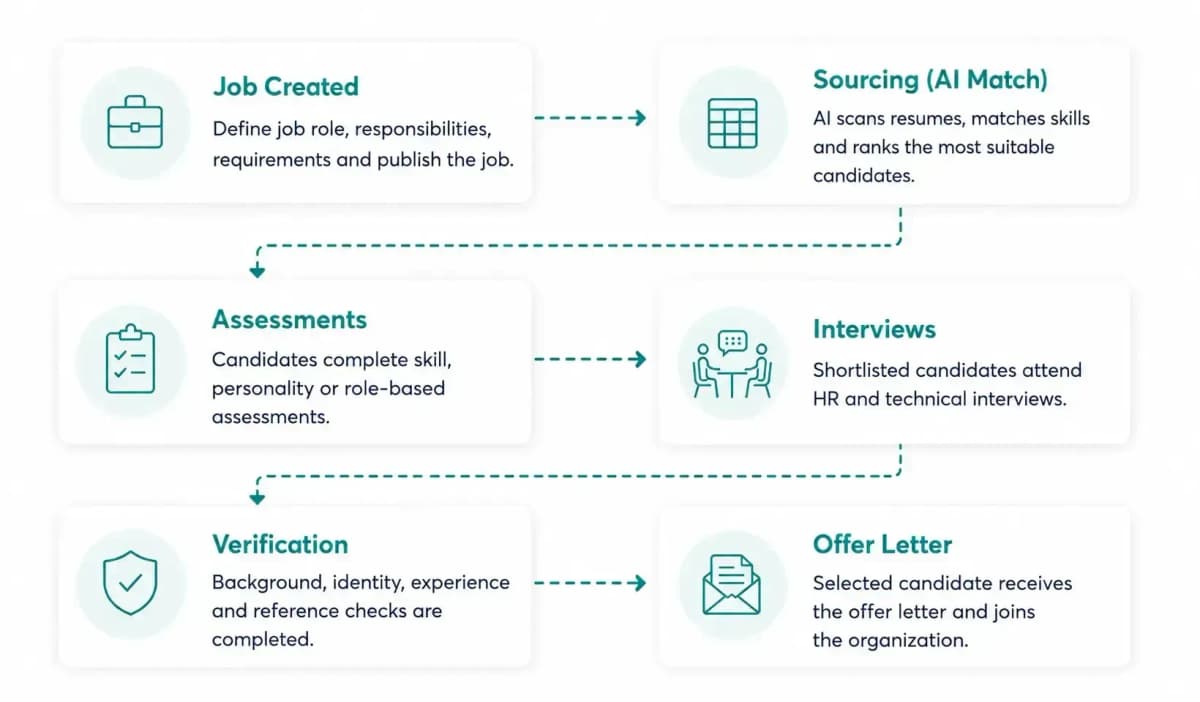
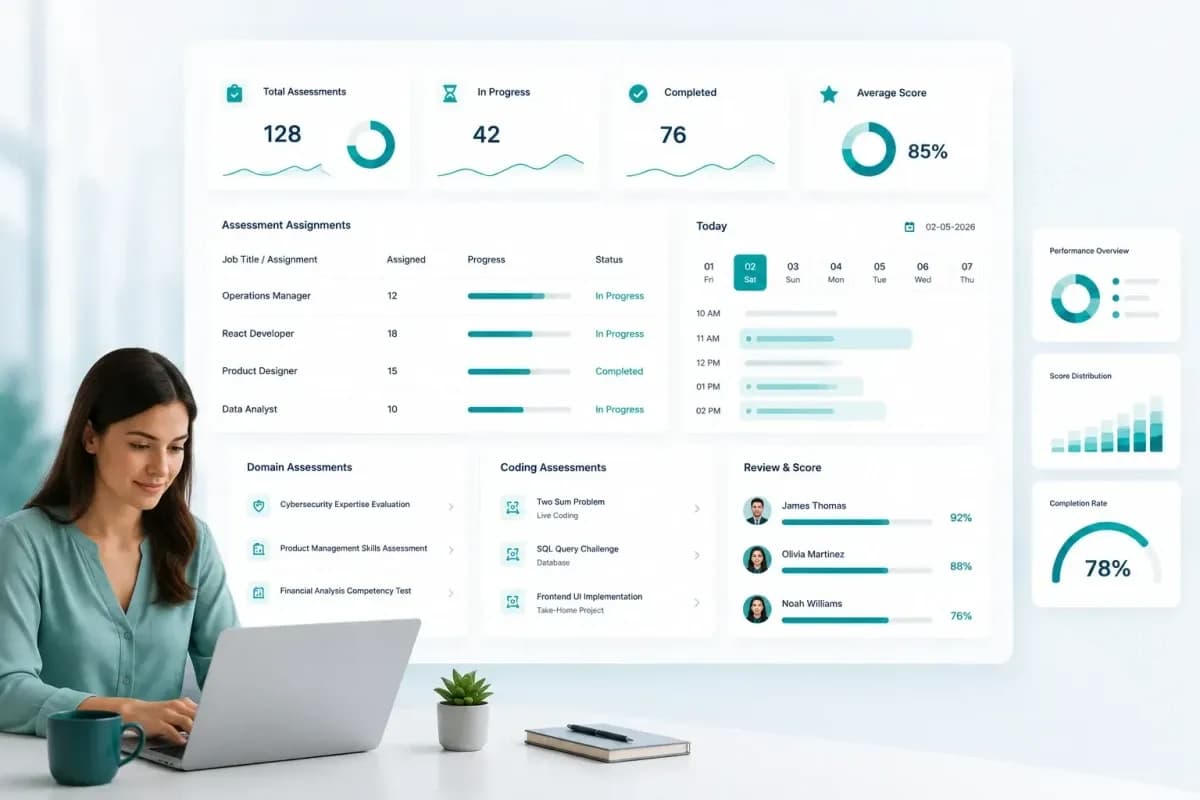
We built assessments into the ATS rather than alongside it, so testing skills is another stage in your pipeline and every score flows into the same candidate record and scoreboard your team already uses.
Three formats can be mixed in a single workflow. Live Assessments give you a virtual interview room with a shared code editor, a collaborative whiteboard, video chat, live proctoring and session recording. Take-Home Tests let candidates solve a realistic problem on their own schedule, with auto-grading for code and rubric scoring for open-ended work. Domain-Specific Evaluations cover engineering, data, design, sales, customer success, operations, healthcare and finance, each scored against the same rubric for every candidate.
Scoring works on two tiers. Each test has its own passing threshold, and a composite score tracks across everything a candidate completes. Both are logged with the reviewer and a timestamp, and both export.
On integrity, we add live proctoring, tab-switch monitoring and recording with audit trails. Sessions with integrity flags go to a recruiter for review rather than being auto-rejected.
Which points at the part that matters most. Candidates are never declined by software. Every decline is made by a member of the recruiting team. Scores rank candidates, they don't exclude them. Cutoff thresholds are filters you set, not hard walls. Every AI-assisted grade is human-reviewable.
Assessments are included in the Candidate Assessment package from $99 a month and the Full Cycle package from $149 a month. What any given deployment does depends on how it's configured, so we'd rather you verify all of this in a trial with a real open role than take it on trust.
FAQs About Candidate Assessment Software
What is candidate assessment software?
A tool that tests a candidate's real skills during hiring and scores everyone against the same standard. It handles sending the test, running it and grading the results, so verifying ability becomes a normal step rather than a separate task.
Which assessment type predicts job performance best?
On the 2022 Sackett et al. re-analysis, structured interviews now show the highest mean validity, with work samples and cognitive ability both revised down from earlier estimates. The most durable finding is that combining methods outperforms any single one, so the practical answer is a structured interview plus a relevant assessment.
Is the research on work samples still good?
Yes, with a correction. Work samples are still near the top of the revised hierarchy, but their estimated validity is about .21 lower than the widely quoted 1998 figure. Treat any vendor still citing the pre-2022 numbers with a bit of caution.
What is a work sample test?
A small version of the real job: a coding project, a writing sample, a sales role-play. Because it resembles the actual work it remains one of the stronger predictors available, on revised estimates.
Do assessments work for non-technical roles?
Yes. Domain and skills assessments cover sales, marketing, finance, operations, healthcare and HR. The same scoring structure and rubric format apply.
Does candidate assessment software automatically reject candidates?
Responsible ones don't. Scores should rank and recommend while the recruiter makes every real decision. With uRecruits, candidates are never declined by software.
Are hiring assessments fair?
They can be, when they're built well. A common test and rubric reduce certain biases. But structure isn't the same thing as an absence of disparate impact, and any selection tool can produce one. Look for human-reviewable scores, logged overrides and audit trails, and check what your jurisdiction requires by way of bias auditing.
How much does candidate assessment software cost? It varies by vendor and by features. Most use tiered monthly plans and offer a trial. Check what each tier includes, since higher plans often add test types, integrations and export options.
The bottom line
Hiring is shifting from what people claim to what they can demonstrate, and assessment software is what makes demonstration practical at scale.
Just be honest with yourself about what it buys you. The evidence says a well-built assessment paired with a structured interview beats either alone, and that no single method is the silver bullet the 1998 numbers made it look like. Start with your roles, look for transparent scoring and real integrity protection, keep the final decision with your people, and run a trial with a live requisition.
Once you can see what a candidate actually does before you interview them, hiring on a resume alone starts to feel like guessing.