
Bullhorn has been a fixture of agency recruiting for years. It's established, deeply featured, and for large staffing firms running high-volume placements it does a lot of things well.
It's also not the right answer for everyone. Teams go looking elsewhere for the same handful of reasons, and it's worth naming them before you shop.
Why teams look for a Bullhorn alternative
Learning curve. Bullhorn is powerful, which is another way of saying there's a lot to learn. A common theme in public user reviews is a steep onboarding ramp and an interface that takes time to master, especially for smaller teams without a dedicated admin.
Performance. Reviewers also mention loading times, occasional lag, and interface quirks as day-to-day friction.
Customization cost. The platform can be configured heavily, but meaningful customization usually needs implementation help, which adds time and budget.
Total cost. Between license fees, implementation, add-on modules, and integrations, the number on the quote and the number you end up paying can be two different conversations.
None of this makes Bullhorn a bad product. It makes it a specific product, built mainly for agency and staffing workflows at scale. If your team is smaller, more AI-forward, or simply wants pricing you can see before you sign, there are better fits.
Quick comparison
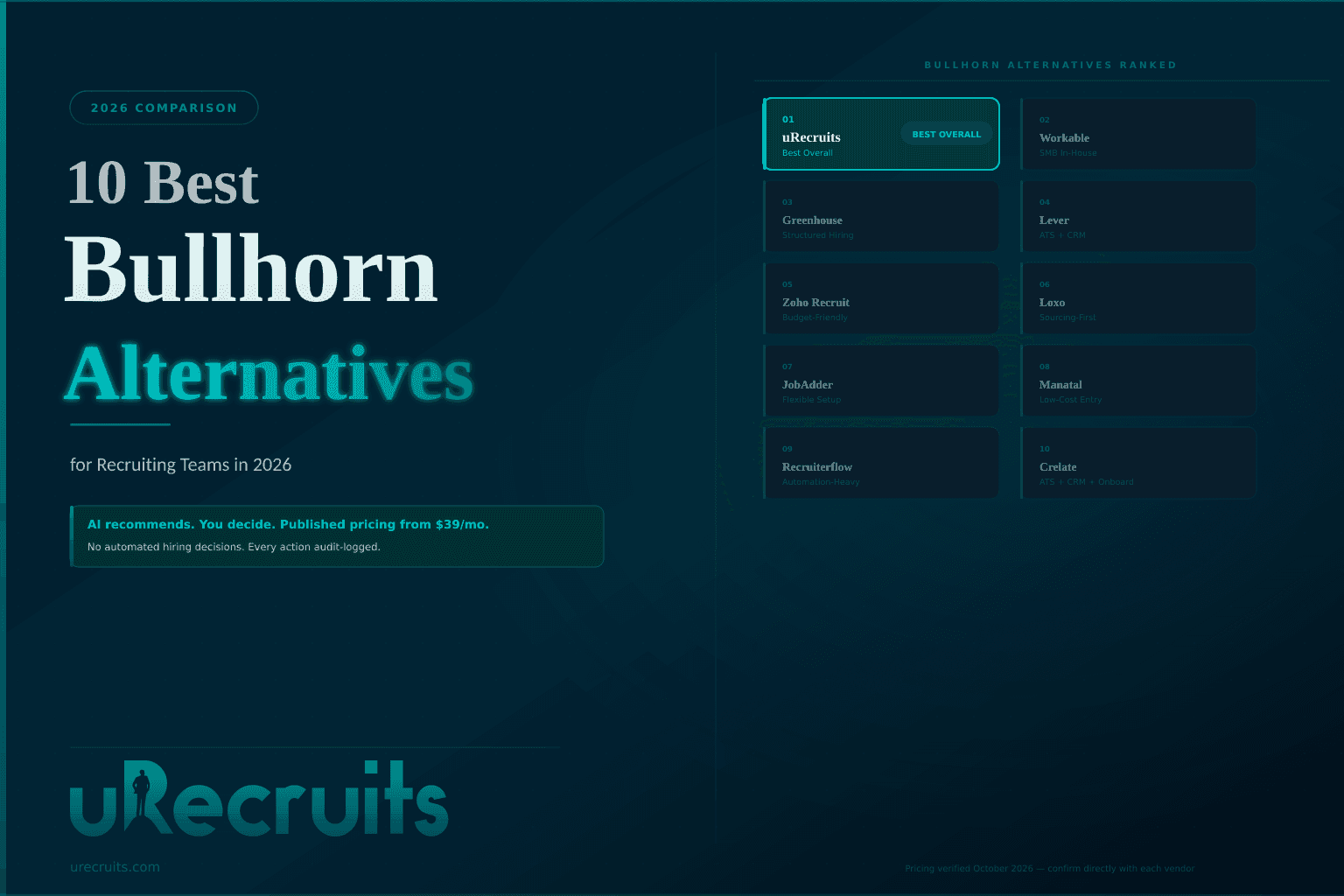
| Platform | Best for | Pricing approach |
|---|---|---|
| uRecruits | In-house teams and agencies that want AI assistance with published pricing | Published tiers from $39/mo (monthly billing); scales by users and active jobs, same core capabilities on every tier within a package |
| Workable | SMB and mid-market in-house hiring | Monthly rate by company headcount band, from $299/mo |
| Greenhouse | Structured hiring at scale | Custom quote, based on hiring volume and complexity |
| Lever | Teams wanting ATS and CRM in one | Custom quote, based on team size and hiring needs |
| Zoho Recruit | Budget-conscious teams already in Zoho | Free plan, then per recruiter license |
| Loxo | Agencies focused on sourcing and outreach | Per user, billed annually, from $149/user/mo |
| JobAdder | Agencies and corporate teams wanting a tailored setup | Tailored proposal, tiered by user count |
| Manatal | Small agencies wanting a low-cost entry point | Per user, from $15/user/mo (annual) |
| Recruiterflow | Agencies wanting automation-heavy workflows | Per user, $149/user/mo |
| Crelate | Agencies wanting ATS, CRM and onboarding in one | Per user, from $85/user/mo (annual) |
Pricing verified against each vendor's public pricing page in October 2026. Models and prices change often. Confirm current pricing directly with each vendor.
1. uRecruits
Best for: in-house teams and staffing agencies that want AI assistance across the hiring workflow without giving up control of decisions. Also for anyone who wants to know what the platform costs before they sign. Agencies running several client pipelines at once are a direct fit. Firms that need full-desk back office, meaning timesheets, billing, and invoicing inside the ATS, should confirm that coverage with any vendor on this list, because uRecruits doesn't include it.
uRecruits is a connected hiring platform covering the full cycle: job publishing, applicant tracking, Talent CRM, candidate assessments, screening, interview scheduling, offers, and analytics. It takes a stated position on what AI should and shouldn't do in hiring.
That position has a name on the product: Governed Autonomy™. AI recommends, you decide. uRecruits makes zero automated hiring decisions. Every advancement and every rejection is made by a person, and every action is logged with an actor and a timestamp, which makes the process auditable from first contact to signed offer.
What you get:
- Recruitment Software. Job creation and publishing, a pipeline view by stage with drag-to-advance across every role, and a configurable uR Position Workflow per role. One candidate record with every interaction logged. Candidate matching is deterministic, not a black box.
- Talent CRM. Proactive sourcing into a talent pool that compounds over time, one-click conversion to applicant, a drag-and-drop pipeline for nurturing relationships, and an append-only history of every action on every candidate.
- Candidate Assessments. Live coding assessments with a built-in IDE, whiteboard, and video, take-home tests, and domain-specific evaluations across engineering, data, design, sales, operations, healthcare, and finance. Results, transcripts, recordings, and scorecards sync to the candidate record and Scoreboard.
- Screening and Hiring. AI pre-screening, background and drug screening through your own CRA (consumer reporting agency) and clinical-testing partner, a workflow that supports the FCRA pre-adverse and adverse-action steps, and conditional offer letters with e-signature.
- uR Agent™. Five AI agents covering job description drafting, workflow building, assessment creation, interview scheduling, and async pre-screening. Each one drafts or proposes in chat. Nothing publishes, sends, or saves without your confirmation.
- HR Insights. Real-time reporting across the funnel: open and closed roles by status and date, which jobs are moving and which are stuck, time metrics across interview and offer stages, and export to your BI tools.
Where it stands apart: published pricing. Three packages, three tiers each, starting at $39 a month, and every tier in a package includes the same core capabilities. You pay for capacity, meaning users and active jobs (and on the Candidate Assessment package, assessments), not to unlock features. The add-on rates are printed on the pricing page. That makes the number on the quote the number you pay, which is still not universal in this category. Background and drug screening run through your own CRA and clinical partner, so you pay them directly rather than through a marked-up bundle. uRecruits is also explicit about what it won't do: no automated hiring decisions, no third-party job boards sitting between you and applicants, and no use of your data to train third-party models.
Worth knowing: three things, stated plainly. uRecruits is newer than most platforms on this list, so it has a smaller review footprint than Greenhouse or Workable. SOC 2 is in progress rather than certified. uRecruits states that plainly rather than implying otherwise. And there's no timesheets, billing, or invoicing module, so agencies that run back office inside their ATS today will pair uRecruits with their existing system for that. Agency-specific detail is on the staffing agency page.
Pricing: published tiers across the Recruitment, Candidate Assessment, and Full Cycle packages, from $39 a month or $30 a month on annual billing, with a Custom package for larger teams. 14-day free trial, no credit card. See current pricing.
Explore the uRecruits platform
2. Workable
Best for: small and mid-sized in-house teams that want a simple, well-supported ATS.
Workable is one of the most widely adopted ATS platforms for in-house hiring, and the polish shows. Job posting reaches a large network of boards, the interface is approachable, and setup is generally quick for small teams. It includes sourcing tools, structured interview kits, and an AI assistant with a monthly credit allowance.
The trade-off is the cost structure. Pricing is set by company headcount band rather than by recruiter seats. That's friendly for teams with many light users, but the bill rises as the company grows whether or not your recruiting volume does.
Pricing: Standard from $299 a month for companies with up to 20 employees, stepping up through headcount bands. 15-day free trial. See Workable's pricing page for current tiers.
3. Greenhouse
Best for: companies that want structured, consistent hiring at scale.
Greenhouse is the reference point for structured hiring. Scorecards, interview kits, and standardized processes are the core of the product rather than optional extras, and the reporting around funnel analytics and DEI is strong. It has a large integration marketplace.
It's built for organizations with real recruiting-operations maturity. Smaller teams often find it heavier and pricier than they need, and configuration takes meaningful setup time.
Pricing: custom quote across Core, Plus, and Pro plans, based on hiring volume and organizational complexity. Greenhouse doesn't publish prices.
4. Lever
Best for: teams that want ATS and CRM in a single product.
Lever's defining idea is combining applicant tracking with relationship nurture, so sourcing and pipeline building live alongside active requisitions. Automated outreach sequences and solid reporting round it out, and the interface is generally well liked.
Like Greenhouse, it's quote-based and built for larger in-house teams, so small teams should ask early whether it fits their budget.
Pricing: custom quote, based on team size and hiring needs. Lever doesn't publish prices.
5. Zoho Recruit
Best for: budget-conscious teams, especially those already using Zoho products.
Zoho Recruit covers both agency and in-house use, with job posting, resume parsing, candidate matching, and workflow automation. The real advantage shows up if you already run Zoho elsewhere, since it integrates tightly with the rest of the suite. There's a usable free plan for very small teams.
The interface feels more utilitarian than its premium competitors, and advanced capability sits behind higher tiers and add-ons.
Pricing: Forever Free plan for one recruiter license and one active job, then Standard and Enterprise plans priced per recruiter license. Zoho uses a pricing calculator rather than a fixed rate card, so run your numbers on their page.
6. Loxo
Best for: agencies whose main bottleneck is sourcing and outreach.
Loxo combines an ATS and CRM with a sourcing database, so candidate discovery and contact data sit in the same place as pipeline management. It includes automated email, SMS, and phone outreach, so the sourcing-to-conversation workflow stays in one system.
The depth is on the sourcing side. Teams that need back-office or compliance tooling should confirm what's included.
Pricing: per user, billed annually. Core from $149 per user per month and Professional from $199, with a 7-day free trial. See Loxo's pricing page for current rates.
7. JobAdder
Best for: agencies and corporate teams that want a tailored setup without an enterprise implementation.
JobAdder serves both agencies and in-house recruiters. Its strength is flexibility: a lot of configuration, multi-board job posting from a single dashboard, and standard applicant tracking, reporting, and client management tooling.
Pricing is proposal-based, so quick comparison is harder.
Pricing: tailored proposal, tiered by user count (Lite for 1 to 5 users, Essential for 6 to 20, Pro for 21 and up, and a Business plan for in-house teams). JobAdder doesn't publish prices.
8. Manatal
Best for: small agencies that want AI-assisted features at a low entry price.
Manatal is a cloud ATS and CRM aimed mainly at recruitment agencies and smaller HR teams. It includes AI candidate recommendations, resume parsing, and customizable pipelines, with reporting dashboards included.
The low entry price is the main draw. Teams that need deep enterprise functionality or complex approval structures may outgrow it.
Pricing: Professional from $15 per user per month on annual billing, with Enterprise and Enterprise Plus tiers above it. 14-day free trial, no card required. See Manatal's pricing page for current rates.
9. Recruiterflow
Best for: agencies that want automation and sequencing at the center of the workflow.
Recruiterflow is an ATS and CRM built for recruiting agencies, with a Chrome extension for sourcing candidates straight from web pages and professional networks. Its automation strength is multi-step outreach sequences. That suits teams running a lot of structured business development alongside recruiting.
It's one of the pricier per-seat options on this list.
Pricing: Platform plan at $149 per user per month, with an AI tier on custom pricing. See Recruiterflow's pricing page for current rates.
10. Crelate
Best for: agencies that want ATS, CRM, and onboarding in one place.
Crelate is a combined ATS and CRM for staffing firms, with applicant tracking, resume parsing, targeted candidate search, and onboarding and compliance add-ons priced per hire. That combination is why agencies that want hiring and onboarding on one platform pick it.
The entry tier is capped at two users, so growing teams move up to the Business plan fairly quickly.
Pricing: Essentials from $85 per user per month on annual billing for up to two users, Business at $119 per user per month, and custom tiers above that. Free trial available. See Crelate's pricing page for current rates.
How to choose your next ATS
When you compare these platforms, the feature lists start to blur. These are the factors that actually decide whether a switch works.
Decide in-house or agency first. It's the biggest fork. Crelate, Recruiterflow, Loxo, and Manatal lean agency. Workable, Greenhouse, and Lever lean in-house. uRecruits, JobAdder, and Zoho Recruit serve both, with uRecruits built for multi-client agency pipelines as well as corporate teams. Picking from the wrong half wastes everyone's time.
Model the total cost, not the list price. Add implementation, data migration, add-on modules, integration fees, and support tiers. Per-user pricing looks cheap at four seats and expensive at twenty. Headcount-based pricing does the opposite. Published tier pricing with printed add-on rates is the most predictable, because you can model the next size up before you need it.
Ask exactly what the AI does, and what it decides. This is the question most buyers skip. There's a real difference between AI that drafts a job description for you to approve and AI that scores and ranks candidates in ways that influence who gets seen. Ask whether any AI output can advance or reject a candidate without a human, and get the answer in writing.
Check the compliance and audit posture. If you hire in the US, ask about audit logging, the records you could produce in an EEOC inquiry, and how the vendor handles jurisdictions with AI hiring rules such as New York City's Local Law 144. Any AI screening tool, including uRecruits' pre-screening, may be in scope for Local Law 144 if it's used for hiring in New York City, so ask how the vendor supports the employer's bias audit and candidate notice. Ask about SOC 2 status, and treat "in progress," stated plainly, as a better sign than a vague claim.
Confirm your must-have integrations. Calendars, email, background screening, assessments, payroll, and your HRIS. One missing integration can undo the whole business case.
Plan the data migration. Ask who does it, how long it takes, what gets lost, and what it costs. This is where switches go wrong more than anywhere else.
Conclusion
The best Bullhorn alternative depends on which part of the market you sit in and how much you value predictability over configurability.
If you run a staffing agency and want onboarding on the same platform, Crelate deserves a look. If sourcing volume is your constraint, Loxo. If you need structured hiring at enterprise scale, Greenhouse or Lever.
If you want AI integrated across the hiring workflow with clear limits on what it decides, and pricing you can read before you talk to anyone, uRecruits is built for that case, whether you're an in-house team or an agency running several client pipelines at once.
Whichever way you go, run a real trial with your own data and your own workflow before committing. Demos are designed to look good. Your actual req load is the only honest test.
Frequently asked questions
What are the best alternatives to Bullhorn?
It depends on your model. For in-house teams, uRecruits, Workable, Greenhouse, Lever, and JobAdder are the strongest options. For agencies, uRecruits, Crelate, JobAdder, Loxo, Recruiterflow, and Manatal are close fits. Zoho Recruit works for either if budget is the main constraint.
Is Bullhorn an ATS or a CRM?
Both. Bullhorn combines applicant tracking with client and contact relationship management, which is why it suits agencies managing both candidates and client companies. Several alternatives on this list, including uRecruits and Lever, also combine the two.
What is the cheapest Bullhorn alternative?
Zoho Recruit has a free plan for one recruiter, and Manatal has one of the lowest paid entry points at $15 per user per month on annual billing. uRecruits publishes its tiers from $39 a month with the add-on rates for extra users and jobs printed alongside, so the cost of growing is knowable in advance. Check each vendor's pricing page for current numbers.
How hard is it to migrate off Bullhorn?
It depends on data volume and how much custom configuration you built. Most vendors offer migration assistance, though the depth varies. Ask specifically about candidate records, notes, attachments, and activity history, since activity history is the piece most often lost.
Which Bullhorn alternative has the best AI?
That depends on what you want AI to do. Most platforms now advertise AI matching or screening. The more useful question is where the line sits between AI assistance and human decision-making. uRecruits is explicit about this: AI drafts and proposes, makes no automated hiring decisions, and every action is logged for audit.
Do I need an ATS and a CRM, or just an ATS?
An ATS manages candidates already in your process. A CRM nurtures people who aren't yet applicants. If you source proactively or hire the same roles repeatedly, you want both. Platforms like uRecruits, Lever, Loxo, and Crelate combine them rather than requiring two systems.
Vendor details, feature sets, and pricing in this article reflect each vendor's publicly available information as of October 2026 and change frequently. Confirm current details directly with each vendor before making a purchase decision. Bullhorn, Workable, Greenhouse, Lever, Zoho Recruit, Loxo, JobAdder, Manatal, Recruiterflow, and Crelate are trademarks of their respective owners. uRecruits is not affiliated with or endorsed by them.