
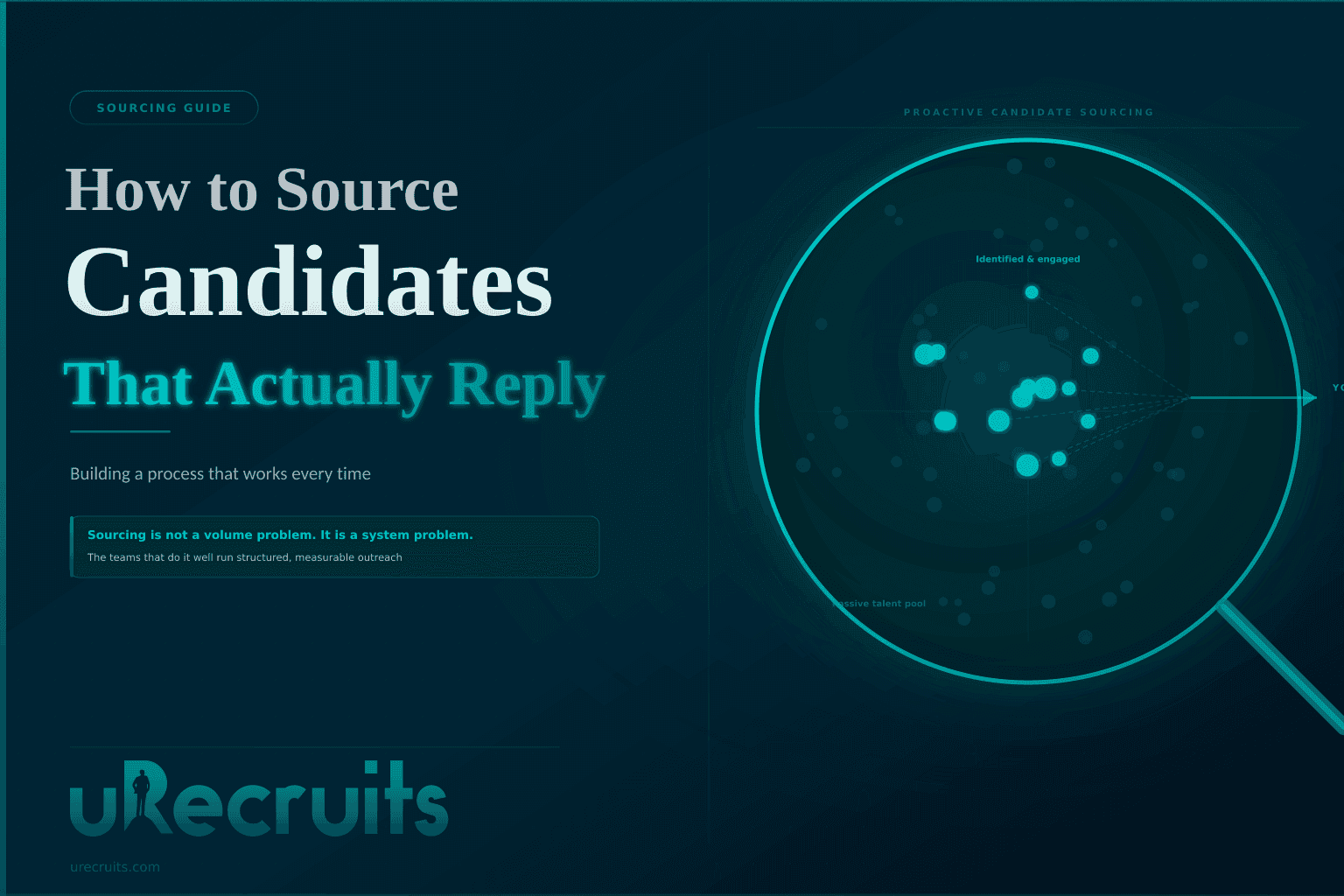
Key idea: Sourcing is not a volume problem. It's a system problem. The teams that do it well run structured, measurable, compliance-aware outreach instead of improvising in an inbox.
Most recruiting teams know the uncomfortable truth about job postings: the people best suited to a role are often not reading them.
They already have jobs. They aren't browsing boards on a Tuesday night. If you want them in your process, someone has to find them, reach out, and give them a reason to reply.
That's candidate sourcing. The idea is simple. Doing it consistently is where most teams struggle.
This guide covers what candidate sourcing means, why it matters more than it used to, how a working sourcing process is structured, where it breaks down, and how to tell whether yours is producing hires.
What is candidate sourcing?
Candidate sourcing is the proactive work of identifying, contacting, and engaging people who have not applied to your roles.
It sits before recruiting in the funnel. Recruiting manages people who are already in your process. Sourcing creates that process in the first place by generating the pipeline.
In practice, sourcing usually involves:
- Identifying people whose background fits a role
- Researching enough to personalize an approach
- Reaching out across one or more channels
- Following up on a planned cadence
- Tracking responses and engagement
- Nurturing people who aren't ready yet
- Handing warm candidates to the recruiter who owns the role
The distinction worth holding onto: sourcing is not just finding names. Finding names is the easy part now. The hard part is turning a name into a conversation, and a conversation into a candidate.
Why sourcing matters more than it used to
Most of the workforce is not applying to anything
Most of the people you'd want to hire are passive: not actively job hunting, but open to the right opportunity. Estimates of how large that group is vary with how "passive" is defined, so treat any single percentage with caution. The directional point is what matters. If your pipeline depends entirely on inbound applications, you're competing for a minority of the market, and often not the part with the specific experience you need.
Sourced candidates tend to convert better
A sourced candidate was selected because they fit the role. An inbound applicant selected themselves. Teams that track source-to-hire usually report that difference showing up in conversion, which is why outbound earns its cost on senior, specialized, and hard-to-fill roles.
That doesn't make inbound worthless. Inbound is cheaper per candidate and builds a sustainable base. The strongest teams run both and know which roles need which approach.
AI has changed the economics
Sourcing has always worked. What held it back was cost: manual research, manual personalization, and dedicated sourcing headcount.
AI assistance cuts the research and drafting load, so smaller teams can run outbound programs that used to need a dedicated sourcing function.
That's an opportunity and a risk. Cheaper outreach means more outreach, which means candidate inboxes get noisier and generic messages work even less well than before.
Where sourcing breaks down
Most sourcing fails for a mundane reason: the process lives in someone's inbox, not in a system.
Cadence breaks. The first message goes out. The follow-up that would have landed never does, because nobody was tracking who was due for a touch. Practitioners consistently report that a large share of replies come on a follow-up rather than the first message, so a dropped cadence is a dropped candidate.
Attribution disappears. Three months later, nobody can say which channel, which message, or which sequence produced the hire. Without that, you can't invest more in what works or stop doing what doesn't.
Knowledge walks out the door. The sourcer who built a relationship over six touches leaves, and the history of that relationship leaves with them. The next person starts cold with someone who already talked to your company.
Candidates get over-contacted. Two recruiters, two campaigns, same person, same week. It reads as disorganized at best and spammy at worst.
None of these are targeting problems. They're system problems, and they're fixable.
What good sourcing looks like in practice
A working sourcing process usually runs in six steps:
- Define who you're looking for. Translate the role into specific, searchable criteria: skills, seniority, industry, location, and the signals that suggest someone might be open.
- Build the audience. Segment your existing talent pool first, since people who already know you respond better than cold contacts, then add new prospects.
- Design the sequence. Plan the touches, the channels, the gaps between them, and the conditions that stop the sequence.
- Personalize the message. Reference something specific and real. Generic templates reliably underperform.
- Track engagement. Log every send, reply, bounce, and unsubscribe, so the next decision is based on data rather than memory.
- Hand off cleanly. When someone is interested, the recruiter who takes over should inherit the full history, not a forwarded email thread.
What makes outreach work
A few patterns hold up across most of what's been published on outreach:
Short beats long. Shorter messages get more replies than longer ones, on InMail (LinkedIn's direct message) and on email alike. Recruiters consistently write too much.
Multi-touch beats single-touch. One message is a lottery ticket. A planned sequence of three to five touches over a few weeks performs better.
Multi-channel beats single-channel. Reaching someone by email and a professional network, rather than hammering one inbox, tends to lift reply rates.
Specific beats clever. The thing that earns a reply is usually evidence you understood what the person does and why this role might interest them, not a clever subject line.
Relevance beats volume. Sending more messages to a weaker list produces more noise and more unsubscribes, not more hires.
What good sourcing is, and is not
It is: targeted, personalized, multi-touch, measured, compliance-aware, and connected to the rest of the hiring process.
It is not: mass mail, scraping whatever contact data you can find, pretending automation is personalization, or treating the candidate as a lead to be processed.
Sourcing outreach is regulated
This part gets skipped, and it shouldn't be.
Unsolicited recruiting outreach in the United States touches real compliance obligations. Commercial email is governed by CAN-SPAM, which requires accurate headers, honest subject lines, a physical address, an opt-out that you honor, and, where it applies, identifying the message as an advertisement. Whether a given recruiting email counts as commercial depends on its primary purpose, which is a question for counsel. Text messaging is governed by the TCPA, which can carry statutory damages per message. Rules vary by jurisdiction and by channel.
Practically, that means a sourcing program should be able to:
- Honor unsubscribes across every future campaign, not just the one the candidate replied to
- Include a working opt-out in outreach messages
- Track communication preferences per candidate
- Limit how often any one person can be contacted
- Keep a record of what was sent, to whom, and when
Employers remain responsible for determining and applying the requirements that apply to their own recruiting activities, and should consult qualified counsel. Using a tool does not transfer that responsibility.
How uRecruits fits
uRecruits doesn't automate outreach sequences today. What it does is solve the part of sourcing that fails most often: keeping the relationship, the history, and the handoff on one record instead of in someone's inbox.
A talent pool that compounds. Talent CRM lets you source candidates from anywhere into a pool that gains value over time, and convert a candidate to an applicant with one click when a role fits.
Nurture without losing the thread. A drag-and-drop Talent Pipeline built for relationship building keeps the people who said "not now" warm, with no automation getting in your way.
Every action on every candidate recorded. Talent CRM keeps a complete, append-only history. When a sourcer moves on, the relationship history stays with the candidate, and the recruiter who takes over inherits all of it. That covers the record-keeping item on the compliance list for everything logged in uRecruits, and it solves the handoff problem on the record.
One record from first touch to offer. The ATS and Talent CRM share the same candidate record, so a sourced candidate who converts doesn't get re-entered or re-asked.
Your email and calendar, connected. Keep sending from Gmail or Outlook; uRecruits connects to both, and to Google Calendar and Outlook Calendar. When someone's ready to talk, the uR Agent™ Scheduling Agent books the interview in chat. It sends a real Google or Outlook invite once you confirm.
AI recommends, you decide. That's Governed Autonomy™. In the words of the Talent CRM page: "The upcoming CRM Agent will surface match recommendations but every sourcing decision stays with you." AI does not make final hiring decisions; AI recommends, you decide.
Keep your sending tool for the sequence itself. Keep the relationship record in uRecruits so the work compounds instead of scattering.
Where sourcing goes wrong
Personalization that isn't personal. Inserting a first name and a company into a template is not personalization, and candidates can tell. If the message would make sense sent to 500 people, it will perform like it was.
Chasing volume over fit. A bigger list with a weaker match produces lower reply rates, more unsubscribes, and a worse reputation for your sending domain.
Treating the first reply as the finish line. A reply is the start of a conversation. Teams that celebrate reply rate and ignore what happens next end up with great-looking metrics and no hires.
No handoff discipline. The sourcer builds the relationship, the recruiter takes over, and the context evaporates. The candidate ends up repeating themselves, which is exactly the experience that loses passive talent.
Ignoring the people who said not now. Most sourced candidates aren't available when you contact them. A program with no nurture path throws away the majority of its own work.
Forgetting the compliance layer until something goes wrong. Unsubscribe handling and cadence limits are not optional extras.
How to tell if your sourcing is working
Reply rate. The cleanest early signal of whether your targeting and messaging are landing. Segment it by channel and by sequence step, not just overall.
Reply-to-interview rate. When replies never convert, look at targeting before messaging.
Source-to-hire by channel. Which channels produce hires, as opposed to producing responses. This is the number that should drive where you invest.
Time to first qualified candidate. How quickly a newly opened role gets someone real in front of the hiring manager.
Cadence completion rate. What share of candidates receive the full planned sequence. If it's low, your process is leaking before your messaging ever gets tested.
Unsubscribe and complaint rate. A rising number here is an early warning that volume has outrun relevance.
Pool contribution. How many sourced candidates stay in the talent pool and convert on a later role. Sourcing compounds, and this is where you see it.
Sourcing is a system, not an inbox
The teams that are good at sourcing are rarely the ones sending the most messages. They're the ones who defined who they were looking for, planned a sequence instead of improvising, tracked what happened, and kept the relationship history somewhere other than a personal inbox.
That's what turns sourcing from a scramble every time a role opens into an asset that gets more valuable each quarter. The pool builds. The attribution sharpens. The next role starts from a warmer place than the last one.
Connected tooling helps with that, not by replacing the judgment of the person doing the sourcing, but by making sure the process doesn't fall apart between the first message and the hire.
Frequently asked questions
What is the difference between sourcing and recruiting?
Sourcing is the proactive work of finding and engaging people who have not applied. Recruiting covers the full process once someone is in it, including screening, interviewing, and closing. Sourcing generates the pipeline; recruiting converts it.
How do you source candidates who are not looking for a job?
Start with people who already know you, including past applicants and talent-community members, then expand outward. Research enough to make the outreach specific. Lead with why this role might matter to that person rather than why your company is great. Keep the message short, and plan several follow-ups rather than relying on one.
What is a good response rate for candidate outreach?
Benchmarks vary widely by role, seniority, channel, and how well the list is targeted, so treat any single industry average with caution. The more useful approach is to track your own baseline, then test message length, personalization depth, and cadence against it.
How many times should you follow up with a candidate?
Most effective sequences run three to five touches over two to four weeks, with longer nurture sequences for talent-community engagement. The important part is that follow-ups are planned and tracked rather than remembered, and that the sequence stops when someone replies or opts out.
Is cold recruiting outreach legal?
Recruiting outreach is lawful but regulated. In the United States, commercial email is subject to CAN-SPAM and text messaging is subject to the TCPA, and requirements differ by jurisdiction and channel. Employers remain responsible for determining what applies to their own activities and should consult qualified counsel.
What should a candidate sourcing process track?
At minimum: who was contacted, through which channel, at which step, what happened (reply, bounce, unsubscribe), and which source produced each hire. Without attribution you can't tell which parts of the program are working.
Can AI do candidate sourcing?
AI can take on the research and drafting load, which is where most of the manual time goes. It shouldn't be making contact decisions or hiring decisions on its own. uRecruits' position is Governed Autonomy™: AI recommends, you decide. The upcoming CRM Agent will surface match recommendations, and every sourcing decision stays with the recruiter.
What happens to sourced candidates who say no?
They should stay in your talent pool with their full engagement history, not disappear. Most sourced candidates are unavailable at the moment you contact them and available at some later point. A nurture path is what makes the sourcing investment compound.
This article is general information about candidate sourcing practice and is not legal advice. Compliance obligations for recruiting outreach depend on jurisdiction, channel, and the nature of the message; consult qualified counsel for your own program. Product capabilities described reflect urecruits.com as of October 2026.