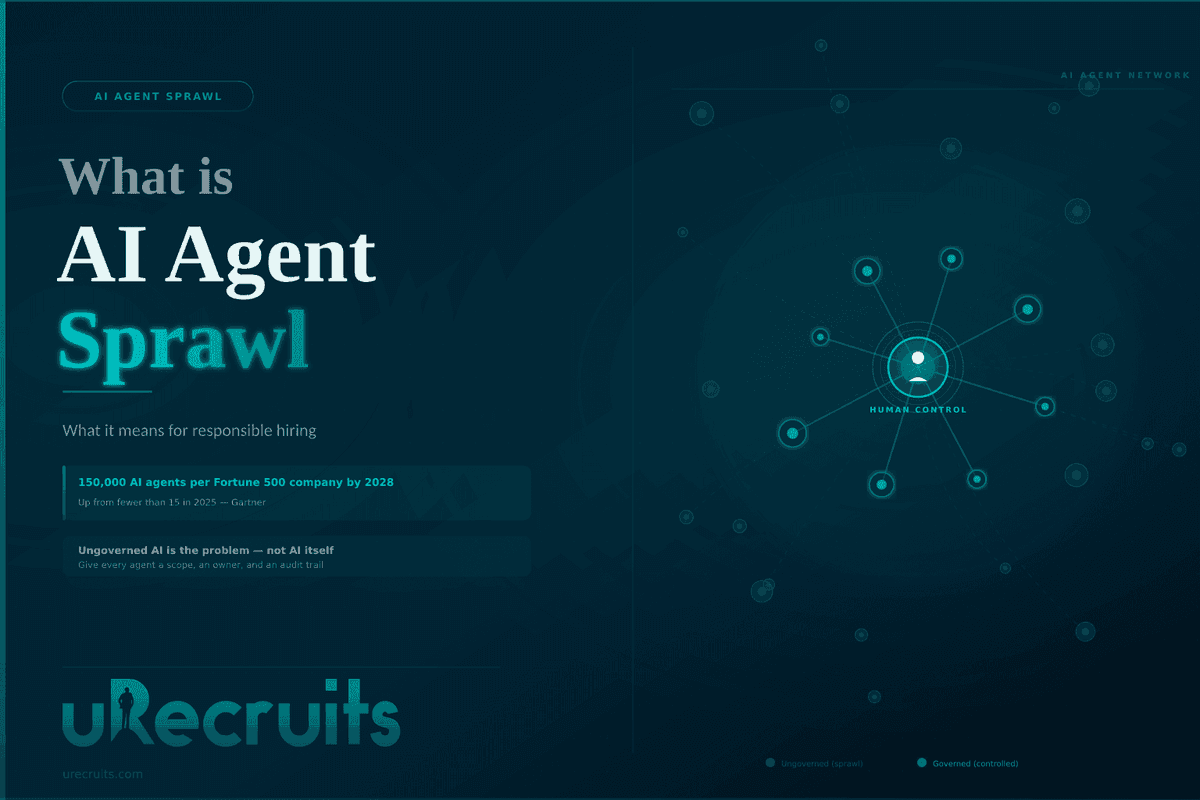

Gartner has published two predictions about AI agents that are awkward to hold at the same time.
The first: 40 percent of enterprise applications will include task-specific AI agents by the end of 2026, up from less than 5 percent in 2025. The second: more than 40 percent of agentic AI projects will be cancelled by the end of 2027, driven by escalating costs, unclear business value, and inadequate risk controls.
Adoption is climbing and abandonment is climbing with it. These are different populations, so the numbers don't cancel out. But read together they say something useful: the technology works well enough to spread fast, and plenty of deployments will still fail.
The difference is rarely the model. It's how the thing is governed.
Recruiting sits in the middle of this, with agents already drafting jobs, screening candidates, and booking interviews. Hiring also carries a constraint most agent use cases do not. People do not want machines making the final call on their careers. Pew Research put numbers on this in its 2023 survey on AI in hiring. Two-thirds of Americans said they wouldn't want to apply to an employer using AI to help make hiring decisions. Asked whether AI should make the final call, they opposed it 71 percent to 7 percent.
That survey is three years old and adoption has moved a long way since. But nothing published in the meantime suggests the discomfort has closed, and the regulators writing rules in this area have landed on much the same instinct.
So the question isn't whether to use AI agents in recruiting. It's how to use them without ending up in the 40 percent that get cancelled. This guide covers what agents do best, what they should never do alone, how to tell the difference, and why keeping a human in charge is now both the trustworthy answer and the compliant one.
What is an AI agent in recruiting?
An AI agent in recruiting is software that carries out a task from start to finish based on a plain-language request, then hands the result back to a person for approval. You tell it what you want and it does the legwork.
This is a step up from tools most teams already know. A basic chatbot answers questions. A rule-based automation follows a fixed script. An agent can plan and complete a multi-step task: reading a job description, writing role-specific interview questions, and adding them to a workflow, all from one instruction.
One warning before you buy anything. Gartner uses the term agent washing for chatbots, assistants, and robotic process automation rebranded as agentic AI without the underlying capability, and estimates that only around 130 of the thousands of vendors making agentic claims are the real thing. Ask any vendor, ours included, to run a multi-step task end to end, live, on your data. If the demo turns out to be a chatbot answering questions, that's agent washing.
A good agent proposes and prepares. It doesn't decide. That line, between doing the work and making the call, is the whole story of this article.
What AI agents do well in recruiting
Agents are good at the work that sits between the moments when you are actually recruiting: drafting job posts, building workflows from a plain description, scheduling interviews end to end, and summarizing long interviews into comparable shortlists.
The one worth dwelling on is the first-round screen, because that is where the time goes and where the argument gets interesting.
Picture a requisition with 300 applicants. The old options were both bad. Screen everyone properly and the process drags for weeks. Screen the first sixty and let the rest age out. That second one isn't neutral either, because who lands in the first sixty is mostly a function of who happened to apply on Tuesday morning. An agent can run the same structured first-round interview with all 300, ask identical role-specific questions, transcribe the answers, and attach a score with written reasoning. (On what the research says about which assessment methods actually predict performance, see our guide to candidate assessment software.) The recruiter then reads sixty chosen summaries rather than sixty arbitrary résumés.
Look at what changed. Consistency went up. Coverage went up. The recruiter's judgment landed on a better-prepared set of options.
Nobody was hired or rejected by software.
That is the common thread. All of this is preparation, not judgment. Recruiters are moving this way: LinkedIn's Future of Recruiting 2025 report found 37 percent of organizations actively integrating or experimenting with generative AI in recruiting, up from 27 percent a year earlier.
What AI agents should not do on their own
Here is the other half, and it matters more.
Make the final hire or reject decision. Choosing who gets the job carries real consequences for people's lives. That judgment belongs to someone who can be accountable for it.
Auto-reject candidates. An agent that quietly filters people out with no human review is both a fairness risk and a legal risk. A screening score should be a recommendation, not a verdict.
Act without explanation. If an agent cannot show why it scored a candidate a certain way, nobody can check its work or catch a mistake. Black-box decisions have no place in hiring. We go deeper on this in why AI explainability is key in HR decisions.
Run without a record. Every action an agent takes should be logged, so you can review it, reverse it, and prove what happened if you are ever asked.
Candidates aren't against AI helping with the process. They're against losing the human on the other side. Keeping people in charge is good ethics, and it protects the candidate experience you're spending money to build.
Human in the loop is the whole point
The phrase for this is human in the loop, sometimes called recruiter-controlled AI. It means a person reviews and approves the agent's work before anything real happens. The pattern is simple.
The agent proposes an action: a drafted job, a suggested interview time, a screening score. It explains what it did and why. You review it, and you can edit, override, or reject it before it becomes real.
A fair question at this point: does everything need approval? No, and a system that demanded it would be exhausting to use. The line falls where consequence falls. Reversible, low-stakes work can run without stopping to ask: a draft saved, a calendar checked, a summary generated. Anything that reaches a candidate, changes their status, or cannot be undone should wait for a person. Reasonable products differ on exactly where that line sits, which is why you should ask any vendor to show you theirs rather than accept a general assurance.
Good systems learn from your edits, so the agent gets better at matching your style over time. What never moves is who decides the outcome. The agent gets faster. It never gets the final say.

The return arrow is the part most vendor diagrams leave out. It is also the part that matters.
The four-question test
Rather than memorizing which tasks are safe, apply four questions to any task before you hand it over.
1. Is the output reversible? A drafted job post is reversible; you delete it. A rejection email is not. Irreversible outputs need approval before they leave the building.
2. Can the system explain it? If the agent produces a score it can't justify in words a recruiter could repeat out loud to a candidate, you can't defend it. Not to the candidate, not to your hiring manager, not to a regulator.
3. Is there a record? Not just what happened, but who reviewed it and what they changed. If you can't reconstruct the decision in two years, you don't have a record. You have a log.
4. Does a named person own the outcome? Not the team. Not the process. A person. If nobody's name is on it, nobody notices when it goes wrong.
Four yeses and the task is a reasonable candidate for automation. A single no tells you where the human belongs, and it is usually one specific step rather than the whole workflow. Treat this as a way to think, not a compliance checklist, and not a substitute for your own counsel.
What to tell candidates
Disclosure costs you almost nothing, and the trust research is hard to argue with. You don't need legal-sounding boilerplate. Three sentences in the job post or the application confirmation will do.
Here's an illustration of the shape. It isn't a recommended form of words, and your counsel should look at anything you actually publish:
We use AI tools to help review applications and conduct first-round interviews. Every decision about your application, including whether to advance or decline it, is made by a member of our recruiting team rather than by software. If you would prefer not to be assessed using these tools, tell us and we will arrange an alternative.
Only claim what's true of your process. Candidates can rely on a statement like this, so if your system can decline an application without human review, don't write the second sentence. Change the configuration first. On the third sentence, California's privacy rules already create opt-out rights around automated decision-making technology, and Colorado's incoming framework gives candidates a right to request human reconsideration after an adverse outcome. Requirements vary by jurisdiction and by the specifics of your process.
Why this approach matters right now
Two forces are pushing teams toward recruiter-controlled AI at once. The first is candidate trust, covered above. The second is regulation, and that picture shifted considerably across 2025 and 2026.
The United States: the explainer disappeared, the liability did not
In May 2023 the EEOC published technical assistance explaining how Title VII applies to employers using AI in selection, alongside guidance on ADA obligations. Following Executive Order 14179 in January 2025, the EEOC removed those documents from its website. The Department of Labor and OFCCP withdrew theirs.
This gets misread constantly. The guidance was non-binding: it explained existing law rather than creating new obligations. Title VII and the ADA are unchanged, and the EEOC's Strategic Enforcement Plan for FY 2024 to 2028 continues to identify technology-related employment discrimination, including algorithmic decision-making, as an enforcement priority. What went away was the manual, not the exam.
The states filled the gap, and they do not agree with each other
Four US jurisdictions have now written rules for AI in employment decisions. No two took the same approach.
- New York City. Local Law 144, enforced since 5 July 2023. Independent bias audit within a year of use, a public summary of the results, and notice to candidates at least 10 business days before the tool is used on them.
- California. Civil Rights Council FEHA regulations on automated-decision systems, effective 1 October 2025, which make bias testing (or its absence) relevant to discrimination claims and extend recordkeeping. Separate CPPA rules add disclosure and opt-out rights.
- Illinois. Human Rights Act amendments effective 1 January 2026, requiring disclosure when AI is used in employment decisions.
- Colorado. The cautionary tale. SB 24-205 was meant to be the first comprehensive state AI law. Its start date slipped twice, a federal court stayed enforcement in April 2026 during a constitutional challenge, and in May 2026 it was repealed and replaced by SB 26-189, which takes effect 1 January 2027. The replacement drops the duty of care, risk management programs, and impact assessments. What survives: pre-use notice, a plain-language explanation within 14 days of an adverse outcome, a right to correct inaccurate data, and a right to request meaningful human review and reconsideration where commercially reasonable. Note the shape of that last one. It is a right the individual exercises, not a blanket requirement that a human review everything.
Europe: transparency now, high-risk rules in 2027
Under the EU AI Act, Article 50 transparency obligations apply from 2 August 2026. The heavier high-risk regime for Annex III systems, which explicitly covers employment and worker management, was scheduled for the same date. The Digital Omnibus on AI, endorsed by the European Parliament on 16 June 2026 and adopted by the Council on 29 June 2026, deferred it to 2 December 2027. AI embedded in regulated products moves to 2 August 2028.
Read that as runway, not reprieve. The obligations didn't change, and conformity assessment, technical documentation, and human-oversight design are not quick work.
The pattern underneath all of it
Four jurisdictions, four drafting styles, one shared conclusion: notice, explanation, human review, and records.
None of them requires you to keep a human in every loop. We go through each framework in detail in our AI hiring compliance guide. What they require is that you can show your work, which turns out to be the same demand wearing different clothes.
A system that can't explain a score, produce a record, or route a contested outcome to someone able to genuinely reconsider it fails all four tests at once.
Nothing in this article is legal advice, and none of it should be relied on as a statement of your obligations. Laws in this area differ by jurisdiction, change frequently, and turn on facts specific to your process. Compliance is your responsibility, working with qualified counsel. What we can say is that the direction of travel is not ambiguous, and it lines up with the trust problem. The trustworthy way and the compliant way turn out to be the same way.
How we build agents that keep humans in charge
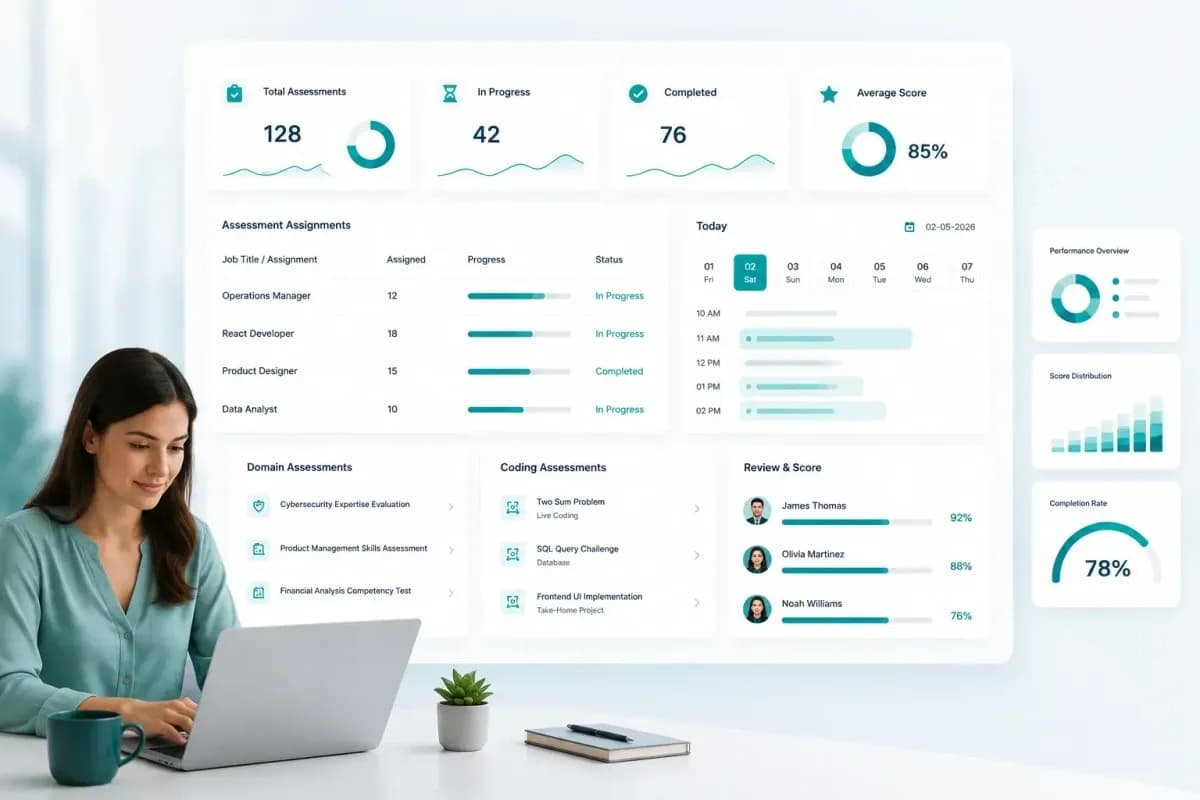
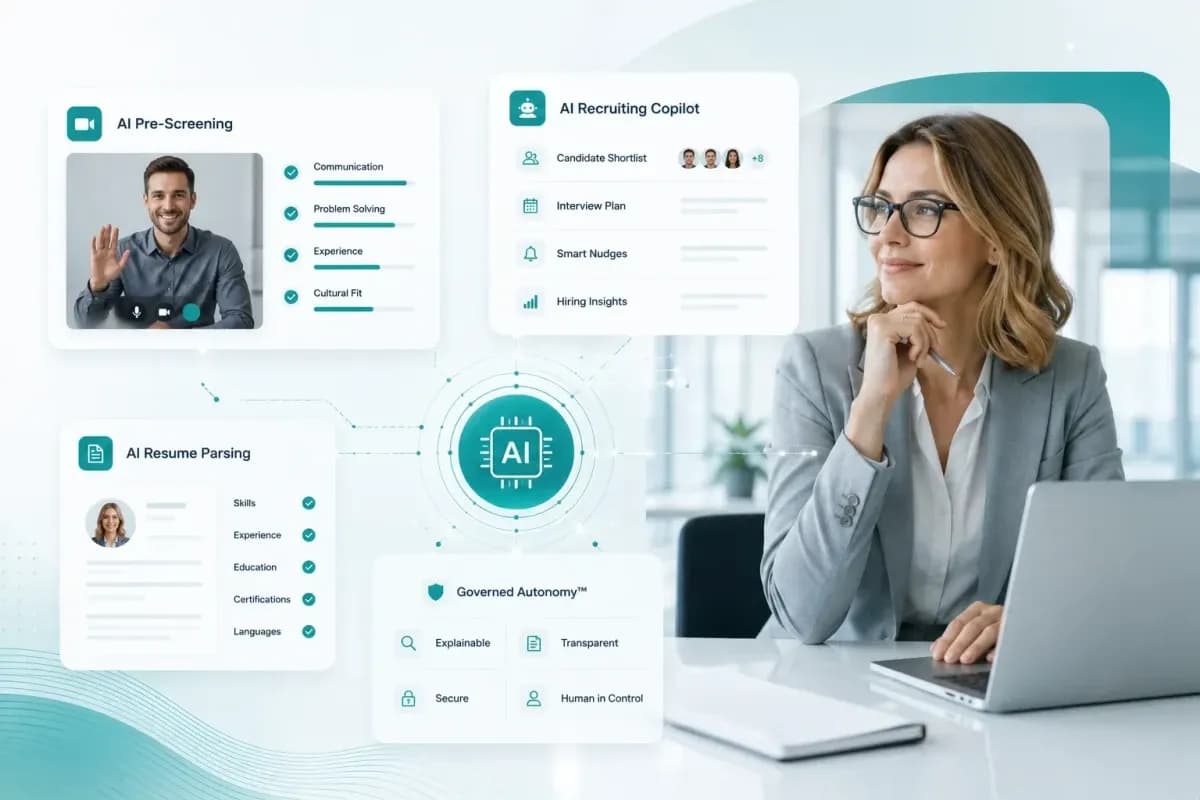
We built uR Agent on this model deliberately. It is a conversational recruiting copilot: you chat with it like a colleague, and it creates jobs, builds workflows, sets up assessments, schedules interviews, and edits anything you have already made, all in plain language.
Five specialized sub-agents are running in beta, covering jobs, workflows, assessments, scheduling, and AI pre-screening. Each handles a slice of the mechanical work. Beta means what it says: the capability is real and in use, and it is still being refined against how customers actually work.
The governance is the part that matters. uR Agent executes a task, explains what it did and why, and improves from your edits. You can edit, override, or reject any output before it is committed, and changes are tracked in an audit trail.
Where it asks and where it acts follows the reversibility line above. Routine, clearly authorized, reversible operations execute directly, which is the point of using an agent at all. Actions carrying real consequence pause for confirmation first. Where exactly that boundary sits is configurable, so the honest answer to "does it always ask?" is that it depends on how you set it up, and we would rather you check that in a trial than take it on trust.
Agents aren't built to make adverse decisions on their own. Pre-screening produces a score for the recruiter to review, and the recruiter's call is the one that counts. There's no auto-reject in the design, and flagged sessions route to a person rather than to an automatic no.
Configuration matters, though. What any given deployment does depends on how it's set up, so don't take our word for it. Test it in your own environment.
An alternative path is also available. Where an employer chooses to offer it, a candidate who would rather not be assessed by AI can request a different route without that request being recorded against them. Worth stating plainly, because that is the point where the human-in-the-loop principle either holds or turns out to be decorative.
What that looks like in practice
We are not going to give you a headline efficiency percentage.
Numbers like that are common across the category, and in our experience they are hard to interpret without knowing how they were produced. Measured against what baseline? Across how many customers? Over what period? Self-reported or instrumented? Until we can answer those questions in a way we would want you to rely on, publishing a number would be marketing dressed as evidence, which is the habit this article is arguing against.
What we can describe is where the effort goes. Agents absorb the drafting, scheduling, chasing, and status-updating that sits between the moments when a recruiter is actually recruiting.
Whether that's worth a lot or a little to you depends almost entirely on how manual your process is today. Which is why the only number that should move your decision is one you generate yourself, in a pilot, on your own requisitions.
The design shows its value soonest in high-volume hiring, where administrative load scales with applicant count and swamps a team long before the judgment work does. One of our healthcare customers came to us with that shape of problem, and agents took the repetitive layer. What did not change is who decides. Every advancement and every rejection still runs through a recruiter, which is what you want in a sector where hiring decisions get documented, audited, and occasionally contested.
That is the design in one line: the volume goes to the agents, the judgment stays with the people.
FAQs
How do I tell a real AI agent from a rebranded chatbot? Ask for a live run of one multi-step task, start to finish, on your data. Not a scripted walkthrough. A real agent reads an input, plans several steps, and produces a finished artifact. A rebranded chatbot answers questions about how it would do that.
What is the biggest cause of agentic AI projects failing? Gartner attributes cancellations to escalating costs, unclear business value, and inadequate risk controls. Those are management problems rather than model problems. The practical implication: pick one bottleneck, define numerically what success looks like before you start, and pilot on a single requisition.
Does human-in-the-loop review actually slow hiring down? Approving a drafted job post or a proposed interview slot takes seconds. The saving comes from not writing the draft and not negotiating the calendar in the first place. What review costs you is the fantasy of a fully unattended pipeline, which is the one thing regulators and candidates both object to anyway.
If AI only recommends, am I still exposed to discrimination liability? Generally, yes. Anti-discrimination law cares about outcomes, and a recommendation a recruiter reliably follows can start to look like a decision. This is why explainability and audit trails matter: being able to show that a human genuinely evaluated a recommendation, rather than rubber-stamping it, is easier when the system produces a record. How this applies to your situation is a question for your own counsel.
What should I document from day one? What the tool does, what data it uses, who reviewed each recommendation and when, what the recruiter decided, and any overrides. If you can reconstruct a hiring decision two years later from your own records, you're in better shape under every framework now in force or scheduled. What any one of them requires of you specifically is a question for your counsel.
Will AI agents replace recruiters? No. Agents take the mechanical prep work. Recruiters still select, advance, hire, and reject, and they still build the relationships that make hiring work. If anything, the regulatory direction locks a human into the decision seat.
The bottom line
AI agents are a real shift, and teams that adopt them well will move faster than teams that don't. But Gartner's cancellation forecast and the regulatory pattern point at the same failure mode: deployments with no risk controls, no explanations, and nobody who can answer for the outcome.
Let agents do the mechanical work, and keep every real decision with a person who can explain it and stand behind it. AI assists. Humans decide. That is how you get the speed of automation without giving up the judgment, fairness, and accountability that good hiring depends on.
Want to see recruiter-controlled AI in practice? Start free or book a demo and watch uR Agent draft a job, run a first-round screen & schedule an interview, with you approving every step.
This article is general information about AI in recruiting. It is not legal advice, and it does not create any advisory relationship. Statements about laws and regulations reflect our understanding as of the date below and may not reflect subsequent developments; regulatory timelines in this area have moved repeatedly. Statements about our own product describe how the platform is designed and may not reflect every configuration or deployment. Consult qualified counsel about your own obligations.