
Something quiet but historic happened on the internet. For the first time, machines outnumber people on it. According to Thales's Imperva Bad Bot Report, more than half of all web traffic now comes from bots and automated systems rather than humans, and AI agents have become a distinct new category of that traffic.
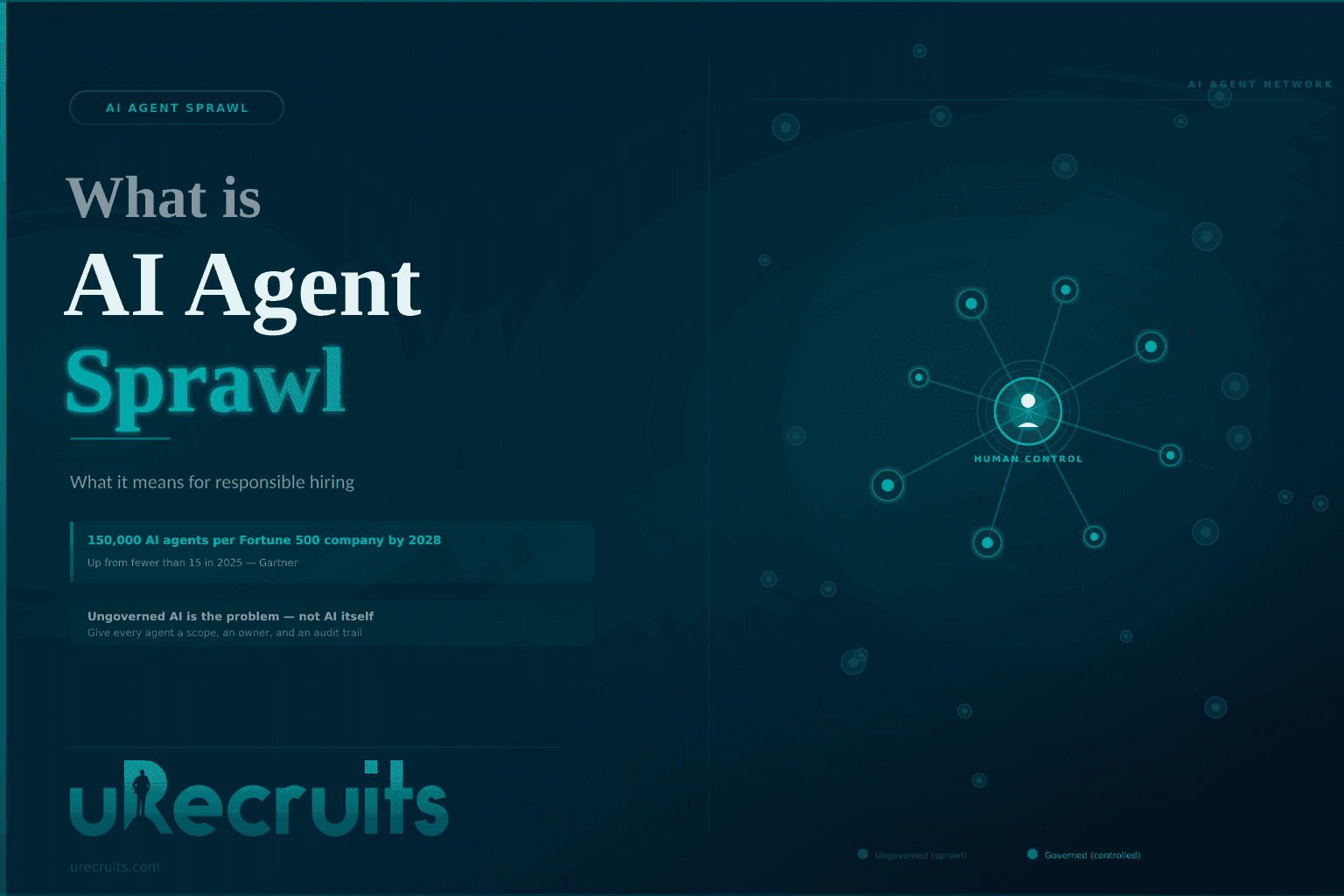
The same thing is now happening inside companies. AI agents are multiplying fast, each one able to read data, call tools, and take actions on its own. Gartner projects that the average global Fortune 500 company will run over 150,000 AI agents by 2028, up from fewer than 15 in 2025. That explosion has a name: AI agent sprawl.
This is not a reason to fear AI or to slow down. It is a reason to be deliberate. The lesson of agent sprawl is simple. Before you let AI agents touch sensitive information, especially something as consequential as hiring data, you need governance, transparency, and human control in place first. This piece explains what agent sprawl is, why it matters, and what it means for hiring in a year when the law is catching up fast.
What is AI agent sprawl?
AI agent sprawl is the uncontrolled spread of AI agents across an organization, faster than anyone can track or govern them. An agent is different from a simple chatbot. It does not just answer a question. It plans and completes tasks on its own, connects to systems and APIs, moves data, and acts at machine speed.
When a few of these live in one tool, that is useful. When thousands of them spread across departments, each grabbing access to systems and data with little oversight, that is sprawl. Gartner describes it plainly, warning that many leaders now face an ungoverned sprawl of agents that exposes their organizations to real risks, including misinformation, oversharing, and data loss.
The core problem is not the agents themselves. It is that adoption is racing ahead of governance. Companies are deploying agents far faster than they are building the rules, logging, and access controls to manage them.
Why sprawl is a real risk, not just hype
It would be easy to dismiss this as another buzzword. The data says otherwise.
Traditional security was built for humans who log in and out of systems. Agents do not work that way. They run continuously, span many applications, pick up permissions as they go, and generate activity around the clock. That breaks the old model of identity and access, and it creates blind spots where no one can see what an agent did, on whose behalf, or with what data.
The consequences are already showing up. Gartner predicts that by 2027, 40 percent of enterprises will have to demote or shut down autonomous AI agents because of governance gaps that only surfaced after something went wrong in production. In other words, a large share of companies will learn the hard way that they deployed first and governed later.
The takeaway is not that AI is bad. It is that ungoverned AI is the problem. The technology is powerful and worth adopting. What has to change is how enterprises bring it in.
Hiring is where sprawl meets the law
Now bring this home to recruiting, because hiring is one of the highest-stakes places an AI agent can operate.
Hiring data is deeply personal. It touches people's careers and livelihoods, and it can brush up against protected characteristics like age, gender, and ethnicity. Let an ungoverned agent loose on that data, making or shaping decisions with no logging and no human in the loop, and you are not just taking a security risk. You are taking a legal one.
And the law has arrived. A patchwork of AI hiring rules is now live or landing in 2026:
- New York City Local Law 144 has required independent bias audits and candidate notice for automated employment decision tools since 2023.
- Illinois amended its Human Rights Act, effective January 1, 2026, to ban AI that produces discriminatory effects and to require notice whenever AI is used in employment decisions.
- Colorado's AI Act, the broadest state law so far, treats hiring as high risk and is phasing in through 2026, adding impact assessments and risk-management duties.
- California now applies its civil rights rules to automated decision systems, with multi-year recordkeeping requirements.
- The EU AI Act classifies hiring as high risk, with obligations for hiring systems applying from August 2026 and penalties reaching up to 35 million euros or 7 percent of global turnover.
- At the federal level, the EEOC applies Title VII and other anti-discrimination law to AI hiring tools through disparate impact, even without a dedicated federal AI law.
You can read a fuller map of the US rules in this employment-law overview from K&L Gates. The details differ by state, but the common thread is striking. Every one of these laws pushes in the same direction: transparency, audit trails, human oversight, and no black-box automated rejection. The question regulators keep asking is the same one candidates ask. Who actually makes the decision?
The answer to sprawl is governed AI, not no AI
Put the two forces together and the path forward gets clear. Security leaders are telling enterprises to rein in ungoverned agents. Lawmakers are telling employers to keep hiring transparent, auditable, and human-led. These are not two separate demands. They are the same demand, and they point to one answer.
The answer is not to reject AI. It is to adopt it through a governed framework, where AI does the heavy lifting and people stay in charge. In practice, governed AI means a few concrete things:
- Every agent has a clear scope and a human owner, not free rein.
- Every action it takes is logged, with a record of what happened, on whose behalf, and why.
- The final decision on any consequential outcome stays with a person who can be accountable for it.
- The system is transparent and explainable, so a score or a suggestion can be checked, not taken on faith.
- Nothing gets auto-rejected. AI can rank and recommend, but it does not quietly close doors on people.
This is what good security governance calls for, and it is what the new hiring laws require. When enterprises adopt AI this way, they get the speed of automation without giving up the fairness, accountability, and control that the moment demands. It also matches what people want. Pew Research found that Americans oppose letting AI make the final hiring decision by 71 percent to 7 percent.
How uRecruits approaches this
uRecruits builds its AI on exactly these principles, by design rather than as an afterthought. Its AI layer, uR Intelligence, is built so that AI assists and humans decide, with no automated hiring decisions anywhere in the platform.
The pattern runs through every feature. Its conversational assistant, uR Agent, proposes actions like drafting a job, building a workflow, or scheduling an interview, then waits for a recruiter to confirm before anything happens. Its AI pre-screening produces a recommendation score that a recruiter reviews, and no candidate is ever auto-rejected. Every action is logged with the person responsible and a timestamp, so there is a complete audit trail. Scoring is transparent and explainable rather than a black box, and any AI output can be edited or overridden by a human before it counts.
Read against the wave of new hiring rules, those are not just nice features. They line up with what transparency, audit-trail, and human-oversight requirements are asking for. uRecruits is continuing to build out a responsible AI framework across the platform as this landscape evolves. The goal is a system enterprises can adopt with confidence, where AI accelerates the work and people stay firmly in control of the decisions that matter.
FAQs About AI agent sprawl
What is AI agent sprawl?
AI agent sprawl is the fast, uncontrolled spread of AI agents across an organization, beyond what teams can track or govern. Because agents run continuously, access many systems, and act on their own, sprawl creates security, privacy, and compliance risks like oversharing and data loss.
Why is agent sprawl a security risk?
Traditional security was designed for human users who log in and out. AI agents run around the clock, span many applications, and pick up permissions as they go, which breaks old identity and access controls. Without governance and logging, no one can see what an agent did, with whose data, or why.
What AI hiring laws apply in 2026?
A growing patchwork applies, including NYC Local Law 144, Illinois's amended Human Rights Act, Colorado's AI Act, California's automated decision rules, the EU AI Act, and federal anti-discrimination law enforced by the EEOC. They vary in detail but share a focus on transparency, audit trails, human oversight, and no automated rejection. This is general information, not legal advice, so confirm your obligations with counsel.
Does governed AI mean using less AI?
No. Governed AI means using AI with guardrails, not using less of it. Agents can still do the heavy lifting, drafting, screening, scheduling, and summarizing. The difference is that their actions are scoped, logged, transparent, and reviewed, and a person makes the final call.
Will AI agents replace recruiters?
No. In a governed model, agents handle the repetitive preparation work while recruiters keep the judgment work, like deciding who advances and who gets hired. That human accountability is exactly what both the new laws and candidate trust require.
The bottom line
AI agent sprawl is the defining side effect of this AI moment. Agents now outnumber people online, and they are multiplying inside companies faster than governance can keep up. The instinct to either ignore it or fear it are both wrong.
The right response is to adopt AI the governed way. Give every agent a scope and an owner, log every action, keep decisions with accountable humans, and make the whole system transparent and auditable. In hiring, that is not only smart security. It is fast becoming the law. The companies that build on that foundation now will be the ones that can use AI with confidence while everyone else is still cleaning up the sprawl.
Want to see governed, human-in-the-loop AI in a recruiting platform? Start free with uRecruits or book a demo.