
A practical look at how teams can hire around real capability, without turning one test, credential, or AI score into the decision.
Key idea: Skills-based hiring is not about replacing a degree with a test score. It is about building a better body of job-relevant evidence for human decision-makers.
Skills-based hiring starts with a simple question that many hiring processes still struggle to answer: can this person demonstrate the skills the role actually requires?
It sounds straightforward. In practice, it takes more work than changing a few lines in a job description.
Teams have to agree on what success in the role actually looks like, identify the skills that matter, gather useful evidence, structure interviews around that evidence, and keep people accountable for the final call.
That is the difference between saying you hire for skills and actually building a process around them.
This guide looks at what skills-based hiring means, why more employers are moving in this direction, where the approach can break down, and what it takes to make it useful in the real world.
What is skills-based hiring?
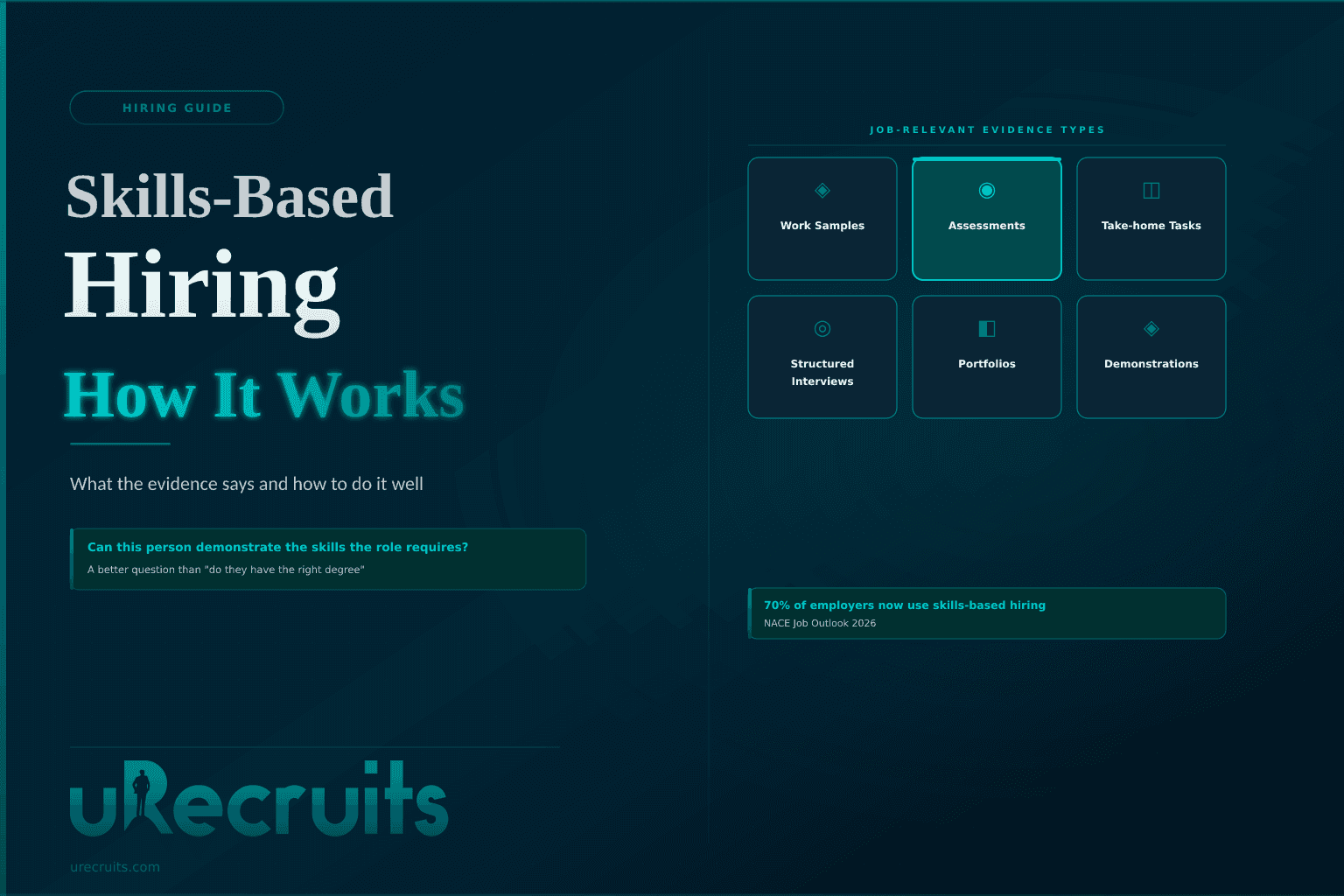
At its core, skills-based hiring means defining the abilities a role requires and evaluating candidates using evidence that is relevant to the work.
That evidence can include:
- Work samples
- Technical or domain assessments
- Take-home assignments
- Structured interviews
- Demonstrations
- Relevant experience
- Portfolios
- Other job-related evidence of capability
Instead of treating a four-year degree, a well-known employer, or a certain number of years in a similar title as proof of ability, the employer looks for evidence that the candidate can do the work.
That does not make education or experience irrelevant. They can still matter. The difference is that they become part of the evidence rather than automatic gatekeepers.
And there is another trap to avoid: replacing one shortcut with another. A degree should not automatically decide who is qualified, but neither should a single assessment score.
The better approach is to give human decision-makers a fuller, more job-relevant body of evidence.
Why skills-based hiring is gaining momentum
More employers are experimenting with this approach, and the trend is showing up in several industry studies.
In NACE's Job Outlook 2026 survey, 70% of participating employers reported using skills-based hiring, up from 65% the previous year. NACE also found that GPA screening has declined substantially: 73% of surveyed employers reported screening candidates by GPA in 2019, compared with 42% in 2026. (National Association of Colleges and Employers)
Separately, TestGorilla's 2025 State of Skills-Based Hiring survey reported that 85% of the employers it surveyed were using skills-based hiring in some form.
The studies use different samples and methods, so the percentages are not universal. Still, they point in the same direction: employers are looking for better ways to understand what candidates can actually do, not just what appears on a resume.
Skills can provide stronger evidence than credentials alone
Credentials can be useful signals. But they are still indirect signals of capability.
Research cited by McKinsey found that hiring for skills was substantially more predictive of job performance than relying on education or previous work experience alone.
That does not mean every assessment is predictive or useful. A skills-based process is only as good as the evidence it collects.
A work sample that closely reflects the job can tell a hiring team something meaningful. A generic test with little connection to the work may add very little.
The goal is not to test more people. It is to measure the things that actually matter for the role.
Traditional requirements can exclude capable candidates
Degree requirements can screen people out before an employer ever gets to see what they can do.
Opportunity@Work estimates that more than 75 million U.S. workers are STARs, meaning workers Skilled Through Alternative Routes rather than through a bachelor's degree.
STARs can develop relevant skills through:
- Community college
- Military service
- Apprenticeships
- Certifications
- Workforce training
- Bootcamps
- On-the-job learning
- Other alternative pathways
Removing an unnecessary degree requirement is not about lowering the bar. It is about making sure the bar reflects the work. When a degree is not truly required, employers can look for more direct evidence of capability instead.
Skills-first approaches can expand the available talent pool
When employers change the signals they use to find and evaluate people, the pool of candidates they consider can change too.
LinkedIn Economic Graph research found that skills-first matching can substantially expand potential talent pools. Its research also found that, globally, potential talent pools can expand more for women than for men when matching is based on skills rather than job titles alone.
The distinction matters. Skills-based hiring does not guarantee a particular diversity outcome. But relying less on narrow proxies such as previous titles or unnecessary credentials can change who gets a chance to be considered.
Retention may also improve
McKinsey has cited research indicating that workers without four-year degrees tend to stay in roles longer than workers with degrees.
More recent Harvard and Burning Glass research found that, among organizations making meaningful progress with skills-based hiring, workers hired into jobs that previously required degrees also showed encouraging retention results.
The takeaway is not that every worker without a degree will stay longer. It is that employers may be missing capable people when credentials stand in for evidence of fit.
The skills employers need are changing quickly
The World Economic Forum Future of Jobs Report 2025 found that employers expect 39% of workers' core skills to change by 2030.
AI and big data lead the report's list of fastest-growing skills, alongside areas such as cybersecurity and technological literacy. At the same time, employers continue to place importance on analytical thinking, resilience, leadership, collaboration and other human capabilities.
For hiring teams, that creates a practical problem. A qualification earned years ago can still matter, but employers increasingly need to know what someone can do today, and how well they can keep learning as the work changes.
Where skills-based hiring gets real
Dropping a degree requirement from a job post is easy. Changing who actually gets hired is much harder.
One of the most studied forms of skills-based hiring has been the removal of unnecessary degree requirements. Research from Harvard Business School and the Burning Glass Institute examined organizations that removed degree requirements and found a large gap between policy and actual hiring behavior. Across the market studied, the additional opportunity created by these reforms translated to fewer than 1 in 700 hires.
The research also found companies that did create meaningful change. What separated them was not the announcement. It was the follow-through.
Changing the words in a job posting did not automatically change:
- How recruiters sourced candidates
- How hiring managers reviewed resumes
- Which candidates advanced
- How interviews were conducted
- Which signals decision-makers trusted
The lesson is simple: policy changes the requirement. Process changes the outcome.
What skills-based hiring looks like in practice
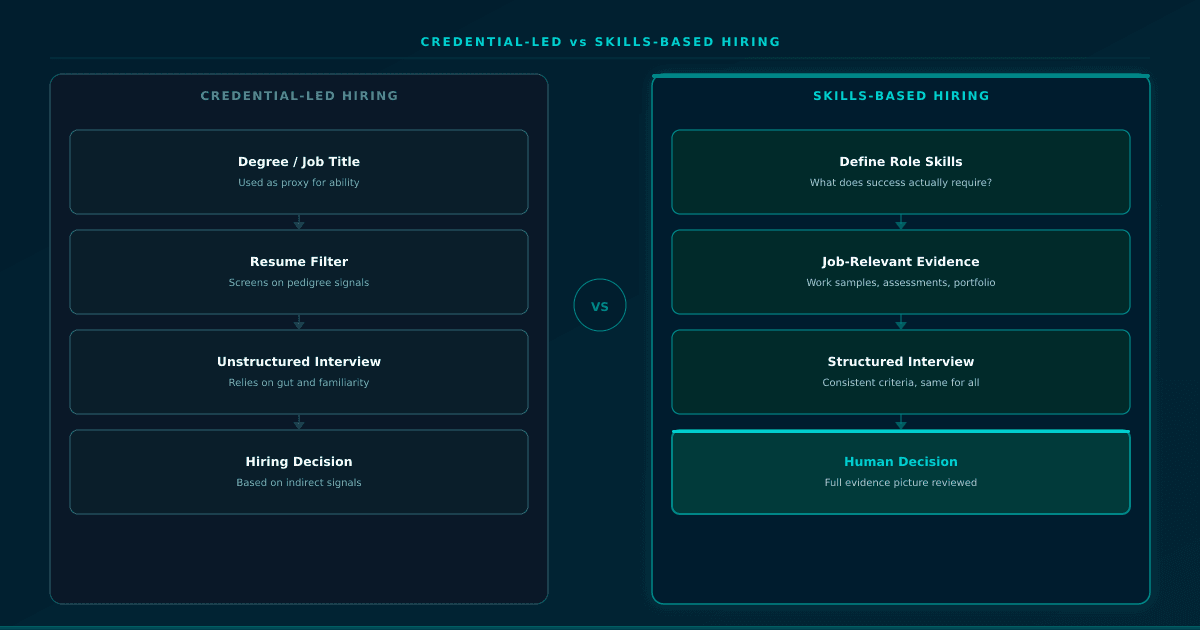
In practice, the process can be boiled down to six connected steps: define the skills that matter, write the role around them, gather job-relevant evidence, run a structured interview, review the full picture, and make a human decision.
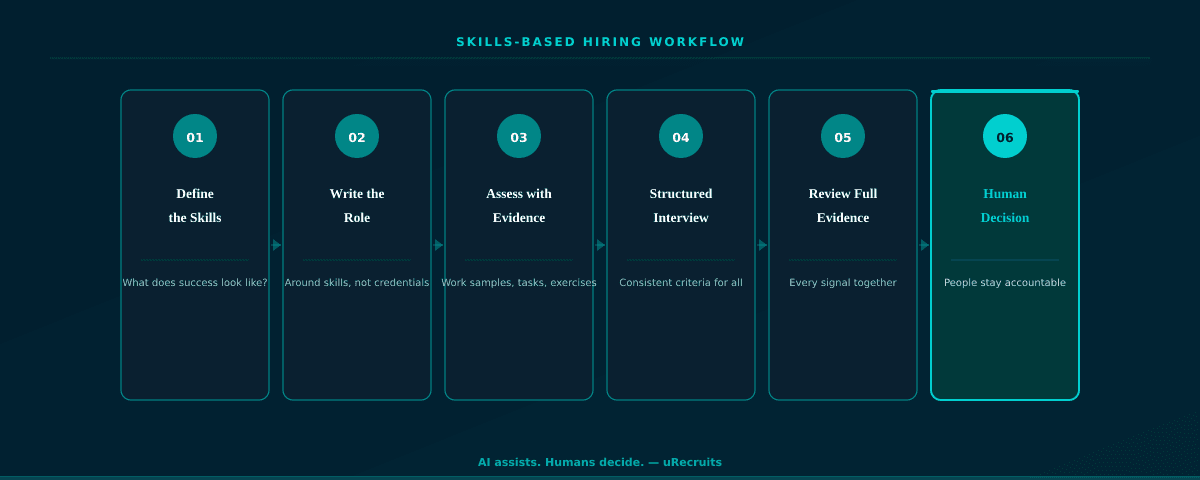
The sequence matters. You define success first, then choose how to assess it. The assessment is one piece of evidence inside a structured process, not a replacement for recruiter or hiring-manager judgment.
What good skills-based hiring is, and is not
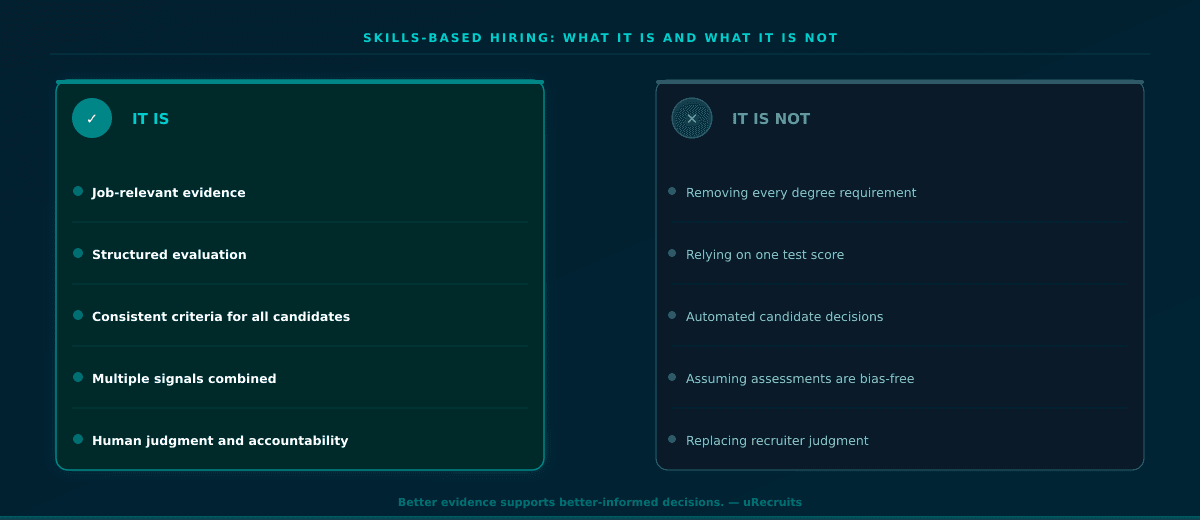
A strong skills-based process uses job-relevant evidence, structured evaluation, consistent criteria, multiple signals, and human judgment. It does not mean removing every degree requirement, relying on a single score, automating employment decisions, or assuming an assessment is automatically fair.
What makes candidate assessments useful?
An assessment is useful only when it is meaningfully connected to the work. Employers also need to think about consistency, accessibility, adverse impact, and validation requirements that may apply.
A useful assessment should measure capabilities that matter to the work. For example:
- A developer might complete a coding task.
- A customer-success candidate might respond to a realistic customer scenario.
- A data analyst might interpret a dataset.
- A content candidate might produce or critique a writing sample.
- A sales candidate might work through a discovery or objection-handling scenario.
The closer the exercise is to meaningful parts of the job, the more useful the evidence is likely to be for the hiring team.
Consistency matters too. Candidates for the same role should go through a process that is consistent enough to support a fair, meaningful comparison.
And the work does not stop once an assessment is launched. Employers should keep checking whether the selection process is actually doing what they intended. Useful questions include:
- Does the assessment measure something important to the job?
- Does performance on it relate to subsequent job performance?
- Are candidates receiving consistent instructions?
- Is the assessment accessible?
- Is it creating unintended barriers?
- Are alternative methods appropriate for candidates who need accommodation?
- Is the assessment disproportionately screening out particular groups?
Under U.S. employment law, employers remain responsible for their selection procedures, including tests supplied by third parties. Job relatedness, validation where applicable, reasonable accommodation and monitoring for adverse impact all matter.
Using technology does not shift that responsibility away from the employer.
How uRecruits supports skills-based hiring
This is where connected tooling can help. The goal is to make the process easier to run without separating assessment evidence from the rest of the hiring workflow.
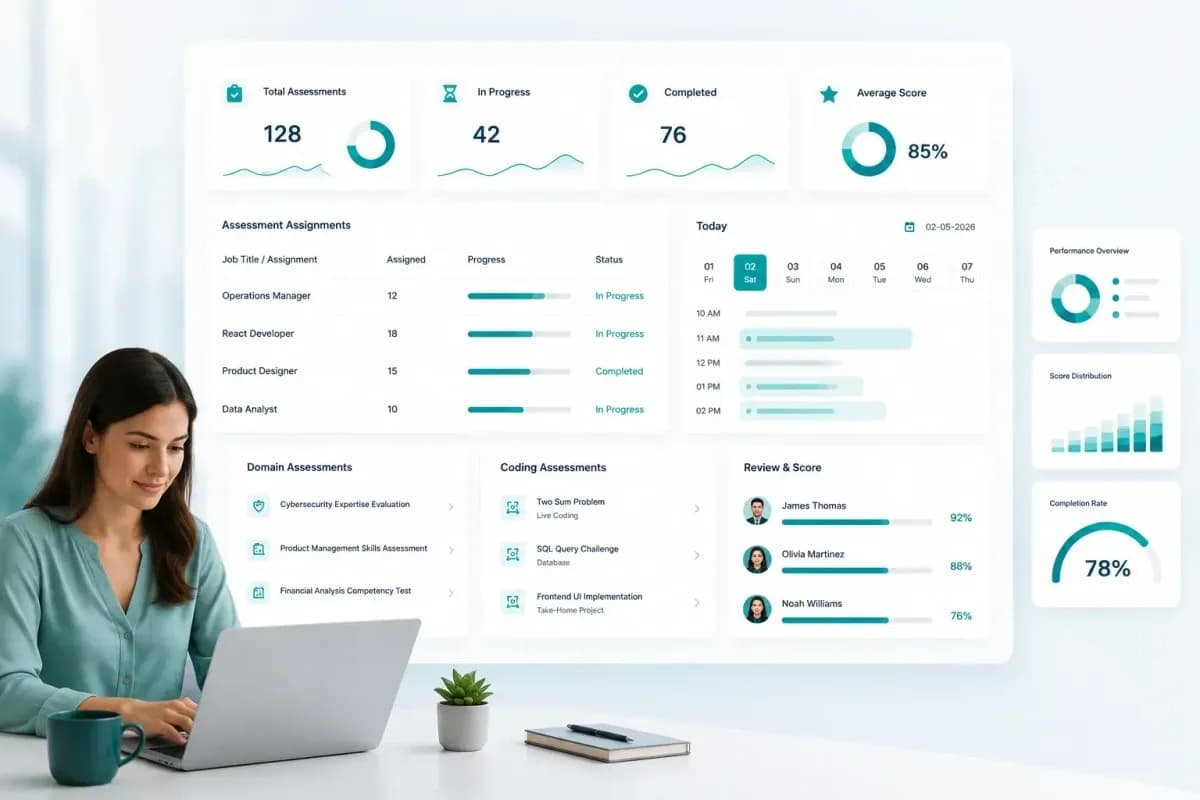
uRecruits Candidate Assessments lets recruiting teams bring skills evidence into the broader hiring process instead of managing it in a separate system.
Live coding assessments. For technical roles, teams can run live coding assessments that support real-time evaluation and collaboration.
Take-home assignments. Candidates can complete asynchronous assignments that reflect the work, including coding tasks and other project-based exercises.
Domain and skill assessments. Hiring teams can use domain- and skill-specific evaluations aligned to the competencies that matter for the role.
Connected candidate evidence. Assessment results stay connected to the candidate record and Scoreboard, so teams can review them alongside the rest of the hiring evidence. That is important because the goal is not to isolate a test score. It is to give the hiring team a more complete view of the candidate.
Human-led decisions. AI assists. Humans decide. uRecruits does not make automated employment decisions. Recruiters and hiring teams remain responsible for reviewing the evidence and making the hiring decision. Human review alone does not determine whether a hiring technology is subject to employment or AI regulation, so employers still need to evaluate how a tool is used in their own process.
Technology should help teams collect, organize, and review evidence more consistently, not take accountability away from the people making consequential employment decisions.
See how uRecruits Candidate Assessments works
Where skills-based hiring can go wrong
Defining the right skills takes work. Job descriptions often carry years of inherited requirements. Working out which ones truly matter can take input from recruiters, hiring managers, and people who already do the job well.
Poor assessments can create new problems. A poorly designed assessment can simply replace one weak filter with another. The test has to reflect the work.
Candidate burden matters. A multi-hour unpaid assignment at the start of a process can push good candidates away. The depth of the assessment should fit the role, the stage, and the amount of time you are asking from the candidate.
Managers may still fall back on familiar signals. A company can remove a degree requirement and still favor familiar universities, employers, or career paths. That is part of what the Harvard and Burning Glass research illustrates. Changing policy is easier than changing habits.
Skills-based hiring does not automatically eliminate bias. Structured, job-related evaluation can reduce reliance on some pedigree-based proxies. But no assessment should be assumed to be bias-free. Design, accessibility, consistency, human review, applicable validation, and adverse-impact monitoring still matter.
Employers still own the hiring decision. Whether an assessment is built internally or supplied by a vendor, the employer still needs to understand how it is being used. A vendor score should never become an unquestioned hiring rule.
How to tell if it is actually working
Quality of hire. Do the skills and evidence used during hiring relate to how the person performs after joining? If not, revisit what you are measuring.
Retention. Are people hired through the process staying and succeeding? Look beyond tenure alone and ask whether role fit is improving.
Qualified talent pool. Has removing unnecessary barriers increased the number of genuinely qualified people who get considered?
Candidate progression. Where do candidates drop out? If an assessment is causing excessive abandonment, it may need to be shortened, moved later, or redesigned.
Time to hire. Is the process helping the team make evidence-based decisions more efficiently, or did it simply add another step?
Consistency. Are candidates for the same role being evaluated against the same core competencies and standards?
Adverse impact. Are selection rates materially different across relevant groups? Employers should understand how their selection procedures behave in practice, not just how they were designed.
Follow-through. How many hiring decisions are actually different because the organization adopted a skills-based process? That is the real test of whether the idea changed behavior or just changed the language in the job post.
Let the evidence do more of the talking
Skills-based hiring is not about pretending credentials no longer matter.
It is about asking a better question: are we using the best available evidence to understand whether this person can succeed in the job?
For some roles, education, licenses, certifications, or particular experience will remain essential. For many others, employers may find that long-standing requirements are screening out people who could do the work well.
That is why the opportunity is bigger than removing degree requirements. It is about redesigning hiring around:
- Clear role requirements
- Job-relevant evidence
- Structured evaluation
- Consistent processes
- Appropriate oversight
- Human accountability
That is what turns skills-based hiring from a statement in a job description into the way a team actually hires.
Connected assessments can help with that, not by deciding who should be hired, but by giving people better evidence to work with.
FAQs About Skills-Based Hiring
What is an example of skills-based hiring?
Instead of automatically requiring a computer science degree for a software developer role, an employer could define the technical skills the role requires, review relevant experience, use a job-related coding exercise, ask structured interview questions, and evaluate the combined evidence against a consistent rubric. A degree can still matter where it is relevant; it just does not have to stand in for proof of ability.
What is the difference between skills-based hiring and traditional hiring?
Traditional hiring often leans heavily on proxies such as degrees, previous employers, job titles, and years of experience. Skills-based hiring puts more weight on evidence that a candidate can do the work, through work samples, relevant assessments, structured interviews, and other job-related signals. Most real hiring processes will still consider experience and qualifications; the difference is how much weight is placed on demonstrated capability.
How do you assess skills during the hiring process?
Start by defining the competencies the role requires. Then choose methods that actually test those competencies, such as work samples, coding exercises, domain-knowledge assessments, case exercises, role simulations, or structured interviews. Apply consistent criteria to candidates for the same role and review the results as part of the broader evidence, not in isolation.
Does skills-based hiring mean removing degree requirements?
Not necessarily. Some jobs genuinely require specific education, licenses, or certifications. Skills-based hiring means checking whether each requirement is truly relevant instead of carrying it forward by default. When a degree is not necessary, employers can use other evidence to understand whether a candidate has the skills to succeed.
Can skills-based hiring reduce reliance on pedigree-based screening?
Yes. Structured, job-related evaluation can reduce reliance on signals such as school attended, employer prestige, or unnecessary degree requirements. But that does not automatically eliminate bias. Design, consistency, accessibility, appropriate validation, monitoring, and human oversight still matter.
What are the benefits of skills-based hiring?
Depending on how it is implemented, skills-based hiring can broaden the qualified talent pool, provide more job-relevant evidence, improve consistency, reduce reliance on unnecessary credentials, and align hiring criteria more closely with the actual work. The results depend heavily on how well the process is designed and used.
What are the biggest challenges of skills-based hiring?
The hard parts are usually practical: deciding which skills really matter, creating job-relevant assessments, keeping candidate burden reasonable, training managers to use evidence consistently, maintaining accessibility, monitoring outcomes, avoiding overreliance on one score, and checking whether the process actually improves hiring decisions.
Does an assessment score determine who should be hired?
No. An assessment score should be treated as one source of evidence, not the entire decision. Employers should review it alongside other relevant information and keep accountable people responsible for consequential employment decisions. At uRecruits, AI assists and humans decide.
Publication note: This article provides general information about hiring practices and technology, not legal advice. Human review does not by itself determine whether a hiring technology is subject to applicable employment or AI regulations. Employers remain responsible for determining the legal and regulatory requirements applicable to their selection procedures and use of employment-related technology.