HR and recruiting get lumped together so often that plenty of people assume they're the same job. They aren't, though they depend on each other more than most org charts admit.
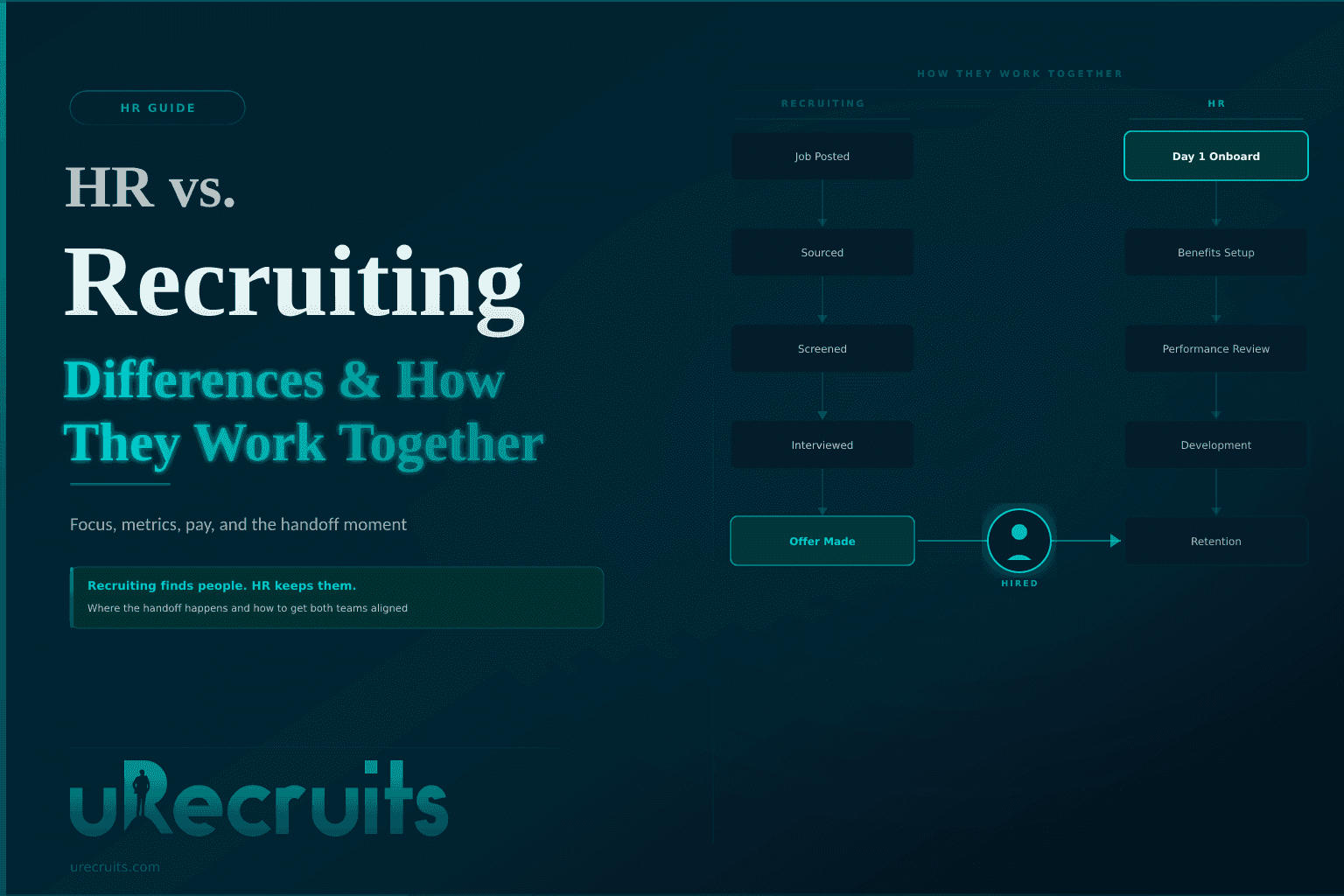
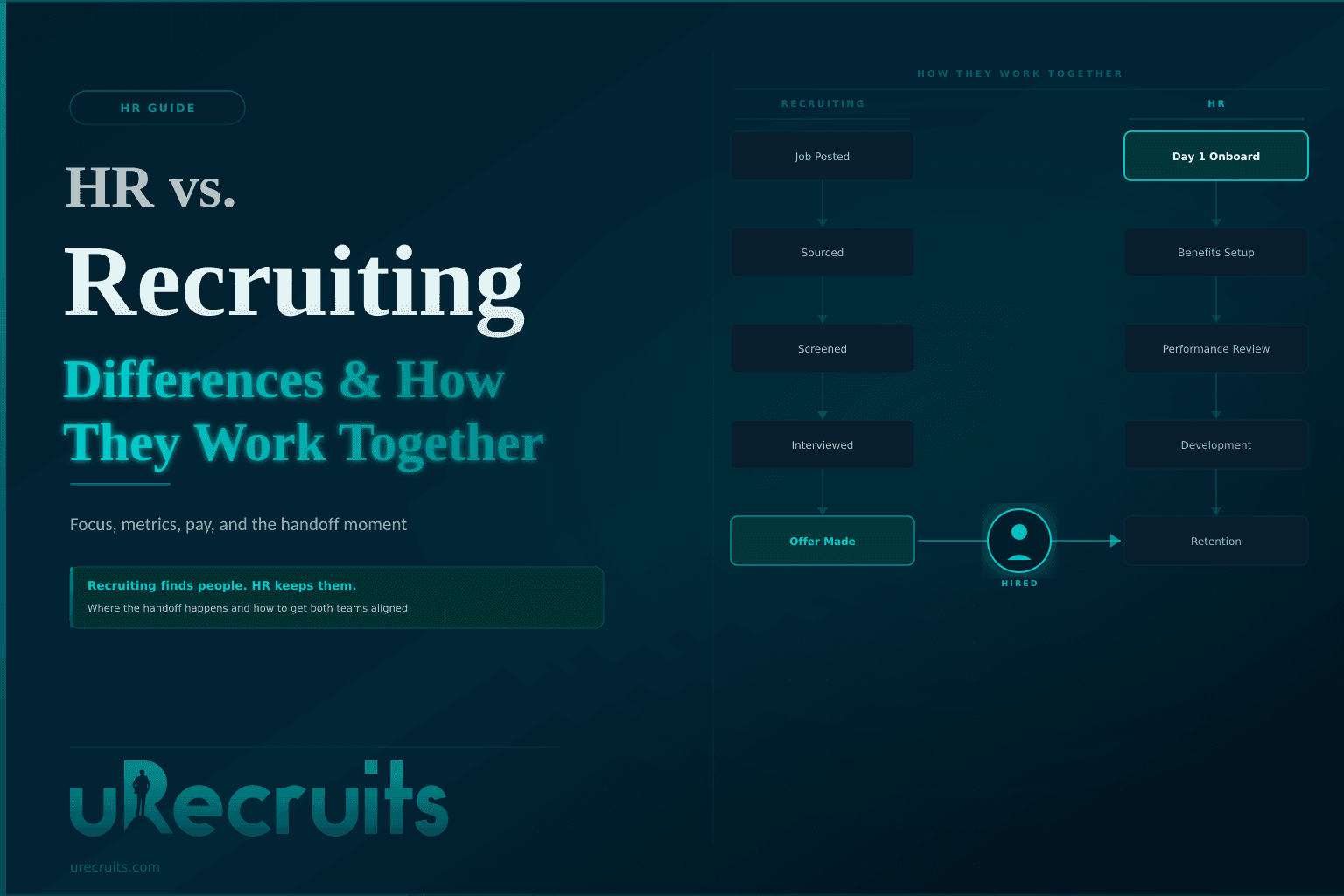
Recruiting is about finding and hiring the right people. HR is about everything that happens to those people once they're on the payroll. One fills seats, the other keeps the organization running around the people in them. Where the two meet, at the moment a candidate becomes an employee, is where a lot of hiring problems start.
This guide covers what recruiting and HR each do, whether recruiting is part of HR, how recruiter and HR roles differ, where the handoff happens, and how to get the two working as one process instead of two disconnected ones.
Is recruiting part of HR?
In most organizations, yes. Recruiting is traditionally one of the core functions of human resources, alongside compensation, benefits, training, employee relations, and employment law.
The U.S. Bureau of Labor Statistics treats it the same way. In its Occupational Outlook Handbook, recruiters are classified as a type of human resources specialist. BLS describes recruitment specialists, sometimes called recruiters or talent acquisition specialists, as the people who find, screen, and interview applicants for job openings.
That said, "part of HR" doesn't always mean "run by the HR generalist." As companies grow, recruiting often becomes its own talent acquisition team with its own leader and budget, or gets handed partly to outside agencies. It still sits under the people function, but it runs with a different rhythm, different metrics, and often different tools.
What is recruiting?
Recruiting is the process of attracting, finding, evaluating, and hiring candidates for open roles. It starts when a hiring need is identified and ends when a candidate accepts an offer.
A typical recruiting cycle covers:
- Working with hiring managers to define the role and what a strong hire looks like
- Writing and posting the job description
- Sourcing candidates who aren't applying on their own
- Screening applications and resumes
- Coordinating and running interviews
- Assessing skills against the role
- Checking references and running background screening
- Making and negotiating the offer
Recruiting is outward-facing and deadline-driven. A recruiter is measured on how quickly and how well open roles get filled, so the work is closer to a sales cycle than an administrative one. Candidates have to be found, persuaded, and closed, often while they're weighing other offers.
How recruiting supports HR outcomes
Every HR outcome starts with who gets hired. Retention, engagement, performance, and even workplace culture depend on whether recruiting brought in people who fit the role and the organization. A poor hire becomes an HR problem: a performance plan, a difficult exit, and another requisition to fill.
That's why the quality of the recruiting process matters to HR, not just its speed. It's also why so many teams struggle to prove it. SHRM's 2026 recruiting benchmarking, drawing on data from more than 4,600 organizations, found that small and extra-large organizations were slightly more likely to measure quality of hire than midsize and large ones.
What is HR?
Human resources manages the full employee lifecycle after the hire, plus the policies and systems that keep an organization running and within the law.
Core HR responsibilities usually include:
- Onboarding and orientation
- Payroll and benefits administration
- Compensation planning
- Training and development
- Performance management
- Employee relations and conflict resolution
- Policy creation and enforcement
- Following federal, state, and local employment law
- Offboarding and exits
HR is inward-facing and long-term. Where recruiting asks "who should we hire," HR asks "how do we keep, develop, and fairly manage the people we have." BLS notes that HR specialists help guide employees through HR procedures, answer questions about policy, and make sure HR functions comply with federal, state, and local regulations.
How HR drives long-term workforce outcomes
HR shapes whether people stay and grow. Fair pay structures, clear policies, useful training, and consistent performance management all affect retention, which in turn affects how often recruiting has to refill the same seats. Strong HR makes recruiting's job easier, because a company with a good reputation as an employer is easier to recruit for.
Recruitment vs. HR at a glance
| Area | Recruiting | HR |
|---|---|---|
| Main focus | Attracting and hiring candidates | Managing employees after hire |
| Timeframe | Short cycles tied to open roles | Ongoing, across the whole employee lifecycle |
| Who they serve | Candidates and hiring managers | Employees and leadership |
| Typical metrics | Time to fill, offer acceptance rate, source of hire, quality of hire | Retention, turnover, engagement, policy compliance |
| Core skills | Sourcing, persuasion, negotiation, speed | Policy, employment law, employee relations, administration |
| Typical tools | ATS, talent CRM, assessments, scheduling | HRIS, payroll, benefits, performance systems |
Where recruiting ends and HR begins
The handoff happens around the accepted offer. Recruiting's job is largely done when a candidate signs; HR's job starts with getting that person onboarded, paid, and productive.
In practice the line is blurrier. Background and drug screening, offer letters, and pre-hire compliance steps sit right on the border, and different organizations assign them to different teams. That shared territory is exactly where things get dropped: a candidate's history doesn't make it into the employee file, a compliance step gets done twice or not at all, or the new hire is asked for the same information they already gave during hiring.
The fix is to treat the handoff as one continuous record rather than a transfer between two systems. In uRecruits, Screening and Hiring covers background and drug screening through your existing consumer reporting agency and clinical-testing partners, a workflow for FCRA pre-adverse and adverse-action steps, and conditional offer letters with e-signature. Screening status changes, review actions, and rejection emails are logged with an actor and a timestamp, so anyone on your team with access can see what happened during hiring. uRecruits covers hiring through the signed offer and pre-hire screening. Onboarding, payroll, and benefits stay in your HR system.
Bridging the gap between recruiting and HR
A clean handoff usually needs three things:
- A clear owner for every border step - Decide in advance whether recruiting or HR runs background checks, offer letters, and pre-hire paperwork, and write it down.
- One source of truth for the candidate - The information gathered during hiring should travel with the person, not get re-collected on day one.
- A shared definition of success - Recruiting and HR should agree on what a good hire looks like, so both teams are optimizing for the same outcome.
Recruiter vs. HR professional
Recruiters and HR professionals often come from similar backgrounds and work side by side, but the day-to-day is different.
A recruiter spends most of their time with candidates and hiring managers: sourcing, screening, interviewing, and closing offers. The work is target-driven and fast, and success is visible in filled roles.
An HR generalist or HR manager spends most of their time with current employees and leadership: policies, pay, benefits, performance, conflict, and employment law. The work is steadier and broader, and success often shows up as problems that never happen.
BLS data shows how the roles compare on pay. Recruiters fall under the human resources specialist occupation, while HR managers are a separate, more senior occupation.
| Occupation | Median annual pay (May 2025) |
|---|---|
| Human resources specialists, including recruiters | $75,940 |
| Human resources managers | $149,280 |
Source: BLS Occupational Outlook Handbook, pages updated 27 August 2026.
BLS reports about 939,700 human resources specialist jobs in 2025, with employment projected to grow 6% from 2025 to 2035, faster than the average for all occupations, and about 73,700 openings a year on average. BLS notes that specialists with thorough knowledge of their organization may advance to become HR managers.
Should recruiting sit inside HR or on its own?
There's no single right structure. It depends on hiring volume and how specialized your roles are.
- Small organizations - One HR generalist often handles recruiting alongside everything else. That works until hiring volume rises, at which point recruiting tends to crowd out the rest of HR.
- Growing organizations - A dedicated recruiter or talent acquisition team, usually still reporting into the people function, lets HR focus on employees while recruiting focuses on pipeline.
- High-volume or specialized hiring - Many companies add outside help. BLS notes that some organizations contract recruitment and placement work to outside firms, and that employment services firms employ about 13% of human resources specialists.
Whatever the structure, workload matters. SHRM's 2026 benchmarking found that extra-large organizations saw a 67% increase in median requisitions per recruiter. When requisition loads climb like that, the handoff to HR is easy to rush.
Why silos between recruiting and HR hurt
When recruiting and HR run as separate worlds, the costs show up in a few predictable places.
- Lost candidate context - What was learned during interviews, assessments, and screening never reaches the people managing the employee.
- Duplicate work for new hires - People get asked for the same documents and details twice, which makes a poor first impression.
- Gaps in border steps - Background checks and adverse-action notices fall between teams, and nobody is sure who owns them.
- No feedback loop on quality - If HR knows which hires struggled and recruiting never hears about it, recruiting can't adjust what it looks for.
- Mismatched expectations - Recruiting promises something about the role, pay, or culture that HR then has to walk back.
The common thread is information that stops at the team boundary. Fixing it is less about reorganizing and more about sharing the same data and the same definition of a good hire.
How to get HR and recruiting working together
You don't need to merge the teams. You need them working from the same information.
- Agree on what a good hire looks like - Define it per role before recruiting starts, and have HR feed back how hires are doing at 90 days and a year.
- Map the handoff - List every step between offer and day one, assign an owner to each, and review it when something slips.
- Keep one candidate record - The history from sourcing through offer should be visible to whoever needs it next, without re-entry.
- Share the reporting - Give HR visibility into hiring progress and give recruiting visibility into retention, so both see the full picture.
- Meet regularly - A short recurring check-in between recruiting and HR catches issues before they become a pattern.
The tooling can help or get in the way. In uRecruits, the ATS and Talent CRM share the same candidate record, and Talent CRM keeps a complete, append-only history for every candidate, so information gathered while sourcing and interviewing stays on the candidate's record in uRecruits. HR Insights reports open and closed roles, shows which jobs are moving and which are stuck, and tracks time metrics across interview and offer stages, with export to your BI tools so hiring data can sit alongside the rest of your people reporting. uRecruits is built on Governed AI: AI recommends, people decide, and there are zero automated hiring decisions, so accountability for every hire stays with your team.
Recruiting and HR are two halves of the same job
Recruiting brings people in. HR helps them stay, grow, and do their best work. Neither works well alone: a great recruiting process feeding a disorganized HR function loses people fast, and a great HR team can't fix a steady stream of poor hires.
The organizations that get this right don't necessarily have bigger teams. They have a clear handoff, a shared definition of a good hire, and one record of each candidate from first contact to signed offer, handed to HR cleanly.
See your hiring and handoff in one place
If you want recruiting working from one candidate record, with hiring reports HR can see, uRecruits brings sourcing, screening, interviews, offers, and reporting into one connected workflow, with every hiring decision staying with your team. Book a demo or start a 14-day free trial, no credit card required.
Frequently asked questions
Is recruiting part of HR?
In most organizations, yes. Recruiting is one of the core functions of human resources, and the U.S. Bureau of Labor Statistics classifies recruiters as a type of human resources specialist. Larger companies often run recruiting as a separate talent acquisition team, but it usually still sits under the people function.
What is the difference between a recruiter and HR?
A recruiter focuses on finding, evaluating, and hiring candidates for open roles. HR focuses on managing employees after they're hired, including payroll, benefits, training, performance, employee relations, and employment law. Recruiting is short-cycle and outward-facing; HR is ongoing and inward-facing.
What does recruitment in HR involve?
Recruitment in HR covers defining the role with the hiring manager, writing and posting the job, sourcing and screening candidates, running interviews and assessments, checking references and backgrounds, and making the offer. It ends when a candidate accepts and the handoff to onboarding begins.
Can HR handle recruiting?
Yes, and in small organizations an HR generalist often does both. As hiring volume grows, recruiting tends to take over the HR generalist's time, which is usually the point where companies add a dedicated recruiter, a talent acquisition team, or outside agency support.
Is talent acquisition the same as recruiting?
They overlap heavily. Recruiting usually refers to filling specific open roles, while talent acquisition is often used for a broader, longer-term approach that includes employer branding, workforce planning, and building talent pools ahead of need. BLS notes that recruitment specialists are sometimes known as recruiters or talent acquisition specialists.
Who earns more, recruiters or HR managers?
HR managers typically earn more because the role is more senior. BLS reports a May 2025 median of $149,280 for human resources managers, compared with $75,940 for human resources specialists, the occupation that includes recruiters.
Where does recruiting end and HR begin?
The handoff happens around the accepted offer. Recruiting is largely done when the candidate signs, and HR takes over with onboarding. Steps like background checks and offer letters sit on the border, so it's worth deciding in advance which team owns each one.
Why do recruiting and HR need to work together?
Because hiring outcomes show up as HR outcomes. A poor hire becomes a performance or retention problem, and HR's feedback on how hires perform is what tells recruiting whether it's looking for the right people. Shared data and a shared definition of a good hire make both teams better.
Sources: U.S. Bureau of Labor Statistics, Occupational Outlook Handbook, Human Resources Specialists and Human Resources Managers (both modified 27 August 2026); SHRM, 2026 Recruiting Executives Benchmarking: Attracting Critical Talent. Checked 23 October 2026.
Subscribe Now
Get the latest hiring insights delivered to your inbox.