
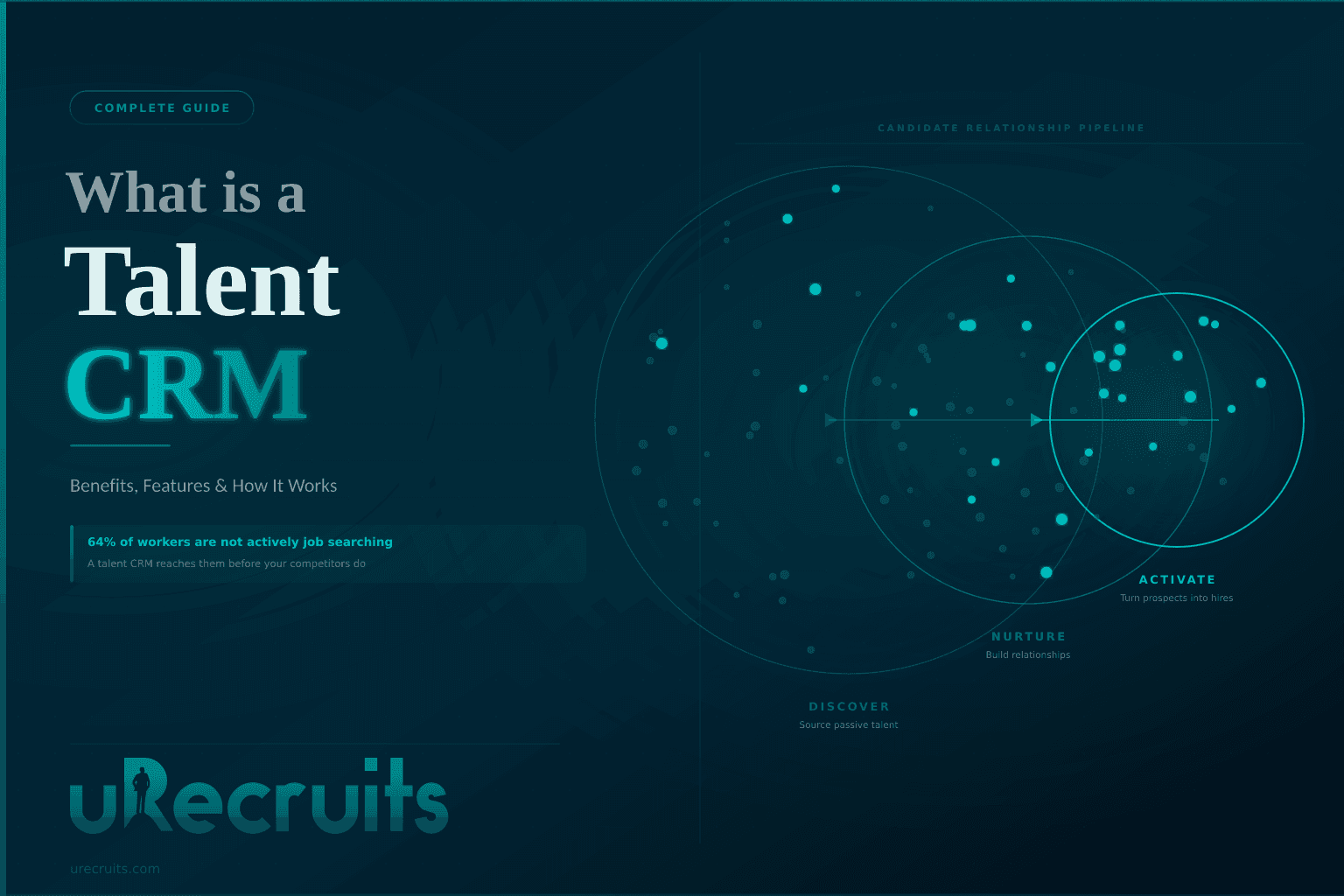
Here is a truth that changes how you should think about hiring: most of the best people for your open roles are not looking for a job right now. According to LinkedIn, only about 36 percent of workers are actively searching at any given time. The rest are heads-down at their current jobs, quietly open to the right move but never scrolling job boards. If you only talk to people who apply, you are fishing in a small pond and missing the majority of great candidates.
A talent CRM is how modern teams reach the rest. It helps you find strong people early, stay in touch, and turn them into applicants the moment a role opens. This guide explains what a talent CRM is, how it differs from an ATS, the features and benefits that matter, and how to pick the right one for your team.
What Is a Talent CRM?
A talent CRM is software that helps recruiters build and manage relationships with candidates over time, not just track the ones who apply. CRM stands for candidate relationship management, and you will hear it called by a few names: hiring CRM, recruitment CRM, recruiting CRM software, or talent acquisition CRM. They all point to the same idea.
So what is CRM in recruiting, in plain terms? It is the place where you keep every promising candidate organized, warm, and ready to activate. You source people from anywhere, group them by skill or interest, keep notes on every conversation, and nurture the relationship until the timing is right. When a job opens, you already have a pool of people who know your company and want to hear from you.
Think of it like the difference between a contact list and a relationship. A contact list stores names. A talent CRM helps you turn those names into a living pipeline that gets more valuable the longer you use it. That is why talent CRM software has moved from a nice-to-have to a core tool for teams that want to hire ahead of demand instead of scrambling every time a seat opens.
Talent CRM vs. ATS: What Is the Difference?
People mix up these two tools all the time, but they do different jobs.
An applicant tracking system (ATS) manages active hiring. It handles job applications, parses resumes, moves candidates through stages for a specific opening, and tracks things like time-to-hire. It is built around one question: who is applying for this role right now? Once a candidate is hired or rejected, the ATS is mostly done with them.
A talent CRM works at the front of the funnel, before anyone applies. It focuses on relationships. It helps you engage passive candidates, stay connected with strong people who were not the right fit last time, and grow a pipeline for roles you will need six months from now.
Most good teams use both. The talent CRM builds and warms the relationship, then hands the candidate off to the ATS when they apply. The two share one candidate record, so nothing gets lost in the handoff. In short, an ATS tracks applicants, a hiring CRM builds the pipeline that feeds it. (For the full platform picture, see our guide to what recruitment software is.)
Key Features of Talent CRM Software
Not every product includes everything, and you do not need all of it on day one. Still, the strongest recruitment CRM software tends to share a common set of features. Look for these:
- Candidate database and profiles. One organized home for every candidate, with resumes, notes, contact history, and skill tags that make searching easy.
- Sourcing and bulk import. Add candidates by hand or import them in bulk from files like CSV, JSON, or resumes, ideally with AI parsing that reads the resume for you.
- Segmentation and tags. Group your pool by category, role, location, or interest so the right people are easy to find later.
- Nurture and communication tools. Email templates, personalized outreach, and follow-ups that keep candidates warm without feeling generic.
- Pipeline stages. A clear view of where each candidate stands, from first contact to genuinely interested.
- Analytics and reporting. Insight into which sources produce your best hires and where candidates drop off.
- Integrations. Connections to email, calendars, job boards, and your ATS so data flows without double entry.
- AI matching and parsing. Smart help that surfaces good-fit candidates and pulls clean data from messy resumes.
- Security and privacy. Protection for candidate data, with access controls that keep your pool private to your company.
A quick tip: the best recruiting CRM software is the one your team actually uses. A shorter feature set you adopt fully beats a long list you ignore.
Benefits of a Talent CRM
Why do so many teams invest in a talent CRM? The payoff is practical and easy to measure.
Faster hiring. When you already have a warm pool of pre-qualified people, you skip weeks of sourcing from scratch. That speed matters. SHRM's 2026 benchmarking puts the median time to fill a nonexecutive role at about 39 days, and a ready pipeline is one of the best ways to shorten it.
Lower cost per hire. SHRM has benchmarked the average cost per hire at nearly $4,700 — and its newest data shows costs still climbing. Filling roles from your own pool cuts your reliance on expensive job ads and outside agencies, which brings that number down.
Better candidate experience. Personalized, timely communication makes people feel valued instead of processed. That impression sticks, and it shapes whether they say yes.
A stronger employer brand. Every warm, respectful touchpoint turns candidates into fans who refer others and speak well of your company, even the ones you do not hire.
Higher quality of hire. Richer candidate profiles and consistent evaluation help you pick people who perform well and stay longer.
Data you can trust. Reporting shows which channels bring your best hires, so you spend your budget where it works.
A pipeline that compounds. Every past applicant and sourced prospect becomes a long-term asset you can tap again and again. Industry benchmarks back this up: Gem's 2026 Recruiting Benchmarks Report found that 46 percent of sourced hires now come from candidates already in a company's database, up from 26 percent in 2021.
How Recruiting Teams Use a Talent CRM
A talent CRM is only as good as how you use it. Here are the most common ways teams get value from one:
- Build a talent pool before roles open. Save strong candidates you meet so you are never sourcing from zero.
- Run nurture campaigns. Keep candidates engaged with helpful, relevant messages, even when there is no open role that fits them yet.
- Re-engage past applicants. Silver-medalist candidates and past applicants are often your fastest future hires. A CRM keeps them warm.
- Source passive candidates. Since most great people are not actively looking, proactive outreach through your CRM reaches talent your job posts never will.
- Activate the pool when a job opens. With one click, move a nurtured prospect into an active applicant, so all that relationship-building turns into a real hire.
Who Uses a Talent CRM?
A talent CRM is not just for large enterprises. It fits many kinds of teams:
- Proactive recruiting teams who want relationships built before roles open, so they never start from scratch.
- High-volume and repeat hiring teams who fill the same roles often and need a warm pool ready to go.
- Staffing and recruiting agencies who keep a private, organized candidate database and move people into client roles the moment they fit.
- Talent leaders who want to turn every past applicant and sourced prospect into a long-term, searchable pipeline.
- Small and mid-sized businesses who are resource-constrained and need to work efficiently without a big team.
How to Choose the Best Talent CRM
Once you know you need one, the question becomes which one. Start with your own pain points, not a feature checklist. Here is what to weigh when comparing options for the best talent CRM for your team:
- Fit for your workflow. Match the tool to how you actually source and nurture, not the other way around.
- Integrations. Make sure it connects to your email, calendar, job boards, and your ATS so your data stays in sync.
- AI with human control. AI should help you find and organize candidates, but the sourcing and hiring decisions should stay with your recruiters, not a black box.
- Security and privacy. Your talent pool is a real asset. Look for strong data protection and access controls that keep it yours alone.
- Room to scale. Pick something that grows with you so you are not switching tools in a year.
- Onboarding and support. Good training and data migration help make the difference between a tool your team loves and one it quietly abandons.
- Pricing and packages. Most vendors offer tiered plans, sometimes per user. Check exactly what each package includes so you only pay for what you will use, and take a free trial with a real pool of candidates before you commit.
Where uRecruits Fits In
If you want an example of a modern hiring CRM done well, uRecruits is a good one to look at. Its Talent CRM is the front-of-funnel tool that keeps every promising candidate organized, nurtured, and ready to activate. The whole idea follows a simple path: discover strong candidates even when the timing is not right, nurture the relationship over time, and activate them the moment the right role opens.
What makes it click is a two-pipeline design that works as one connected journey. The Talent Pipeline is a free-form, drag-and-drop board for building relationships, with six stages you control by hand: Sourced, Contacted, Engaged, Nurturing, Interested, and Not Interested. There is no forced automation getting in your way, and a Do Not Contact status is always respected. The Hiring Pipeline is the opposite by design. It is a per-job funnel with six stages (Invited, Applied, Declined, In Progress, Hired, Rejected) that updates automatically from real events in your recruitment workflow, so you always have an accurate view without manual updates.
The bridge between the two is "Invite to Job." When a nurtured candidate reaches Interested, you invite them to a specific open role with one click. They get an email, set a password, and their account is created for them, landing them right on the job to apply. No phantom applications, no manual data entry. You can invite one candidate or bulk-invite many at once, and every invite is logged and resendable.
Building your pool is just as flexible. You can add candidates by hand or bulk import from CSV, JSON, or resume files — multiple files at once — with AI parsing that reads across 10 or more resume layouts and lets you review and confirm before anything is imported. You can organize everyone with company-specific categories and sub-categories, keep multiple resumes per candidate, and open a full five-tab profile (Summary, Resume, Notes, History, and Jobs) for complete context. Under the hood, every client gets two databases: a private client database for your own candidates, and access to the uRecruits candidate database of registered candidates — so you can search the wider network and pull people straight into your private pipeline. Every action is kept in a complete, append-only history, so relationship context is never lost.
On privacy, uRecruits is built on a secure, multi-tenant architecture. Every candidate, category, note, and pipeline is scoped to your company, with no cross-company access, secure single sign-on, and resumes stored in private encrypted storage with time-limited access links. Your talent pool stays yours alone.
One more thing worth calling out: uRecruits does not auto-reject or auto-rank candidates anywhere in the platform. Sourcing decisions stay with the recruiter. Its upcoming CRM Agent will surface match recommendations, but the final call always stays with you. Talent CRM is available on the Recruitment and Full Cycle plans. Every plan starts with a 14-day free trial, no credit card required.
FAQs About Recruitment CRM
What is a talent CRM in simple terms?
It is software that helps you build and manage relationships with candidates over time, not just track the ones who apply. You source people, keep them organized, nurture the relationship, and turn them into applicants when a role opens.
What is CRM in recruiting?
CRM stands for candidate relationship management. In recruiting, it means using a system to source, organize, and nurture candidates so you have a warm pool of talent ready before you even post a job.
What is the difference between a talent CRM and an ATS?
An ATS manages active applicants for open roles and is transactional by design. A talent CRM works before people apply, focusing on relationships and pipeline building. Most teams use both, with the CRM feeding qualified candidates into the ATS.
Is a talent CRM the same as recruitment CRM software?
Yes. Talent CRM, hiring CRM, recruitment CRM software, recruiting CRM software, and talent acquisition CRM all describe the same kind of tool. The names are used interchangeably.
What features should the best talent CRM have?
Look for a strong candidate database, easy sourcing and bulk import, segmentation and tags, nurture and communication tools, clear pipeline stages, analytics, integrations with your ATS and email, AI matching or parsing, and solid security. Focus on the features your team will actually use.
How much does talent CRM software cost?
Pricing varies by vendor and depends on features and team size. Most tools use tiered plans, often per user, and many offer a free trial. Basic tiers cover core relationship management, while higher tiers add automation, AI, and deeper integrations. Always check what each package includes.
Do talent CRMs make hiring decisions automatically?
The best ones do not. Good platforms use AI to help you find and organize candidates, but keep the sourcing and hiring decisions with your recruiters. uRecruits, for example, does not auto-reject or auto-rank anyone, and its upcoming CRM Agent will only surface recommendations while the final call stays with you.
Can small teams and agencies use a talent CRM?
Absolutely. Small teams often benefit the most because they are stretched thin and need to work efficiently. Staffing and recruiting agencies use a talent CRM to keep a private candidate database and move people into client roles quickly.
Can I import my existing candidates?
Yes. Most talent CRMs let you bulk import candidates from files like CSV, JSON, or resumes, often with AI parsing and a review step before anything is saved. Larger pools can usually be imported through an API.
Final Thoughts
Hiring has changed. The best candidates are rarely the ones refreshing job boards, and the teams that win are the ones building relationships long before a role opens. A talent CRM is what makes that possible. It turns scattered contacts into a warm, organized pipeline, shortens your time-to-hire, lowers your cost per hire, and gives every candidate a better experience along the way.
The right choice depends on your team size, your hiring volume, and how much you value keeping people in control of decisions. Start with your needs, compare packages honestly, and take a free trial with a real pool of candidates. Once you see your whole sourcing and nurturing process living in one connected system, going back to spreadsheets and lost email threads is hard to imagine.