
Good Job Descriptions Take Days. Job Agent Takes Minutes.
Job Agent removes the blank page. You give it a short brief with the role title, level, and key responsibilities, and it drafts a structured job description covering the role summary, responsibilities, qualifications, benefits framework, and a proposed salary range. You review, edit, and publish.
- Create Job
- Job Description Creation
- Job Publishing
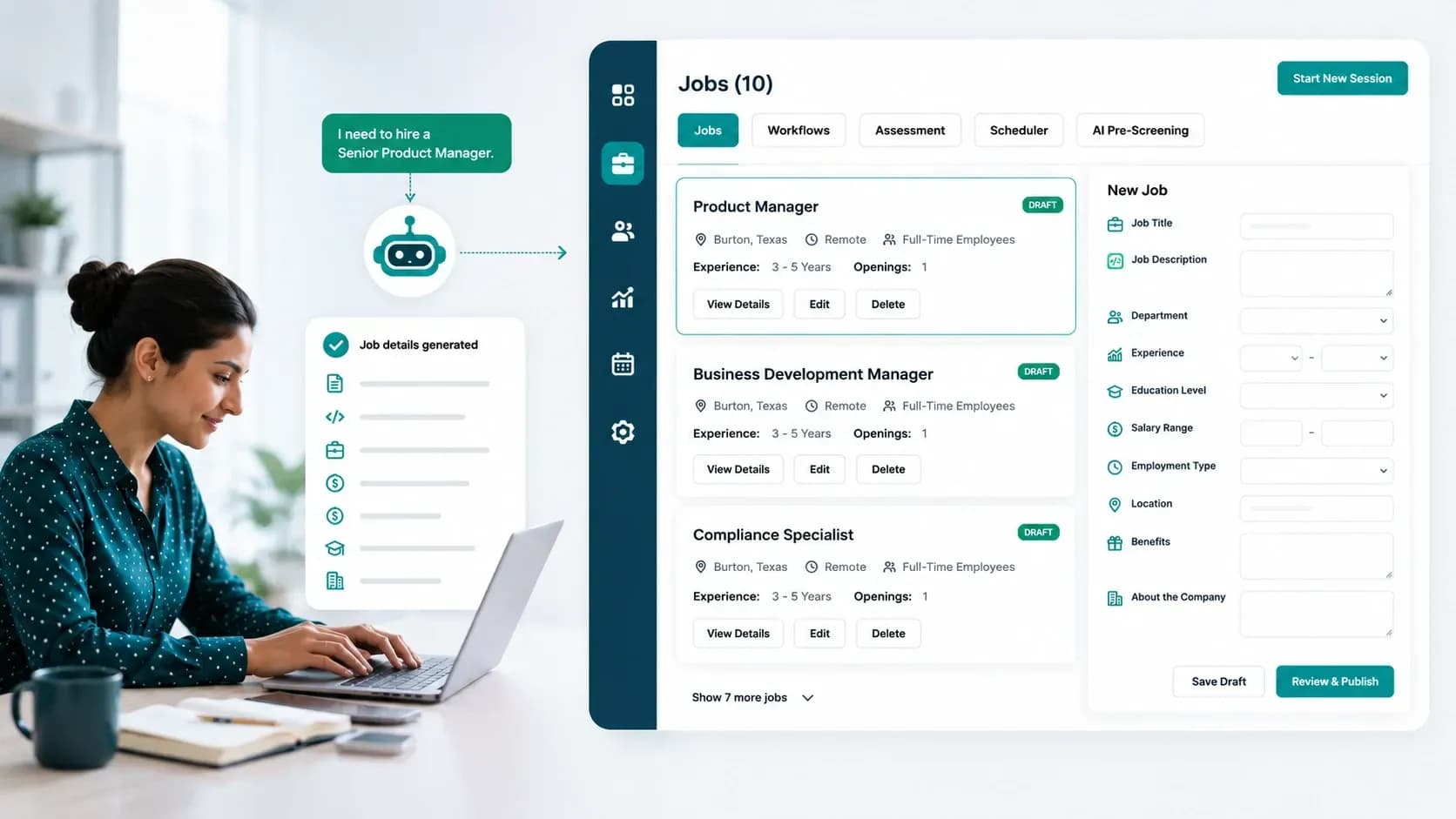
Why job descriptions turn generic or take days
The blank page problem
A new role opens and the hiring manager wants it posted today, but the recruiter is staring at a blank job description template. The cycle starts: ask the hiring manager for input, get a one-paragraph summary, ask for more detail, draft something, send for review, get edits back, revise, send again, finally publish. Two days for what should take a fraction of that. The blank page is not the only problem. Job descriptions drift toward generic phrasing like self-starter, team player, and fast-paced environment, because writing detailed, distinctive descriptions takes time recruiters do not have. Generic descriptions hurt application quality, and weak applications hurt the rest of the workflow.
Where this sits in the platform flow
Job Description Creation
Job Agent drafts from your brief
Job Publishing
Distributes the published role
ATS
Applications come back in
Position Workflow
The role's workflow takes over
Job Agent removes the blank page so the rest of the workflow starts from a stronger post.
Brief In. Structured Draft Out. Recruiter Edits. Recruiter Publishes.
You can give Job Agent as little as a role title and level, or as much detail as you want. The more you share, the closer the first draft lands.
You provide a role brief
Job Agent drafts the job description
You review and edit
You publish
You provide a role brief
Job Agent drafts the job description
You review and edit
You publish
The brief you provide
Your org's prior job descriptions where the platform has history
Role-type conventions for the title and level
Length and structure norms for effective postings
Beyond the Create Job wizard, Job Agent is available in the main uR Agent chat, where Create Job, Filter Jobs, and Show Remote Jobs commands let you draft and find roles without leaving the conversation.
What Job Agent drafts, and what it leaves to you
- Drafts
- Role summary, responsibilities, required and preferred qualifications, benefits framework, and a proposed salary range for you to confirm
- Never does
- Publish on its own, set pay without your input, invent qualifications you did not specify, or override your equal-opportunity language
Sensible defaults are pre-filled — full-time, general shift, one opening, one-month notice period — so you're never staring at an empty form. Change any of them.
About the salary range. Job Agent does propose a salary range. It is a suggestion generated from your brief, not a compensation decision. Review it against your bands before you publish, and check your pay-transparency obligations — several jurisdictions require a good-faith range in the posting. The published number is yours, not the agent's.
A Draft Is a Draft. The Recruiter Owns What Gets Published.
Job Agent's outputs are clearly framed as drafts that need review. Every word you publish is your choice. Every action Job Agent takes, from the draft it generates to the sections it regenerates, is captured in the audit log with an actor and a timestamp.
Agent drafts
Fills the job description with a role summary, responsibilities, qualifications, benefits framework, and a proposed salary range
Recruiter reviews and edits
Adjusts the tone, calibrates qualifications, adds company language, confirms or changes the salary range
Recruiter publishes
Submits when ready. Nothing goes live without approval
What stays with the recruiter
Final job description content
Compensation ranges
Qualifications, required versus preferred
Pay-transparency disclosure
Publishing decisions
Equal-opportunity language
Where care is needed
- Compensation
- The agent proposes a salary range. Treat it as a starting suggestion — check it against your bands and your pay-transparency obligations before publishing.
- Requirements
- The agent generates a skills list, an experience range, and an education level from your brief. Over-specified requirements measurably shrink and skew applicant pools, and inflated degree or experience minimums can carry disparate-impact risk under Title VII and equivalent regulations. Calibrate them deliberately.
- Language
- Job-posting language influences who applies. Review the draft for wording that would discourage qualified candidates. Final equal-opportunity language is yours, with counsel.
Audit trail
Every step is logged: the brief you provide, the draft Job Agent generates, your edits and final published version, the time between draft and publish, and any regeneration requests. This audit trail supports internal hiring-process reviews and external regulatory inquiries, including NYC Local Law 144 audit-readiness considerations.
What Teams Get From Job Agent
Draft time
Job descriptions go from brief to a publish-ready draft in minutes, not days
Hiring manager involvement
Fewer revision cycles, because the first draft captures more of what the hiring manager actually wanted
Description distinctiveness
Less generic phrasing and more role-specific detail
Workflow integration
Drafts flow directly into Job Publishing without manual copy and paste
* Customer results vary.
Included in your plan
Job Agent is included in the Recruitment Package and Full Cycle Package, operating on the Job Description Creation surface in both. Confirm tier-specific configuration depth with your account team.
Job Agent FAQs
At minimum, a role title and level. More useful is a few sentences on key responsibilities, must-have skills, location, and work mode. The more detail you provide, the better the first draft.
Not on its own. Job Agent proposes a salary range generated from your brief, clearly marked as a suggestion rather than a compensation decision. Salary ranges involve business considerations and pay-transparency requirements that you and applicable counsel handle, so you check the proposal against your bands and set the published number. Nothing goes live without your approval.
Job Agent's primary capability is drafting from a brief. Rewrite and refinement capabilities are evolving, so confirm scope with your account team.
Job Agent uses your org's prior job descriptions where available to inform tone and structure. Specific learning behavior, such as per-tenant fine-tuning, varies by configuration, so confirm with your account team.
English is the primary language in production today. Multi-language support is on the roadmap, so confirm the timeline with your account team.
DEI-aware drafting is a design consideration. Specific bias-scrubbing capabilities vary, so confirm scope with your account team. Final equal-opportunity language is your responsibility with applicable counsel.
Edit any section, regenerate any section, or discard and start over. Job Agent's outputs are starting points you shape into the final published version.
A published job description triggers the rest of the uRecruits workflow. Job Publishing distributes the role, applications come back to the ATS, and the Position Workflow configured for the role takes over.
Draft Your Next Job Description Faster
The next role you post can have a structured first draft in minutes, instead of two days of revision cycles with the hiring manager.
uRecruits provides AI-assist tools to support customer hiring operations. Customers remain responsible for the content of published job descriptions, including equal-opportunity language, pay-transparency disclosures where applicable, and compliance with jurisdiction-specific employment law.
Job Agent assists with drafting job descriptions. AI outputs may be incomplete or incorrect and require user review. Job Agent does not publish without recruiter approval.