
First-Round Screening Doesn't Scale. AI Pre-Screening Agent Makes It Async.
A role with 200 applicants does not need 200 first-round phone screens. AI Pre-Screening Agent lets every applicant answer the same role-specific questions in their own time, then produces a recommendation score with a structured rationale. You review and decide who advances. It never auto-rejects.
- Screening & Hiring · AI Pre-Screening
- Async Candidate Conversation
- Recommendation Score
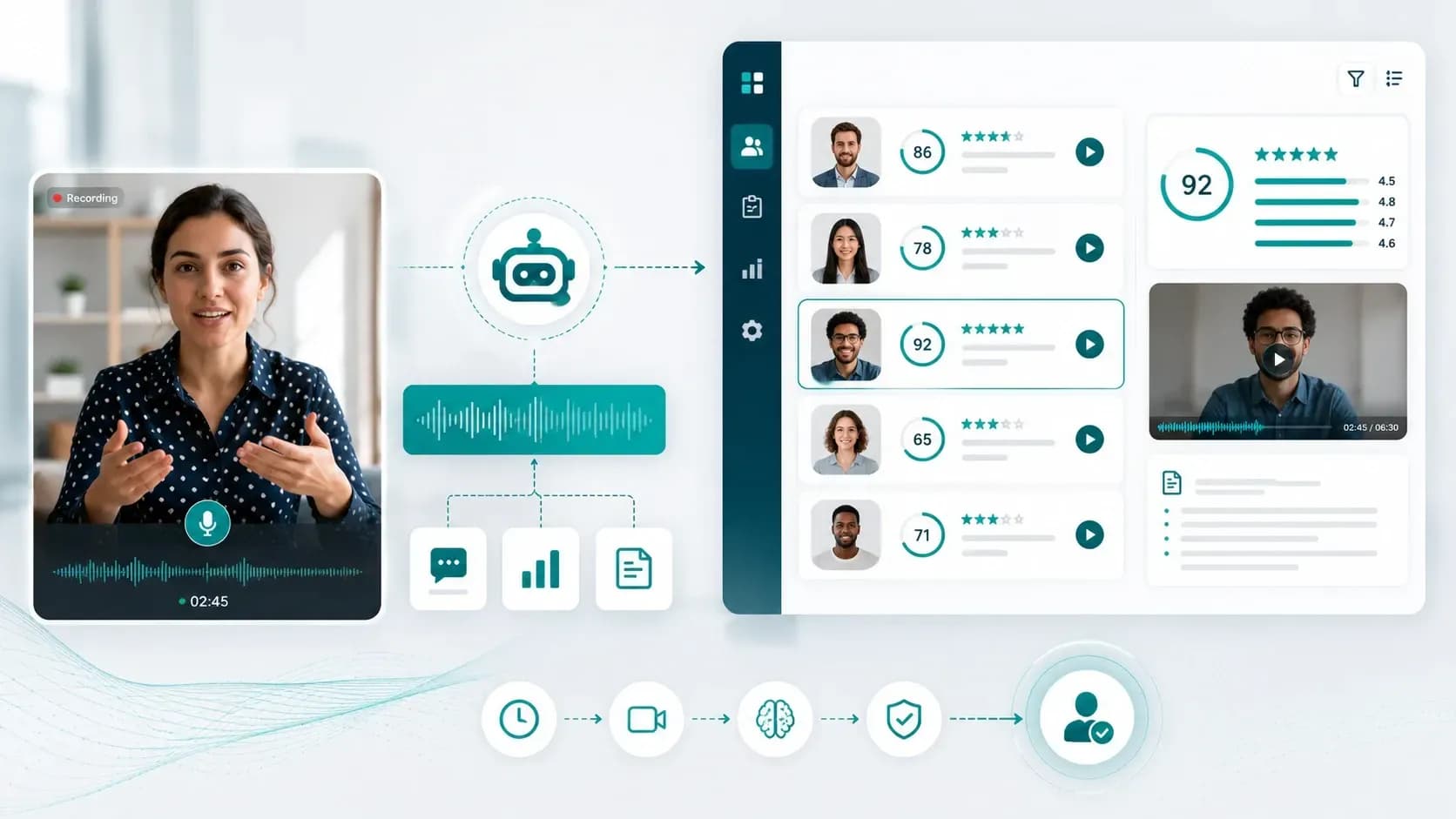
Why first-round screening does not scale
The first-round bottleneck
A role with 200 applicants does not need 200 thirty-minute first-round phone screens. What recruiters need is a way for every applicant to answer the same role-specific questions in their own time, so the next conversation starts from an informed place. That is what AI Pre-Screening Agent does. The async pre-screening conversation runs for each candidate when the Position Workflow advances them to the AI Pre-Screening round. The candidate completes it at their convenience, typically 4 to 30 questions calibrated per role, and the agent produces a recommendation score with a structured rationale. You review and decide whether to advance.
Where this sits in the platform flow
Talent CRM
Candidates sourced and nurtured
Recruitment Software
They apply to jobs
AI Pre-Screening
One of the first rounds
HR Interview
Comes after, already informed
AI Pre-Screening Agent runs the async round so recruiters walk into interviews already informed.
Async Conversation. Structured Rationale. Recruiter Decision.
The candidate completes the conversation at their convenience, typically 4 to 30 questions calibrated per role. The agent produces a recommendation score with a structured rationale, and you decide whether to advance.
Workflow advances the candidate
Candidate answers the question set
AI Pre-Screening Agent scores the responses
Structured rationale is generated
Score and rationale surface
You decide on progression
Workflow advances the candidate
Candidate answers the question set
AI Pre-Screening Agent scores the responses
Structured rationale is generated
Score and rationale surface
You decide on progression
Never auto-rejects
A best practice and a risk safeguard
What the score is, and what it is not
- What it is
- A recommendation based on the role's specific question set, one factor among many in your decision, and always paired with a structured rationale
- What it is not
- A reject or accept threshold, a hire or no-hire signal, a final assessment of the candidate, or a substitute for human judgment
This Is Where Responsible AI Matters Most. Here's How We Handle It.
AI Pre-Screening sits closer to the consequential edge of hiring AI than anything else in uRecruits, so the guardrails are explicit. The agent scores, you review, you decide.
Agent scores
Runs the async conversation and produces a recommendation score with a structured rationale
Recruiter reviews
Reads the score, the rationale, and the full transcript on the Scoreboard
Recruiter decides
Advances, rejects, requests more information, or overrides with notes. Nothing happens automatically
The principles
No auto-reject, the agent never removes a candidate from consideration
Recommendation, not verdict, the output is a recommendation with a rationale
Override always available, and every override is logged
Audit log of every AI action, with an actor and a timestamp
Transparent rationale, visible to you and on the Scoreboard
Calibration support, you tune question sets per role over time
Regulatory alignment
AI Pre-Screening Agent is built with awareness of regulations governing AI in employment decisions. uRecruits provides the AI infrastructure, the audit trail, and the recruiter-in-the-loop framing. Compliance with any specific law remains the customer's responsibility with applicable counsel.
Decimal Scale. Per-Job Calibration. Visible Rationale.
Recommendation scores are produced on a decimal scale out of ten. Higher scores line up with stronger alignment to the role's question rubric.
Score format
Low scores are highlighted on the in-product surface, for example a 1.1 out of 10 shown in red, as a prompt for you to look closer, not an instruction to reject
Per-job calibration
Each role's question set is configured per role, so a 7.5 on a senior engineering screen is not the same as a 7.5 on an entry-level support screen, and recruiters read scores in the context of the specific role
What Teams Get From AI Pre-Screening Agent
First-round interview time reduction
Recruiters skip 30-minute first-round phone screens for candidates whose responses do not merit advancement
Cohort review speed
Sorting by average score surfaces the most promising candidates for review first
Calibration over time
As scores accumulate per role, recruiters tune question sets to better separate the candidates they want to advance
Candidate experience
Candidates complete the screen on their own schedule, which usually beats coordinating a phone screen across timezones
* Customer results vary.
Included in your plan
AI Pre-Screening Agent is included in the Recruitment Package and Full Cycle Package, operating on the AI Pre-Screening surface in both.
AI Pre-Screening Agent FAQs
No. The agent produces a recommendation score with a structured rationale. You review and decide who advances. Every progression decision is yours, with a full audit trail.
The candidate receives an automated invitation when the workflow advances them to the AI Pre-Screening round. They click the link, complete the async conversation in their own time (usually 10 to 30 minutes, depending on the question count), and submit. They do not see their score, which goes to the recruiter.
Per role. Each role's AI Pre-Screening has its own question set with its own rubric, and scores are interpreted in the context of the specific role.
Candidates can request accommodation, such as extended time or an alternative format, and the request routes to the recruiter for handling. uRecruits supports the workflow, and ADA or equivalent compliance is the customer's responsibility.
Yes. Override is always available, and every override is logged with an actor, a timestamp, and optional reviewer notes.
On the candidate's Scoreboard, the cross-family score aggregation surface, and on the AI Pre-Screening surface as a per-job average score.
Local Law 144 requires annual bias audits of automated employment decision tools used in NYC hiring decisions. AI Pre-Screening Agent's no-auto-reject framing positions it as a recommendation tool. Whether your use qualifies as an AEDT, the audit cadence, and candidate notice are your responsibility with applicable counsel.
The product surface is the recruiter-facing view: how the table looks, how to configure question sets, and how to use the data day to day. This page covers the sub-agent that powers it: how the conversation works, how scores are produced, the Responsible AI specifics, and regulatory alignment. Same product, two angles.
Override patterns can inform agent calibration over time. Specific learning behavior, such as per-tenant fine-tuning, varies by configuration, so confirm with your account team.
Run an Async Pre-Screening That Actually Helps
The next role you publish can have an async AI Pre-Screening configured in minutes. Candidates complete it on their schedule, scores roll in, and you review the top of the cohort first.
uRecruits provides AI-assist tools to support customer hiring operations. Customers remain responsible for their own hiring decisions, candidate notices (including NYC Local Law 144 AEDT candidate notice where applicable), lawful basis and consent, bias-audit obligations, and jurisdiction-specific employment compliance.
AI Pre-Screening Agent assists with running async candidate conversations and producing recommendation scores. AI outputs may be incomplete or incorrect and require user review. AI Pre-Screening Agent does not auto-hire or auto-reject candidates. Every progression decision is the recruiter's.