Choose uRecruits
Why Startup Teams Choose uRecruits
Fill roles
Fill roles 40% faster to extend runway +3 months
Job Target
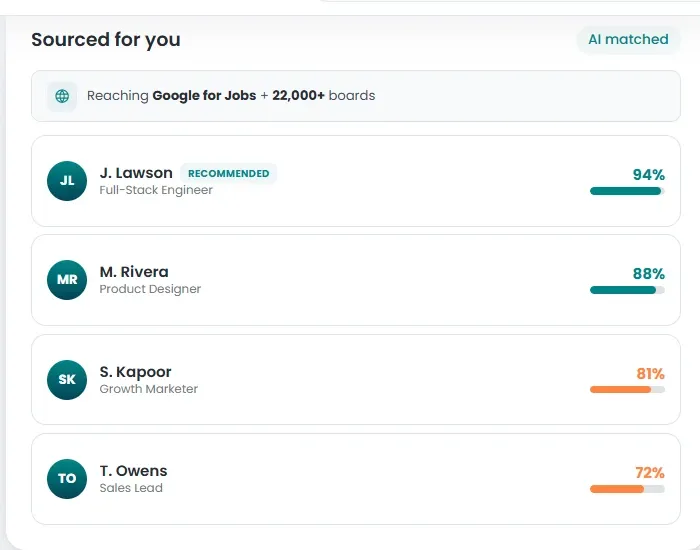
Post to 22,000+ boards in 60 seconds via JobTarget
skills assessments
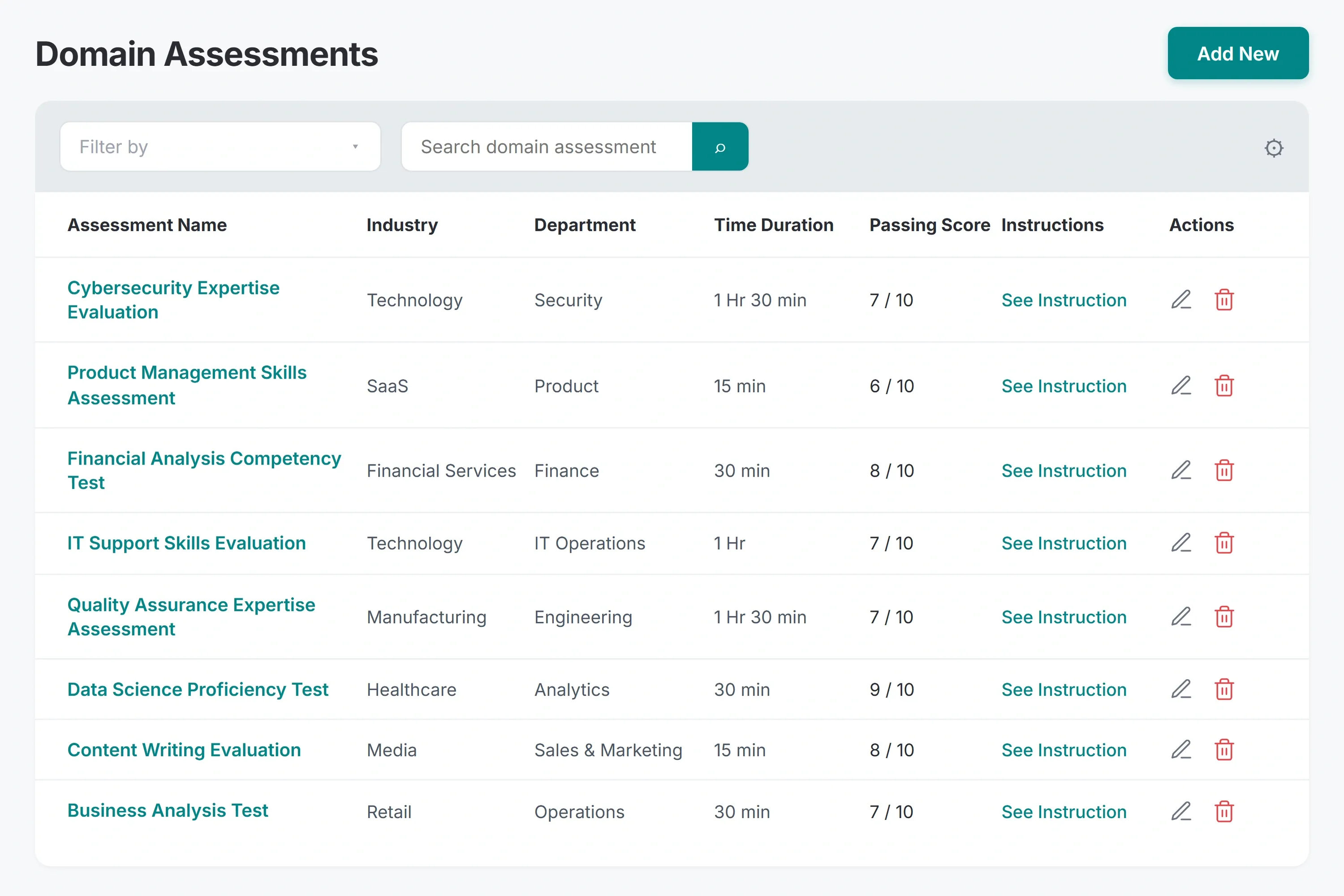
Reduce bad hires with skills assessments before offers
Build skill
Build talent pool – 30-40% roles from vetted candidates
Workflows
Scale workflows from 10 to 100 hires seamlessly
Highlights of Startup ATS Software
Best Applicant Tracking System For Startup Teams
Hire Faster Without Sacrificing Quality
When you're racing to product-market fit, every hire matters. You can't afford to spend weeks coordinating interviews or let qualified candidates slip away because your process feels disorganized. Traditional recruiting methods force founders to choose between moving fast and hiring well. Our applicant tracking system for startup companies eliminates that tradeoff by automating busy work while keeping you in control of hiring decisions that matter.
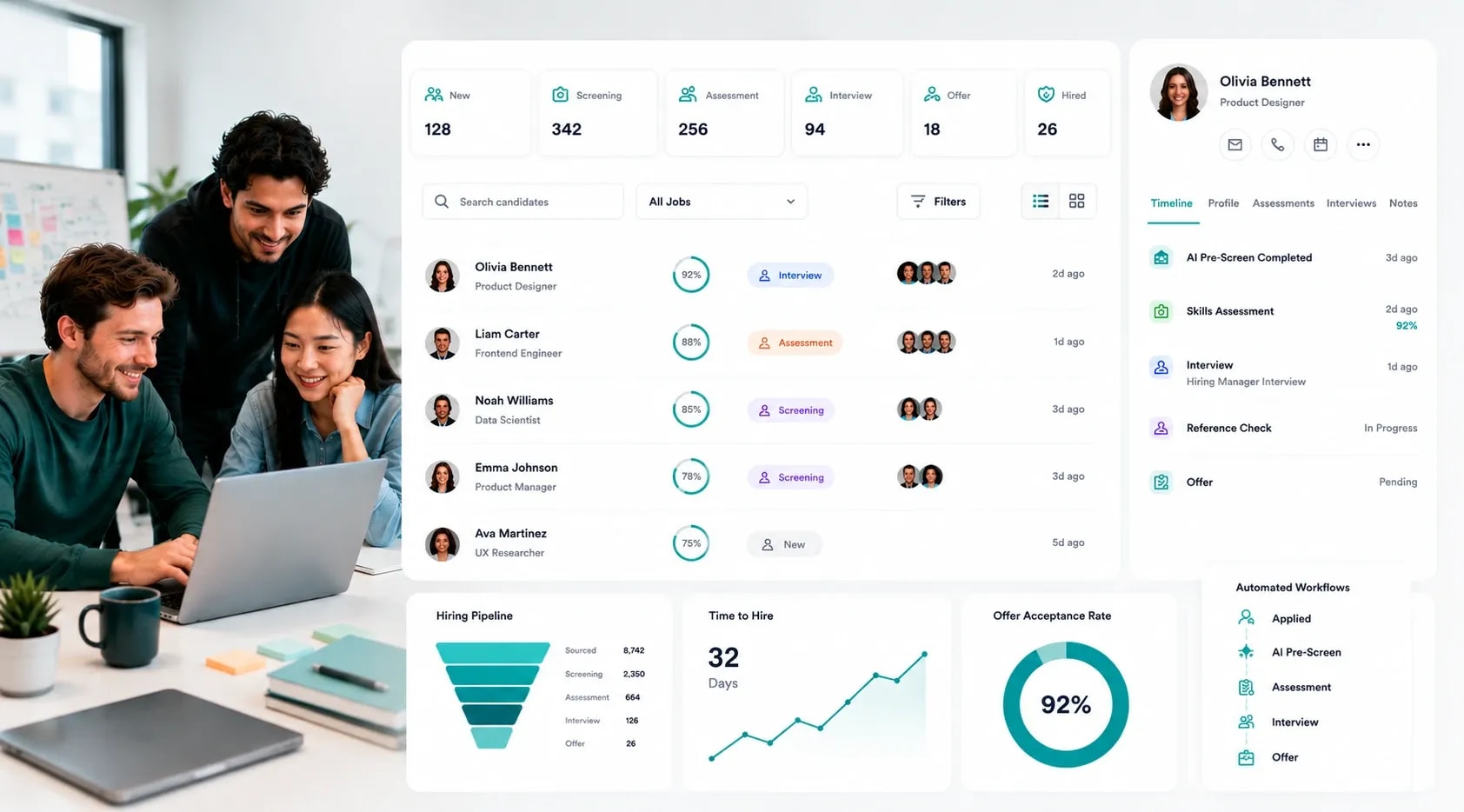
Post to 22,000+ job boards instantly through JobTarget, screen candidates with AI-assisted resume parsing and organization, and coordinate interviews with calendar integration. The best applicant tracking system for startup growth handles the recruiting logistics so you focus on finding people who'll help you scale.


How uRecruits accelerates startup hiring
uRecruits brings three layers together for startups: the ATS serves as your hiring command center where all candidates, feedback, and decisions live in one place; assessments help you verify skills and reduce costly bad hires before making offers; and AI-assisted coordination handles repetitive tasks like posting jobs and organizing resumes so founders can focus on evaluating culture fit and selling the mission.
Recruitment Tools That Build Your Employer Brand
Top talent wants to join startups with clear vision and professional operations. When your hiring process runs smoothly, candidates see an organized company worth joining. When it feels chaotic, they question everything else. Our top recruiting software for startups helps you create career pages, send polished communications, and deliver hiring experiences that make candidates excited to join your mission, even when you're competing against companies with bigger names and deeper pockets.

Key Features in Our Recruiting Software For Startups
Everything Your Startup Needs to Hire Great Teams

Multi-Board Job Posting and Distribution
Stop copying and pasting the same job description into six different websites. Our recruiting software for startups lets you create your job description in under 60 seconds using our AI Job Creation Agent, preview how it will appear across different platforms, and publish to uRecruits Job Marketplace plus free job boards like Google For Jobs and premium job boards like JobTarget simultaneously. Through JobTarget, distribute your job to 22,000+ job boards to reach qualified candidates quickly. What founders used to spend hours doing now happens in minutes with the best recruitment software for startups.

Career Pages for Startup Hiring
Candidates can browse your organization's open positions on dedicated career pages. Our recruitment software for startups provides a careers page where candidates can explore your team culture and growth trajectory. Candidates apply from their phones, upload resumes, and track application status from any device. Mobile-optimized applications reduce drop-offs and make it easy for busy professionals to apply between tasks with our applicant tracking system for startup hiring.

Resume Parsing for Faster Recruiting
When dozens or hundreds of applications flood in, manually reviewing each one burns valuable time. Our applicant tracking system for startups reads resumes automatically, extracts relevant skills and experience including certifications, qualifications, and technical abilities. The system organizes candidates based on required skills and experience, delivering prioritized shortlists automatically. Search for specific technical skills, filter by experience level, and identify candidates who align with your needs instantly with the top recruiting software for startups.

Organized Candidate Management and Structured Evaluation
Our recruiting software for startups helps you quickly identify candidates based on skills, experience, and qualifications. Standardize evaluations with structured interview feedback and objective scoring to reduce bias, improve hiring decisions, and increase retention. The best applicant tracking system for startup teams helps you identify the right fit faster.

Skills Assessments and Collaborative Hiring
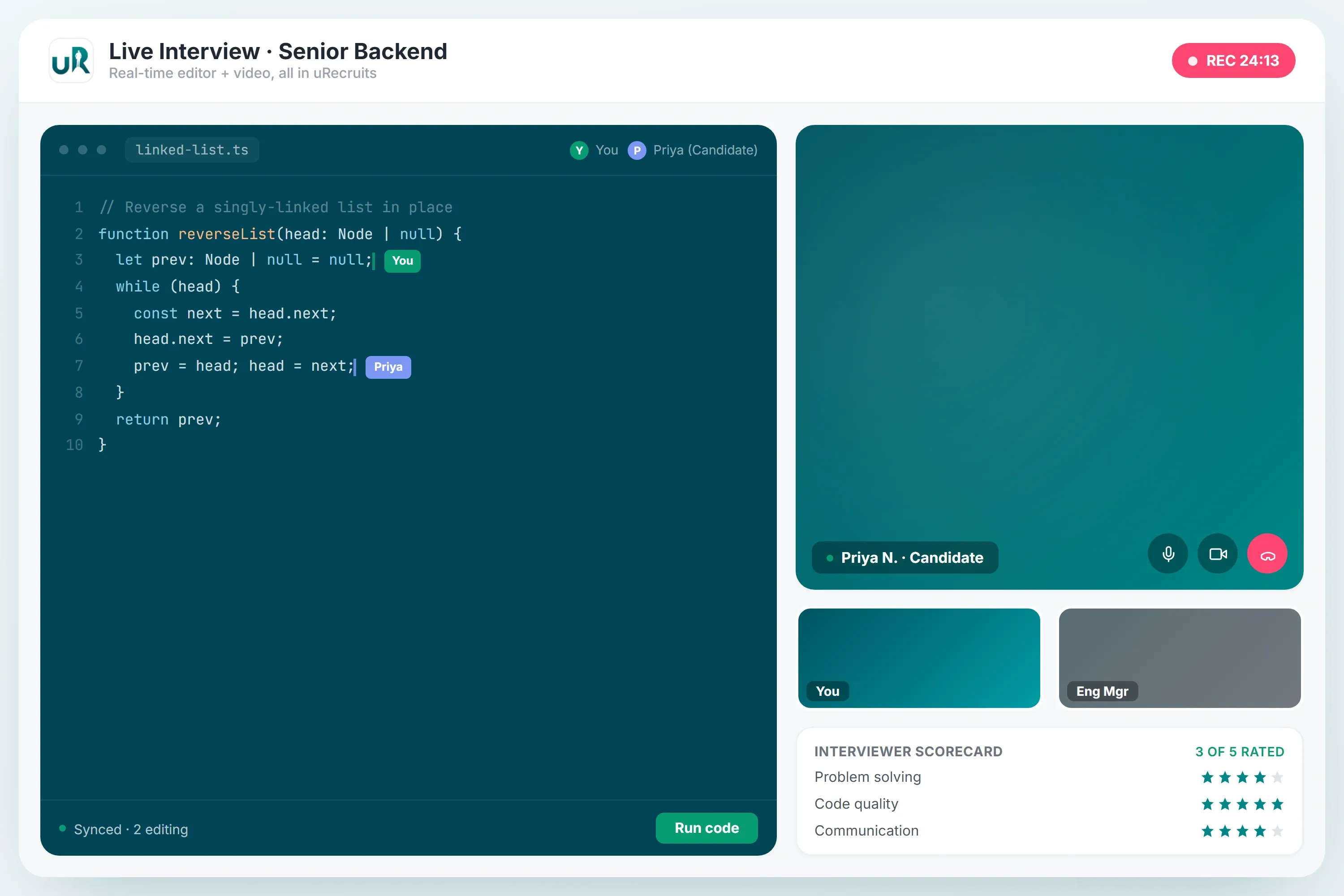
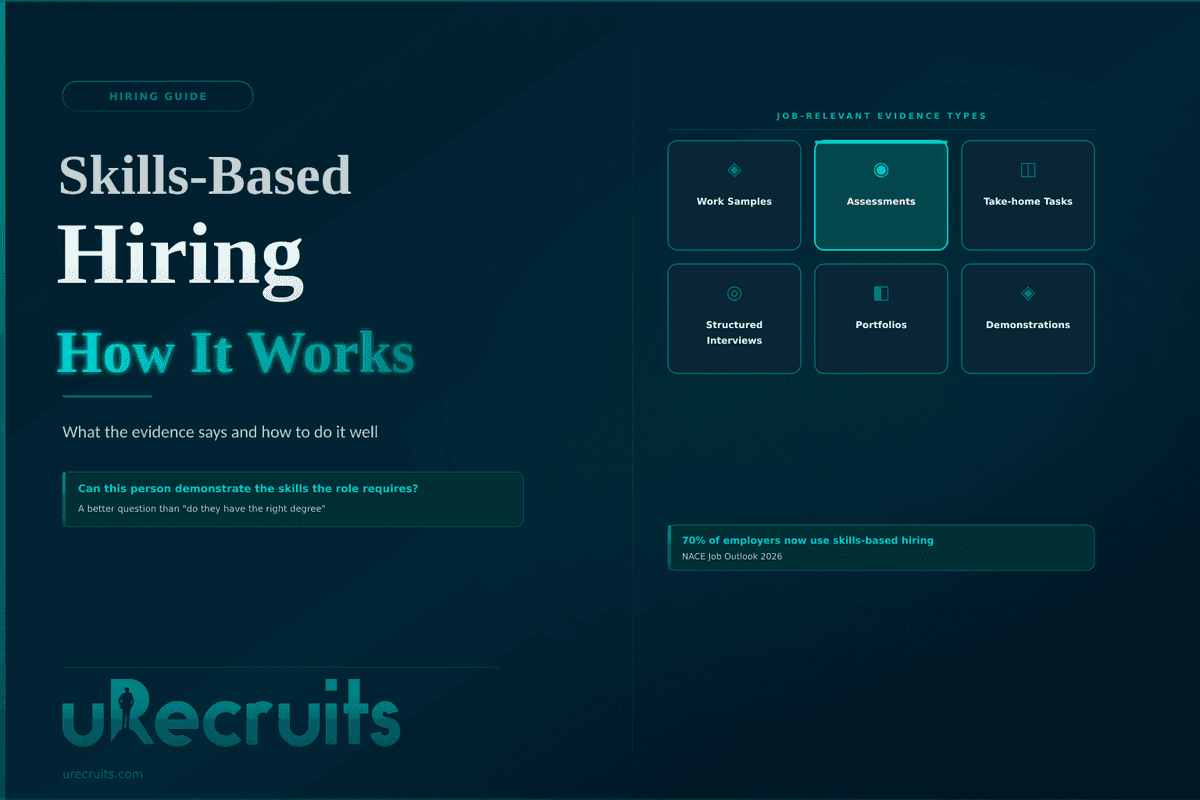
Evaluate candidates with Functional/Domain Assessments for role knowledge, Live Task Assessments for real-time problem-solving, or Take Home Assessments for independent skill verification. The platform supports multiple programming languages for technical roles, making it ideal for hiring software developers for startup teams. Our best recruitment software for startups combines assessment results with structured interview feedback to evaluate candidates consistently, reduce hiring bias, and prevent costly bad hires. For startups where every hire shapes culture and burn rate, assessments act as quality gates before you extend offers. Get input from multiple team members using evaluation scorecards, shared notes, and structured feedback forms. The top recruiting software for startups centralizes all perspectives so you make informed hiring decisions together.

Position Workflow Management
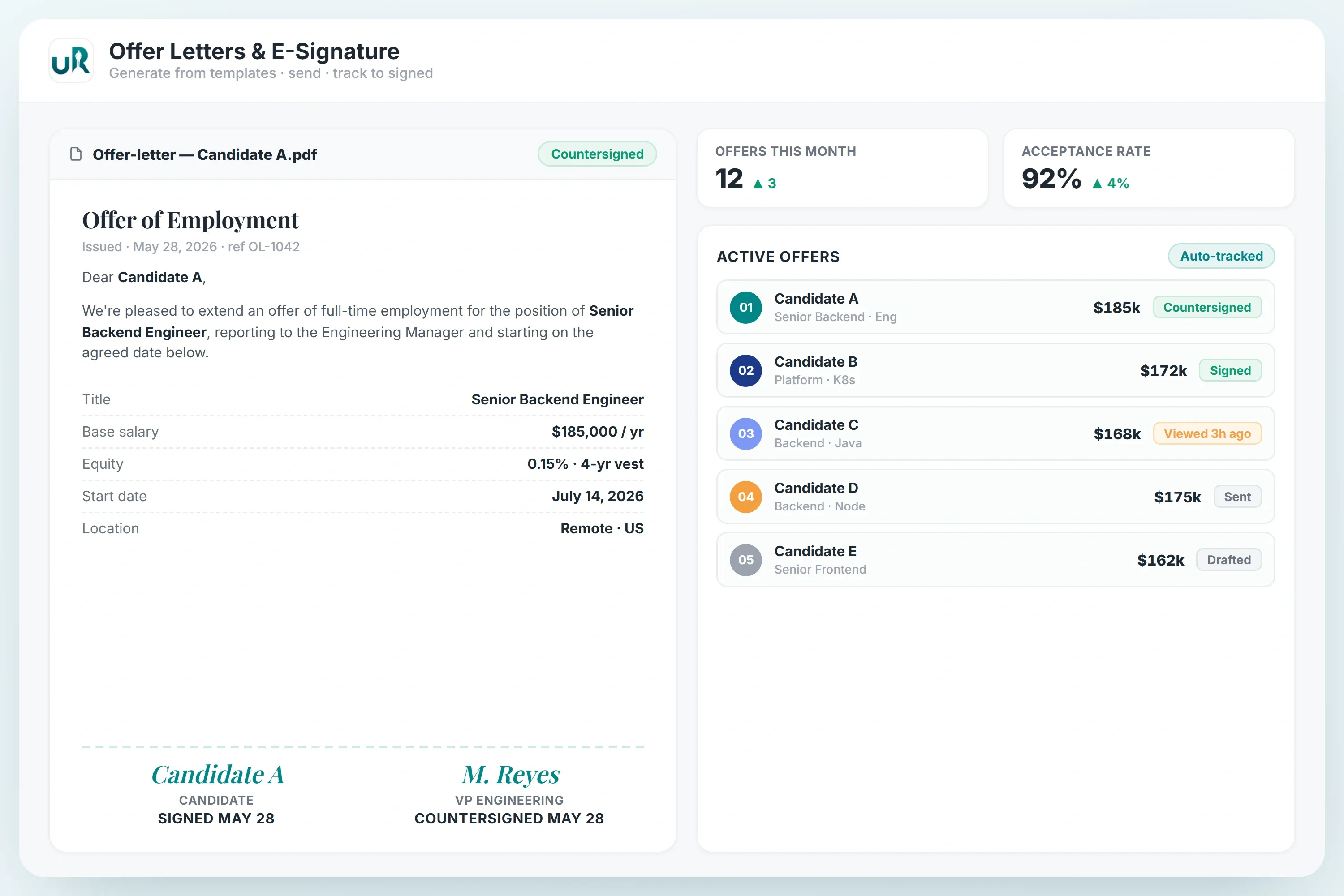
Manage candidates through structured workflows designed for startup hiring with our applicant tracking system for startup companies. Our recruiting software for startups includes HR Audio/Video Interview for initial screening, Functional/Domain Assessment for role knowledge testing, Live Task or Take Home Assessment for skills verification, Technical Audio/Video Round for deeper evaluation, Senior HR Audio/Video Round for culture fit or leadership potential, Conditional Offer Letter Generation, and Background Screening. Customize hiring stages for different roles since your engineering recruitment pipeline looks different from your sales hiring process. Move candidates with drag-and-drop functionality and track real-time status across all stages. Your ATS becomes the single system of record for hiring as you scale, so every candidate, interview stage, and team decision is organized in one place instead of scattered across Slack threads, Notion docs, and email.

Background and Drug Screening
Build position workflows that trigger background checks and drug screening at the right stages. Our applicant tracking system for startups integrates with Universal Background Screening to conduct pre-employment criminal background checks, employment and education credential verification, and drug testing. Verification steps are embedded in your workflows so checks happen at the right stages, but your team always reviews the results and decides who gets hired. The system sends status updates and logs every verification step. Results come back documented so you have a clear record of what was checked and when, ensuring every hire meets your requirements before their start date. Additional verification providers can be integrated based on your needs.

Build Your Talent Pool for Future Hiring
Not every great candidate fits your current hiring needs. Every person who applies to your company gets saved in your database with our recruiting software for startups. Tag impressive applicants for future roles and build your talent database as you grow. When you raise your next round and start aggressive hiring, search candidates you've already vetted instead of starting recruitment from scratch. Smart startups using the top recruiting software for startups fill 30% to 40% of roles from existing pipelines.

Hiring Analytics and Performance Tracking
Track hiring performance and pipeline health with built-in dashboards in our applicant tracking system for startups. Monitor job status and open positions, assessment report, interview passing rates, and offer distribution. Understand where your hiring process bogs down, and how recruitment velocity impacts growth with the best applicant tracking system for startup growth. Use data to optimize your recruiting strategy as you scale.
ATS Software Benefits For Startups Hiring at Scale
The best applicant tracking system for startup companies connects seamlessly with tools you already use for recruiting and hiring:
Outlook Email for streamlined candidate communication
Google Calendar and Outlook Calendar for automated interview coordination
Universal Background and Drug Screening for pre-employment verification
Google Jobs, uRecruits Job Marketplace, and JobTarget for instant multi-board distribution
Your hr software for startups fits into existing workflows instead of requiring your team to learn yet another disconnected recruiting tool
TRY IT FOR FREE
Ready to get started?
Create a free account in just 2 minutes
No charges require
Schedule a personalized demo
FAQs About Applicant Tracking Systems For Startups
Some questions and answers
What should startups know before purchasing an ATS?
What are the primary benefits of using recruitment software for startups?
Is recruitment software affordable for startups with limited budgets?
How can startups automate their hiring process?
How does recruiting software for startups help compete for top talent?
What factors should startups consider when choosing an ATS?
Why do startups need an ATS when they're just starting to hire?
What integrations are essential in ATS for startups?
How quickly can startups implement an ATS and start seeing results?
What ROI should startups expect from investing in recruitment software?
How does ATS software help with hiring software developers for startup teams?
Blogs

The Complete Guide to Recruitment Software: What AI Changes for Every Hiring Team
Hiring has always been hard. But the version of hard that most recruiting teams deal with today is different from what it was five years ago. Inboxes fill up with hundreds of applications for a single role. Phone screens take days to schedule. Qualified candidates drop off because the process moves too slowly. And the team responsible for fixing all of this is usually the same size it has always been. This is where recruitment software comes in and why the AI-powered version of it represents a genuine shift rather than a marginal improvement. The right platform handles the coordination work that eats recruiter time, brings in candidates across thousands of channels at once, and keeps human decision-makers fully in control at every stage that actually matters. This guide breaks down what recruitment software is, what separates the best from the average, what AI makes possible, and what to look for when evaluating your options.
What Is Recruitment Software?
Recruiting software is a platform that manages the full hiring lifecycle from job creation and publishing through applicant tracking, screening, assessments, offers, and verification. The goal is to give recruiting teams a connected, structured system so that no candidate falls through the cracks, no process step is skipped, and no hiring decision is made without the right information in front of the right person. Early versions of these tools were mostly tracking systems. They held candidate data and let recruiters move people through stages manually. What has changed is automation, intelligence, and integration. Modern online recruitment software connects job publishing, AI evaluation, scheduling, assessments, and offer generation in a single workflow. Recruiters spend less time coordinating and more time making the decisions that require human judgment. The practical difference shows up fast. According to SHRM, the average cost-per-hire in the United States is approximately $4,700, and the average time to fill an open position sits around 36 to 42 days. Both numbers reflect how much disconnected, manual recruiting processes cost organizations. A connected platform built for automation compresses both figures significantly.The Recruiting Problem Most Teams Are Still Fighting
Most recruiting teams are dealing with two distinct problems at the same time, and the combination is what makes hiring feel impossible to keep up with. The first problem is candidate supply. Teams post to one or two job boards and wonder why the applicant pool is thin or unqualified. The channels being used simply do not reach enough people. The second problem is time. Even when qualified candidates do apply, the coordination work of screening, scheduling, and evaluating them takes more hours than the team has. Candidates go cold. Offers get delayed. Good people take other jobs. A LinkedIn analysis of global talent acquisition trends found that finding enough qualified candidates consistently ranks as the top challenge for talent acquisition professionals worldwide. The answer, increasingly, is not to hire more recruiters. It is to make the existing team dramatically more efficient through better tooling. This is the problem that AI recruiting software is built to solve on both fronts simultaneously.What AI Recruitment Software Actually Does Differently
The term AI recruitment software gets used loosely. In practice, the platforms that deliver real efficiency gains do specific things that manual or semi-automated systems cannot. Here is what distinguishes genuine AI powered recruiting software from tools that simply added an AI label to existing features.Resume Parsing and Candidate Matching at Scale
When 300 applications arrive after a job post goes live, a recruiter cannot realistically read every resume before shortlisting. AI-powered parsing extracts skills, calculates experience, verifies education, and generates a match score against the role requirements automatically. Every incoming resume gets evaluated against the same criteria. Recruiters review ranked candidates rather than raw stacks of applications. uRecruits handles this at the parsing stage. Every incoming resume is parsed against role requirements with skills extracted, experience calculated, education verified, and a match score generated. A manual review flag surfaces when AI confidence is low so recruiters know exactly where to look closer.AI Pre-Screening: Video Interviews Without Recruiter Time
This is one of the most significant capabilities in top-tier AI powered recruitment software. Instead of recruiters spending three days on 30-minute phone screens, an AI conducts structured video interviews with every applicant simultaneously. It asks identical questions to every candidate, listens, scores each answer, and returns a complete result to the recruiter for review. The operational change is significant. A recruiter who previously spent 15 hours on phone screens can instead review 50 AI pre-screening scores in 20 minutes and move directly to interviewing only the candidates who have already demonstrated they can articulate the role. Same team. Better use of expertise. Faster decisions. uRecruits includes native AI Pre-Screening in its Full Cycle plans as a stage within the Screening and Hiring capability. The AI conducts the interview. The HR team or recruiter reviews the result and decides who advances.Scheduling Automation Without Back-and-Forth
Interview scheduling is coordination work, not hiring judgment. AI handles it better and faster. A Scheduler Agent sends booking links, confirms calendar availability, resolves conflicts, and gets interviews booked from a single command. No back-and-forth email chains. No missed replies. No scheduling gaps.Consistent, EEOC-Auditable Evaluation
One of the compliance risks in informal hiring processes is inconsistency: different interviewers using different criteria, different questions, different scoring standards for the same role. SHRM and employment law experts consistently recommend structured interviews and documented evaluation criteria as best practice for both quality of hire and EEOC compliance. AI pre-screening asks identical questions to every candidate. Structured scorecards apply the same criteria to every interviewer at every stage. Every AI output and recruiter decision is logged in an auditable record.7 Core Hiring Capabilities to Look for in Top Recruiting Software
When evaluating best recruiting software options, look beyond the feature list and ask whether the capabilities are actually connected. Disconnected tools create the same coordination gaps they claim to solve. Here are the seven hiring capabilities that matter most in a full-cycle platform.- Job Description Creation: A wizard or AI agent that gets a role from a sentence to a published, structured job description in under 60 seconds, connected to a Position Workflow before it goes live. uRecruits offers a 7-step wizard and uR Agent™ for this.
- Applicant Tracking System (ATS): A structured pipeline connected to the job's workflow. One profile per candidate with parsed resume, match score, AI pre-screening result, assessments, scorecards, and all decisions on one screen.
- Job Publishing: Reach matters. One publish action that goes to Google Jobs plus 22,000+ boards via JobTarget means more qualified applicants without extra steps per board. uRecruits handles this in a single publish action.
- Resume Parsing: Automatic parsing against role requirements on every incoming application. AI extracts skills, calculates experience, verifies education, and generates a match score.
- Candidate Matching: Ranked shortlists based on match scores so recruiters review the strongest applicants first rather than working through every resume in submission order.
- Scoring and Structured Evaluation: Same criteria, same scale, every candidate, every interviewer, every stage. Gated advancement means a recruiter always confirms before the pipeline moves.
- Screening and Hiring Suite: AI Pre-Screening, Interviews, Assessments, Offers, Background Screening, and Drug Screening connected in a single workflow. Every stage automated on trigger. Recruiter reviews and advances. In uRecruits, all six of these are part of the Screening and Hiring capability.
Platform Capabilities: The Infrastructure That Connects Everything
Beyond the hiring-specific capabilities, the best hr recruitment software includes platform-level infrastructure that runs across every stage. In uRecruits, five platform capabilities support every hiring workflow.- Connected Hiring Workflow: The Position Workflow engine that is required before any job publishes. Every stage is defined, structured, and enforced at the platform level. No role goes live without a hiring process attached.
- Integrations: Google Jobs, JobTarget, Auth0 for identity and access, background and drug screening connections, and a REST API. HRIS integrations are in development.
- uR Agent™: An AI console with five live agents: Job Agent, Workflow Agent, Assessment Agent, Scheduler Agent, and Pre-Screening Agent. Every action is proposed and waits for HR/Recruiter confirmation before executing. An Analytics Agent is on the roadmap.
- Analytics: Pipeline analytics, hiring velocity, stage conversion rates, time-to-fill, and recruiter performance across all roles and capabilities.
- Knowledge Base and Support: Platform documentation, onboarding guides, feature walkthroughs, and support for HR teams and recruiters across all capabilities.
Why the Best AI Recruiting Software Keeps Humans in the Loop
One of the most important questions to ask any automated recruiting software vendor is this: what does the AI do autonomously, and what requires a human decision? The concern with fully autonomous AI in hiring is real. Inconsistent or biased outputs can go undetected without human review. Decisions that affect people's careers carry ethical weight that a score alone cannot capture. And regulatory frameworks around employment decisions require documentation and accountability. According to Forbes, the organizations seeing the strongest results from AI in HR are those that use it to augment human decision-making rather than replace it. The AI handles the volume. The human handles the judgment. uRecruits HR/Recruiter-In-Loop Architecture: At every key AI output, including pre-screening results, match scores, and Scheduler Agent proposals, the HR team reviews and confirms before the pipeline advances. Every AI evaluation is an input to a human decision, never a replacement for one. uR Agent™ proposes every action and waits for confirmation. No AI action executes without recruiter awareness and approval. This distinction matters practically too. Responsible AI principles that are built into the architecture, rather than offered as an opt-in setting, mean that compliance is structural. Every AI output and every recruiter decision is logged in an auditable record. EEOC-compliant structured evaluation is enforced, not aspirational.Cloud Recruitment Software: Hire From Anywhere, On Any Device
Modern hiring teams are not always at a desk. Recruiters review candidates between calls. Hiring managers approve offers from their phones. HR operations teams need pipeline visibility without logging into a desktop application. Genuine cloud recruitment software makes every feature available on web and mobile, not a subset of features with a "full access requires desktop" caveat buried in the fine print. uRecruits runs on AWS cloud infrastructure with data encrypted at rest and in transit. Every capability, including reviewing AI pre-screening results, advancing candidates, approving offer letters, and using uR Agent™ to issue workflow commands, is accessible on web and mobile. No capability is desktop-only. The infrastructure scales automatically with hiring volume. A team hiring two roles and a team hiring two hundred roles use the same platform without performance differences or per-seat constraints that make scaling painful.Who Benefits Most From AI Powered Recruiting Software?
HR Teams and People Operations
For in-house HR recruiting software users, the core value is standardization across every role and every hiring manager. The same workflow, the same AI-assisted evaluation, the same consistent process for every candidate. Compliance and fairness become structural rather than something HR has to police after the fact. Every stage is visible, reviewable, and auditable.Staffing and Recruiting Agencies
Agencies running multiple client pipelines simultaneously need inbound reach and coordination efficiency at the same time. 22,000+ job boards in one publish solves the reach problem. The Scheduler Agent handles coordination across simultaneous pipelines. Recruiters generate more output per person without adding headcount.Small and Mid-Sized Businesses Without a Dedicated HR Team
The best recruiting software for small businesses gives any hiring manager the same infrastructure that large enterprise teams use, without requiring implementation projects or dedicated HR staff. A 7-step wizard and an AI agent console let any team create a role, publish it to thousands of boards, and run a structured pipeline from application to offer. uRecruits starts at $39/month with no feature gating and a 30-day free trial with no credit card and no auto-charge at trial end.How to Evaluate and Choose the Best Recruitment Software
The best ai recruiting software for your team depends on what your current bottlenecks actually are. But there are evaluation questions worth asking every vendor regardless of company size or team structure.- Is pricing published without a demo? Many enterprise platforms require a sales conversation before disclosing pricing. Transparent pricing upfront is a signal of a platform built for self-service evaluation. uRecruits publishes pricing from $39/month at urecruits.com/pricing.
- Does it work fully on web and mobile? Ask specifically whether all features are available on mobile or only a subset. Test it before committing.
- Is AI Pre-Screening native? Some platforms partner with third-party video interview tools. Native AI Pre-Screening, where the AI conducts the interview and the result surfaces directly on the ATS profile, is a different capability.
- Are assessments built in? Assessments that require a third-party integration add cost and create another coordination gap. Full Cycle plans in uRecruits include coding, take-home, domain, and functional assessments natively.
- Is workflow required before publish? A platform that enforces a defined hiring process before any job goes live is structurally different from one where workflow is optional. uRecruits requires a Position Workflow to be attached before any role publishes, enforced at the platform level.
- Is there a free trial with no auto-charge? A 30-day trial with no credit card and no auto-charge at trial end lets you evaluate the platform without financial commitment. uRecruits offers this on all plans.
- What does the AI actually do autonomously vs. what requires human confirmation? This is the most important question. Understand the boundary before you commit.
FAQs About Recruitment Software
What is the difference between AI recruiting software and a standard ATS?
A standard ATS stores applicant data and tracks candidates through stages. AI powered recruitment software automates the work between stages. AI parses resumes, generates match scores, conducts pre-screening video interviews, schedules interviews, and handles coordination. The recruiter sees a parsed profile with a ranked score and a complete pre-screening result and decides who advances. The ATS is one component. The AI coordination layer is what makes it automated recruiting software rather than just a tracking tool.How many job boards does modern recruitment software post to?
It depends on the platform and the integrations it uses. uRecruits publishes to 22,000+ job boards in one publish action via JobTarget, plus the uRecruits Job Marketplace. Google Jobs is automatic on every role published through the platform with no additional steps required. This gives every role organic visibility in Google Search alongside broad board distribution.What does HR/Recruiter-In-Loop mean in AI recruitment software?
HR/Recruiter-In-Loop means the HR team or recruiter is actively involved in the decision at every key AI stage. Every AI output is reviewed and confirmed before the pipeline advances. HR/Recruiter-On-Loop means full oversight of every automated action: visible, reviewable, and reversible. In uRecruits, both apply across all AI capabilities. AI always acts as an input to a human decision, never a replacement for one.What is the best recruitment software for small businesses?
The best recruitment software for small businesses provides professional hiring infrastructure without requiring a dedicated HR team or a complex implementation. uRecruits starts at $39/month with no feature gating, a 7-step job creation wizard, uR Agent™ for plain language workflow commands, 22,000+ board publishing, and AI Pre-Screening on Full Cycle plans. A 30-day free trial with no credit card and no auto-charge at trial end means you can evaluate the full platform before committing.Is online recruitment software secure and compliant?
The best online recruiting software runs on enterprise-grade infrastructure with data encrypted at rest and in transit, SSO and MFA via an identity provider like Auth0, role-based access control, and audit logs for every AI output and every recruiter decision. uRecruits runs on AWS cloud infrastructure and uses Auth0 for identity and access management. Responsible AI principles are built into the architecture. Every AI output is EEOC-auditable by design.The Bottom Line on AI Recruitment Software
The gap between teams using genuinely connected ai recruiting software and teams still stitching together disconnected point solutions is growing. The former processes more candidates, makes decisions faster, maintains better compliance records, and gives recruiters time back for the work that requires human judgment. The best platforms solve both problems that recruiting teams face simultaneously: more qualified candidates in the pipeline and more efficiency in managing them once they arrive. That combination, built on a connected workflow with AI doing the coordination and HR/Recruiter making the decisions, is what top recruitment software actually delivers. If you are evaluating options, uRecruits offers every hiring team, from SMBs to staffing agencies to enterprise HR operations, a complete, connected platform starting at $39/month with a 30-day free trial, no credit card required, and no auto-charge at trial end. All 12 capability areas. Every feature on web and mobile. HR/Recruiter always in the loop. Ready to see how AI recruitment software changes what your team can do? Start a free 30-day trial at urecruits.com or Book a Demo
Written by
Thomas Alexander
Admin

How AI Candidate Pre-Screening Is Transforming First-Round Hiring
I spend my days talking to recruiters. Not about technology, but about their actual problems. The conversation almost always starts the same way. A recruiter is managing eight open roles. They have 40 applicants sitting in one position alone. Their calendar is blocked with phone screens, back to back, 20 minutes each, and by Thursday they can't remember what the Tuesday candidates actually said. By Friday, they're behind on two other roles because the screening didn't leave room for anything else. This isn't a productivity problem. It's a structural one. The phone screen is the very first human touchpoint in most hiring processes. It is also the most inconsistent, the most time-consuming, and the least documented step in the entire workflow. And it tends to be where the most correctable mistakes happen. We built AI Pre-Screening inside uRecruits to fix that structure. Not to take humans out of hiring, but to give them back the part of the job that actually requires human judgment: deciding who moves forward.
The Structural Problem Nobody Talks About
When I ask recruiters what frustrates them most about first-round screening, they don't complain about candidates. They complain about the setup they've inherited. Traditional candidate pre-screening relies entirely on the recruiter's capacity in the moment. A candidate who calls at 9am on a Monday gets a different version of the screen than someone who calls at 4pm on Friday. Most recruiters know their phone screens aren't fully consistent. They start with a script, then drift. The recruiter knows this, it bothers them, and they just don't have a fix. Beyond inconsistency, the documentation problem is just as real. Phone screen notes end up scattered across notebooks, email drafts, sticky notes, and personal Notion docs. The hiring manager asks about a candidate from two weeks ago and the recruiter has to dig through four places to find anything useful. The ATS has the application. The actual screen result lives somewhere else entirely. Then there's the compounding issue. According to SHRM, 48% of HR managers admit that unconscious biases affect the candidates they ultimately hire. Phone screens conducted under varied conditions, at different energy levels, with inconsistent questions are not a system designed for objectivity. They are a system that makes bias harder to avoid, not easier. The solution isn't to ask recruiters to be more disciplined. The solution is to change the structure.What Pre-Screening Candidates Actually Looks Like Today
Let me be specific about what the old model costs recruiting teams. Traditional resume screening alone consumes an average of 23 hours per hire. That's before a single conversation happens. Add phone screens for a role with 40 applicants, and a recruiter can easily lose half their week to top-of-funnel evaluation before any real hiring work begins. Volume makes this worse every year. Applications have surged more than 45% year over year across major platforms. The workload of pre-screening candidates grows linearly with pipeline size, but recruiter capacity doesn't. The recruiter who sources well creates their own bottleneck. Even when notes exist after those calls, they're not structured. Comparing two candidates means reading through paragraphs of impressions formed at different times, under different conditions, in different moods. There's no fair comparison happening, just a patchwork of gut feelings documented unevenly. These aren't complaints about effort. The recruiters I work with are working hard. The structure is failing them.How AI Candidate Pre-Screening Works Inside uRecruits
When a candidate reaches the AI Pre-Screening stage in uRecruits, they receive a unique invite link and complete a structured interview session covering audio, video, text, and multiple-choice questions entirely on their own schedule. The recruiter doesn't attend it. They don't schedule it. They don't take notes during it.Setting Up the Session
The recruiter configures the session in advance. They choose a question preset: Balanced, Technical Heavy, Culture Fit, All MCQ, All Audio/Video, or Custom. They set category weights across Domain/Technical, Behavioral, Job-Fit, and Situational dimensions, then choose up to 40 questions and click Generate Questions with AI. The platform builds the full question set directly from the job description, job title, and required skills. The recruiter reviews the generated questions, edits anything that doesn't fit, sets the session duration and expiry window, and publishes. That's the extent of their involvement at this stage. The session goes live and the recruiter moves on to sourcing, follow-up, or hiring manager prep. Questions are generated using advanced AI models including GPT-4o, so the output is role-specific and meaningfully varied rather than pulling from a generic question bank applied to every position.What Candidates Go Through
Candidates access the interview through a secure link with no login required. Before starting, there's a simple device readiness check. Once inside, an AI voice guides them through questions using natural-sounding audio, with clear on-screen instructions and timers throughout. The experience supports multiple response formats: video for behavioral and communication assessment, audio for verbal fluency evaluation, text for written clarity, and multiple-choice for objective competency checks. Candidates can complete sessions on their own schedule, which removes the coordination overhead that slows down traditional phone screens. Session integrity is monitored automatically. Tab switching gets flagged. Multiple people in frame gets detected. Copy-paste attempts are tracked. A session integrity report is generated alongside the scored results, giving recruiters full visibility into how candidates engaged throughout the process.What Shows Up in the Results Dashboard
When candidates complete their sessions, every response is scored automatically. Audio answers are transcribed and evaluated. Video responses are assessed. MCQ answers are marked against correct responses. Each candidate receives a composite score out of 10, per-question AI feedback, response time data, fluency metrics for audio answers, and the full session integrity report. The recruiter opens the results dashboard and sees every candidate ranked. They click into any profile and read the full AI Summary covering what was strong, what was missing, what the candidate could improve on, and a recommendation to advance or hold. Then the recruiter decides. The platform also includes a Candidate Compare screen, so recruiters can place two or more candidates side by side for direct evaluation before finalizing the shortlist.The Part That Actually Matters: Recruiter Authority
I want to be straightforward about something that comes up in nearly every customer conversation. The AI recommendation does not decide anything. It is one input, a structured, consistent, documented input, that the recruiter reviews alongside the score, the per-question breakdown, the candidate's resume, and their own judgment. The recruiter advances or rejects. Nothing happens automatically. This matters for two reasons. The first is practical. Recruiters know things the AI doesn't. They know the team dynamic. They know the manager's communication style. They know that a 7.2 from a candidate who gave thoughtful, honest answers is often more valuable than an 8.5 from someone who gave polished but shallow responses. The AI provides structured data. The recruiter brings context. The second reason is about trust. Glassdoor research found that 67% of candidates are comfortable with AI screening as long as a human makes the final decision. That's not a coincidence. It reflects something recruiting teams also feel intuitively. Tools that support judgment are more durable than tools that try to replace it. The Re-Evaluate with Custom Prompt feature in uRecruits exists specifically for this dynamic. A recruiter can take any scored session and re-score it against criteria they define themselves. That capability is not a workaround. It is the point. The recruiter is always in authority.What the Research Says About AI Pre-Screening
The data behind AI in pre-screening reflects measurable outcomes that are increasingly hard to overlook. SHRM's 2025 Talent Trends report found that 43% of organizations now use AI for HR tasks, up from 26% in 2024, with recruiting being the leading use case. Nearly 9 in 10 HR professionals whose organizations use AI to support recruiting say it saves time or increases their efficiency. The World Economic Forum found that conversational AI in hiring can reduce financial costs by 87.64% compared to traditional screening methods, primarily because AI handles initial evaluations while freeing recruiters for higher-value conversations. The same WEF study also found that candidates who completed AI-led interviews succeeded in subsequent human interviews at a rate of 53.12%, compared to 28.57% from traditional resume screening groups, indicating that AI pre-screening does a better job of surfacing genuinely qualified candidates. On the recruiter side, Workable's AI in Hiring 2024 Survey found that organizations using AI in recruitment report 85.3% time savings and 77.9% cost savings compared to traditional approaches. Separately, Greenhouse's 2024 research found that 58% of recruiters say AI reduces busywork and lets them focus on candidate relationships, which is exactly what the shift looks like in practice. These aren't numbers about replacing recruiters. They're numbers about what becomes possible when AI tools for candidate pre-screening handle the repetitive first pass so that human effort can concentrate on the decisions that actually require it.What Changes in Your Weekly Schedule
The teams I work with who have adopted AI Pre-Screening describe the same shift consistently. Before, their week is organized around screening calls. The calendar drives everything. Sourcing, follow-up, and hiring manager prep get whatever time is left, which often isn't much. After, screening results arrive in the pipeline. The recruiter reviews them on their own schedule, between meetings or at the start of the day when focus is high. They spend their phone time on candidates who have already demonstrated a baseline of fit. The conversations are better. The decisions are faster. The hiring manager gets a stronger shortlist with documented reasoning behind every candidate on it. The phone screen didn't disappear. It moved later in the process, to where it actually belongs. AI candidate pre-screening surfaces who is worth a real conversation, and the recruiter goes into that conversation with context already in hand rather than starting from zero. The feedback I hear from teams using AI Pre-Screening inside uRecruits isn't about the feature itself. It's about what the feature makes possible.What I Tell Every New Customer
If you come to AI Pre-Screening expecting it to make hiring decisions for you, it won't. That's not a limitation. It's a deliberate design choice, and it's the right one. If you come to it expecting every candidate to receive a fair, consistent, documented first evaluation, one your whole team can see, discuss, and act on together, it will do exactly that. The recruiters I work with who get the most from this feature came in with a specific frustration: they were spending too much of their best working hours on a step that wasn't producing structured, shareable, comparable output. AI Pre-Screening fixed that for them. Everything that followed, the interviews, the offer, the hire, got better because the foundation was stronger. That's what customer success looks like to me. Not a feature being used. A problem actually being solved.Ready to See AI Pre-Screening in Action?
See how uRecruits transforms your first-round evaluation with AI-driven screening that's faster, more consistent, and built around recruiter control. No credit card required. Full platform access from day one. Start Your Free 30-Day Trial | Book a Live DemoFAQs About AI Candidate Pre-Screening
What is AI Pre-Screening and how does it work?
AI Pre-Screening is an automated interview solution that replaces manual first-round screening with a structured, AI-driven evaluation. Candidates complete a guided interview session using video, audio, text, or multiple-choice responses on their own schedule. The AI generates role-specific questions from the job description, evaluates every response, scores each candidate, and provides the recruiter with a detailed results dashboard for review. The recruiter then makes the final decision on who advances.Does AI Pre-Screening replace recruiters or human judgment?
No. The system is specifically designed to support recruiter judgment, not substitute for it. The AI recommendation is one input among several, alongside per-question scores, candidate transcripts, the resume, and the recruiter's own context. Nothing in the process advances a candidate automatically. Recruiters also have access to a Re-Evaluate with Custom Prompt feature, which lets them re-score any session against criteria they define themselves.What types of questions does AI Pre-Screening generate?
Questions are generated from the job description, job title, and required skills using GPT-4o. Recruiters can choose from preset formats including Balanced, Technical Heavy, Culture Fit, All MCQ, and All Audio/Video, or configure a fully custom question set. Up to 40 questions are supported per session, with category weighting across Domain/Technical, Behavioral, Job-Fit, and Situational areas. All generated questions can be reviewed and edited before publishing.How does the system ensure fair and consistent evaluation?
Every candidate in a given role is evaluated using the same questions, the same scoring criteria, and the same AI evaluation model. This removes the variability that comes from manual phone screens conducted under different conditions at different times. The session integrity system also flags tab switching, copy-paste attempts, and multiple people detected in frame, giving recruiters full visibility into how candidates engaged with the process.Can candidates complete the interview on their own time?
Yes. Candidates receive a unique secure link and can complete the session at a time that works for them, within the expiry window set by the recruiter. No login is required. The interview includes a device readiness check before starting, and candidates can resume sessions if interrupted. Automatic submission occurs on completion or when the timer runs out.How does AI Pre-Screening integrate with the rest of the hiring workflow?
AI Pre-Screening is a native workflow round inside uRecruits, fully integrated with Temporal for workflow automation. Interview invites are sent automatically when a candidate enters the pre-screening stage. The system tracks completion status, progresses candidates to the next stage automatically, and handles expiry and non-participation scenarios. Recruiters can also send manual invites or trigger bulk invites for high-volume roles.Where are interview recordings stored and who can access them?
All interview sessions and individual candidate responses are captured and stored securely using Amazon S3. Recruiters have full playback access to recordings, transcripts, and per-question feedback from the results dashboard at any time after the session is completed. Access is limited to authorized team members within the platform.What does the results dashboard show?
The dashboard shows every candidate in the session ranked by composite score. Clicking into any candidate profile shows the per-question breakdown, AI feedback on each response, audio fluency data, response time metrics, a session integrity report, and the full AI Summary with a recommendation to advance or hold. The Candidate Compare screen allows recruiters to evaluate two or more candidates side by side before making shortlisting decisions. Ready to fix your screening process? Start your free 30-day trial or book a live demo. No credit card required.
Written by
Thomas Alexander
Admin

Responsible AI in Hiring: Principles, Governance, and What Real Implementation Looks Like
In 2024, AI-powered hiring tools processed over 30 million applications and triggered hundreds of discrimination complaints in the same period. Fast adoption without governance is not progress. It is liability. AI in hiring is no longer experimental. It is operational, regulated, and increasingly scrutinized. This guide covers what responsible AI actually means in a hiring context, what the research says about current risks, what 2026 regulations now require, and what genuine responsible AI implementation looks like at the product level.
AI Adoption in HR Has Outpaced Governance
SHRM's 2025 Talent Trends research found that 43% of organizations now use AI for HR tasks, up from 26% in 2024, nearly double year-over-year. SHRM's 2026 State of AI in HR report shows 92% of CHROs expect AI integration to grow further this year. Adoption alone does not mean governed adoption. HR Defense's 2025 compliance analysis documented that AI-powered hiring tools processed over 30 million applications in 2024 while triggering hundreds of discrimination complaints in the same period. Fast rollout without a governance framework is where the liability exposure comes from.What Is Responsible AI? The Working Definition for Hiring
Responsible AI, sometimes referred to as responsible artificial intelligence, refers to artificial intelligence systems that are transparent in how they operate, subject to meaningful human oversight, free from unchecked bias, and accountable through reviewable records. In hiring specifically, this translates into four concrete requirements:- AI criteria must be visible and team-defined, not hidden inside platform logic.
- Human authority over final hiring decisions must be preserved and enforced at the product level.
- Candidate data must be handled within clear privacy boundaries.
- Every AI-assisted action must be logged in a way that can be reviewed later.
The Documented Bias Problem
Any organization deploying AI in hiring needs to understand what the research says about how current tools perform across demographic groups. 85% The rate at which leading AI models favored white-associated candidate names, even when resumes were otherwise identical. Source: University of Washington, 550+ real-world resumes tested A University of Washington study tested three leading large language models across over 550 real-world resumes, varying only the candidate names to signal different racial and gender identities. Black male-associated names were never preferred over white male-associated names, even with identical qualifications. A separate study covering approximately 361,000 simulated resumes across five leading AI models confirmed something more complex: leading AI models systematically favored female candidates while disadvantaging Black male applicants, even when qualifications were held constant. The bias patterns were not uniform; they operated intersectionally. Brookings Institution recommends broader support for independent auditing of hiring AI systems, transparency requirements when automated systems make adverse decisions, and scrutiny that applies to human-AI collaboration just as much as to fully automated systems. Adding a human reviewer at the end does not fix a biased screening process upstream. 45% Reduction in biased hiring decisions when human oversight is genuinely integrated with AI, versus AI operating alone. Source: Lewis Silkin and Ribbon AI research Oversight that only reviews the final shortlist, without touching the criteria and logic driving the screening, captures far less of that benefit. The keyword is "combined."What Candidates Expect from AI-Assisted Hiring
79% / 67% Of candidates want transparency when AI is used in their hiring process. 67% accept AI screening, as long as a human makes the final call. Source: HireVue candidate perception research, via Truffle Candidates are not resisting AI. They are asking for two specific things: tell them it is being used, and keep a human accountable for the outcome. Platforms that satisfy both earn more trust. Those that operate as black boxes erode candidate confidence regardless of how efficient the backend has become.The Regulatory Landscape in 2026
Responsible AI governance in hiring has moved from best practice to legal requirement across multiple jurisdictions. Organizations that have not yet built a formal responsible AI policy for hiring are now facing regulatory deadlines, not just ethical expectations. New York City Local Law 144 has been in force since 2023. It requires annual independent bias audits of any automated employment decision tool, advance notice to candidates, and public posting of audit results. California's Civil Rights Council regulations, effective October 2025, require meaningful human oversight of any automated decision system used in employment, with someone trained and empowered to override it. Employers must proactively test for bias and retain records for at least four years. Vendor liability is explicitly included. Illinois amended its Human Rights Act to require transparency disclosures when AI is used in employment decisions and banned using ZIP codes as proxies for protected characteristics. Colorado's AI Act, effective June 30, 2026, classifies employment AI as high-risk, with obligations around risk assessment, documentation, and algorithmic discrimination mitigation. The EU AI Act classifies hiring AI as high-risk regardless of where the vendor is based, relevant for any organization with global or remote hiring pipelines. The direction is consistent across all jurisdictions: human oversight is mandatory, bias testing is mandatory, documentation is mandatory. Organizations whose platforms cannot demonstrate all three are already behind.Responsible AI Principles That Apply to Hiring
The responsible use of AI in hiring requires these five principles to work in combination. Individual commitments without the others leave meaningful gaps in governance. Human authority over consequential decisions. Recruiters and hiring managers must decide who gets interviewed, who advances, and who receives an offer. This is not a philosophical position. It is a legal one, enforced from the EEOC to the EU AI Act. Transparent, team-defined criteria. If a platform surfaces or ranks candidates, the criteria behind that output should come from the hiring team, not opaque platform scoring models. Hidden logic means hidden liability. Standardized evaluation to reduce bias entry points. Catalyst's 2024 research on structured interviewing documents how unstructured processes allow subjective impressions to override qualifications. Research cited by Alva Labs puts structured interviews at twice the predictive validity of unstructured ones for job performance. Privacy boundaries. Candidate data collected for one organization's hiring should not be used to train models that benefit other organizations. In most regulatory jurisdictions, this is not just an ethical standard. It is a legal one. Auditability. AI-assisted actions need to be logged with enough context to reconstruct what happened: what the system proposed, whether a human confirmed or cancelled it, the timestamp, and the result.How uRecruits Implements Responsible AI
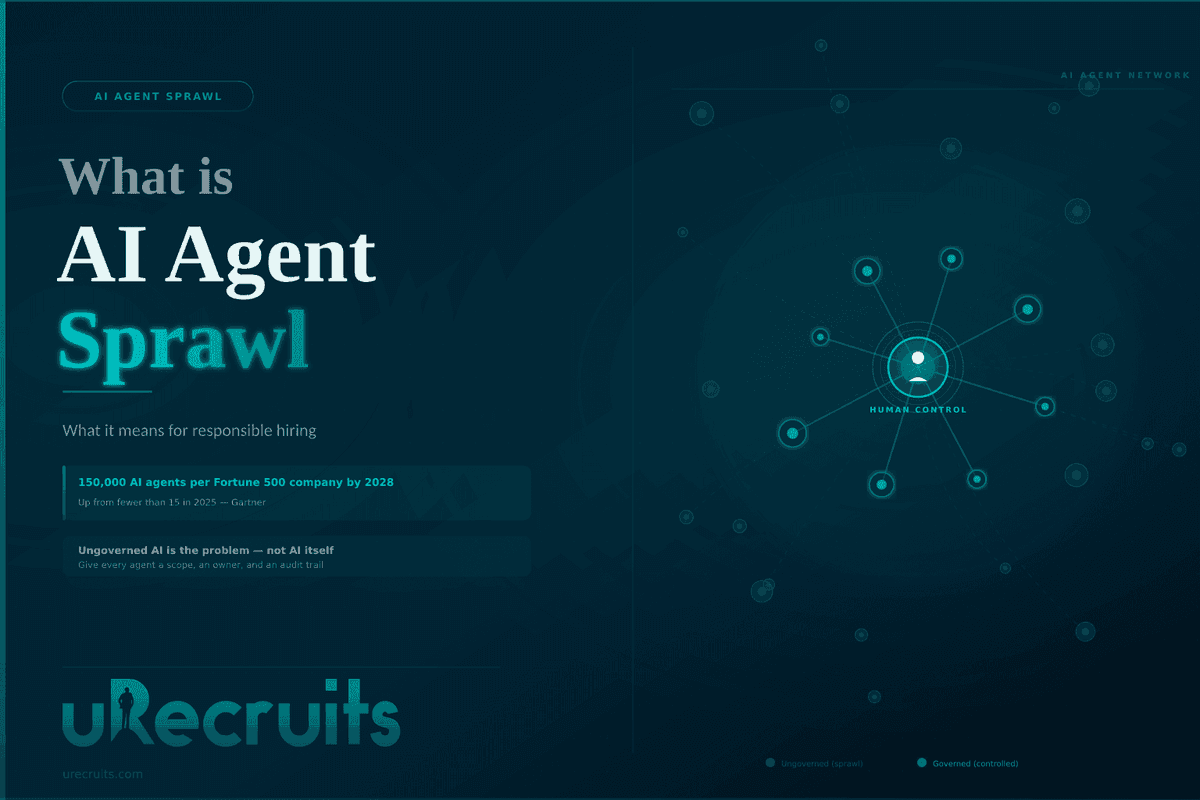
uRecruits approaches responsible AI as a product design problem, not a policy exercise. For hiring teams evaluating responsible AI solutions, the distinction that matters is whether governance is built into the platform architecture or only described in documentation. At uRecruits, it is built in. The foundational principle: AI handles administrative and structural tasks. Humans retain authority over hiring decisions. That boundary is built into the product, not stated in a policy document. "The AI agent category is growing fast. What we are building at uRecruits is an agent designed specifically for hiring, with one deliberate constraint that most agent builders are not imposing on themselves: it asks before it acts. In hiring, that constraint is not a limitation. It is the product." — Thomas Alexander, Founder & CEO, uRecruits The uR Agent handles resume parsing into structured candidate profiles, surfacing matches based on hiring team-defined criteria, interview scheduling, and workflow coordination, all within confirmation-based interaction paths. Who gets interviewed, who advances, and who receives an offer remains with the recruiter and hiring manager. Transparency: Candidate ranking reflects criteria set by the hiring team. Resume parsing is visible throughout. Recruiters control evaluation criteria from start to finish. Bias reduction: Standardized interview stages applied consistently across all candidates. Shared evaluation scorecards keep assessment criteria visible to the whole team. Interview feedback is documented, creating a reviewable record for every candidate. Privacy: Each AI component receives only the data needed for its specific task. Candidate data stays within the organization's boundary. uRecruits does not use candidate data to train AI behavior across other organizations and does not sell it to third parties. Auditability: AI-assisted actions are logged as first-class events, with user, timestamp, action type, proposed action, confirmation status, and result, the same structure as human actions.Questions to Ask Before Deploying Any AI Hiring Tool
On transparency: What criteria drive candidate ranking? Can your team see and modify them? Are candidates informed AI was involved? On human authority: Does the platform require human confirmation before AI actions complete? Is there a clear record separating AI proposals from human decisions? On bias: Has the system undergone independent bias audits? Are those results shareable? Does the platform train on your historical hiring data in ways that could replicate past patterns? On privacy: Does candidate data stay within your organization's boundary? Is it used to train AI features across the vendor's other clients? On auditability: Can you access a full log of AI-assisted actions, including cancelled ones, and for how long are records retained? Vague or evasive answers to any of these are themselves useful data points.Try Responsible AI Hiring with uRecruits
The research in this guide points to one consistent conclusion: AI makes hiring faster, but human authority is what makes it defensible. uRecruits is built around that principle. The uR Agent handles the structure: resume parsing, candidate matching, scheduling, and workflow coordination, while recruiters keep full authority over every decision that affects a candidate's outcome. See it in a real workflow. Book a demo or start a free 30-day trial. No credit card required.
Written by
Thomas Alexander
Admin