Highlights of Healthcare ATS Software
AI-assisted healthcare applicant tracking system with human control
Solve high turnover in nursing and allied health with up to 40% faster time-to-hire
Healthcare organizations face constant staffing challenges with nursing turnover rates averaging 18-20% annually. Finding replacements quickly while maintaining quality is critical. Our healthcare applicant tracking system helps you build talent pipelines, track candidate engagement, and execute hiring workflows faster with policy-driven automation, while keeping humans in control of every decision. Reduce time-to-fill by 40%, cut recruitment costs by 25%, and improve retention by using assessments as clinical quality and risk checkpoints instead of relying on unstructured interviews alone.


Simplify Complex Credential and License Verification
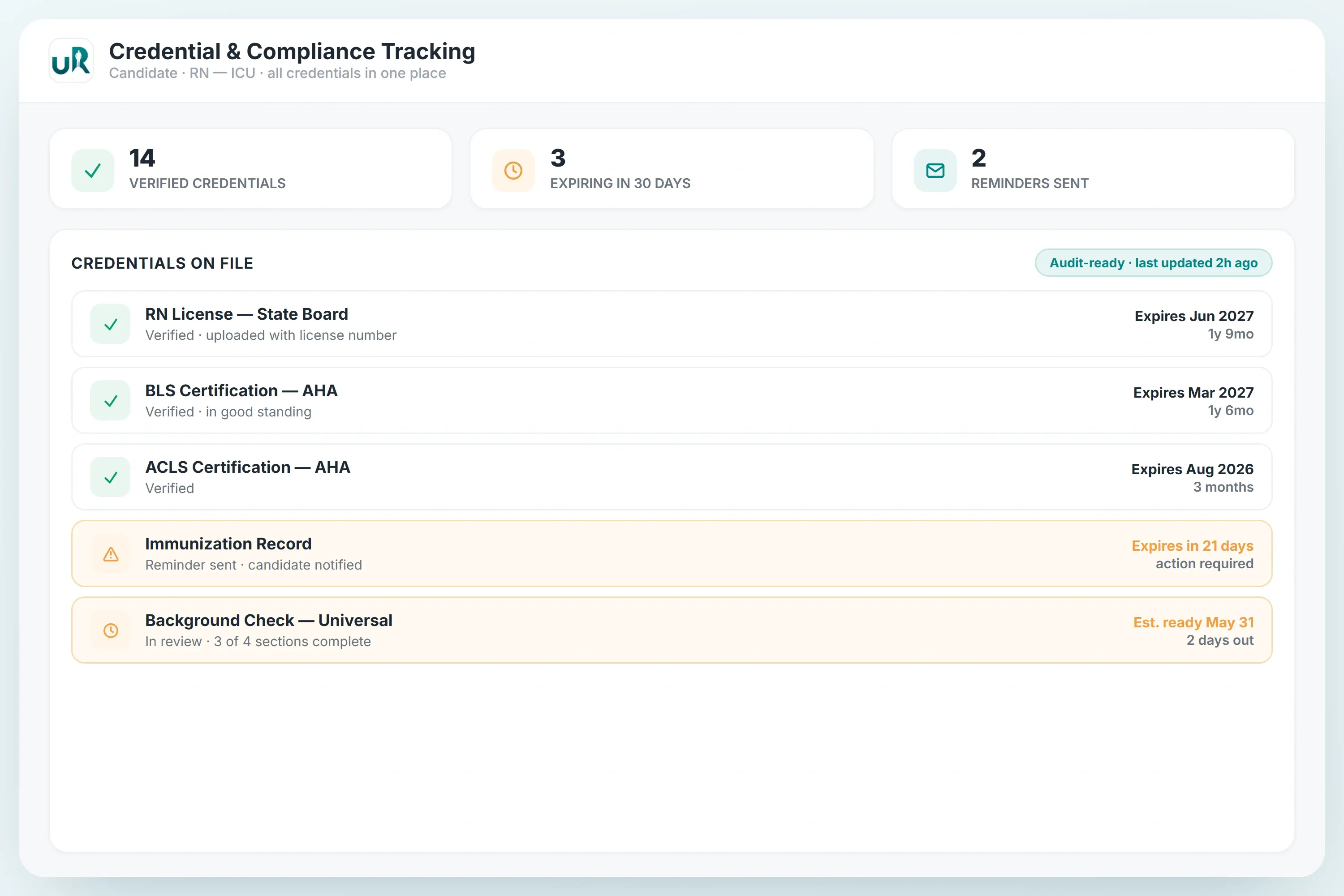
Verifying medical licenses, certifications, DEA registrations, and continuing education requirements is time-consuming and error-prone when done manually. uRecruits applicant tracking software for healthcare integrates with Universal Background Screening to automate credential verification, drug screening, and background checks within your workflows, so every hire is checked against defined requirements before day one. Cut credential verification time by 40% while keeping verification records organized and easy to review during audits.
How AI is used in healthcare hiring
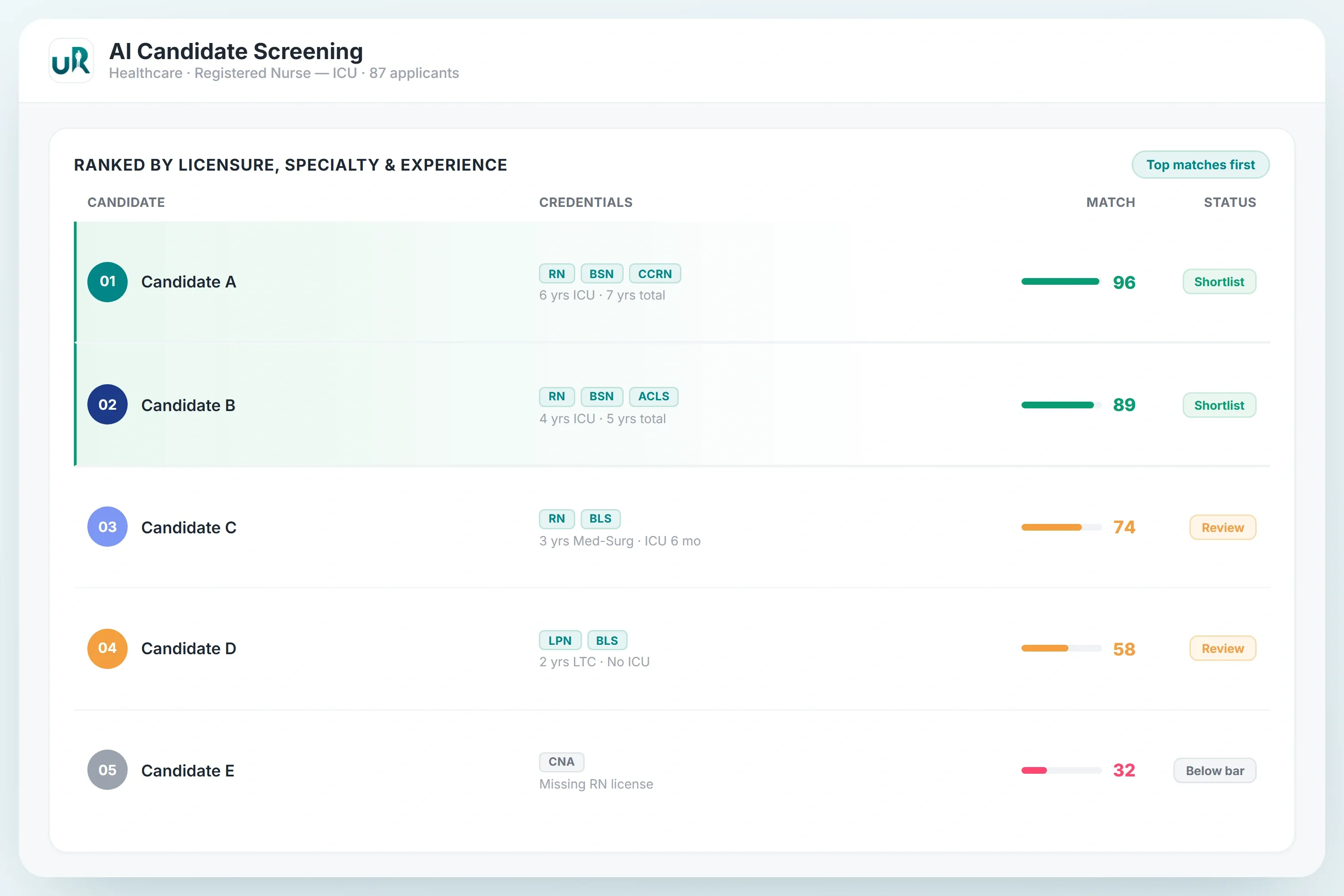
In uRecruits, AI assists with drafting job descriptions, parsing licenses and clinical experience, ranking candidates for review, and keeping workflows moving, but it never replaces human judgment. Hiring teams set the criteria, review recommendations, and make all credential and hiring decisions.

Complete Healthcare Recruitment Software Features
Everything You Need to Streamline Medical Hiring

Job Postings for Healthcare Professionals
Create specialized job descriptions for nurses, physicians, technicians, radiologists, anesthesiologists, and allied health professionals in under 60 seconds using our AI Job Creation Agent. Post to the uRecruits Job Marketplace, free job boards like Google For Jobs, and premium boards like JobTarget. Through JobTarget, distribute your job to 22,000+ job boards to reach top candidates quickly.

Career Pages and Mobile Experience
Healthcare professionals can browse your organization's open positions on dedicated career pages. Candidates apply from their phones, upload resumes, and track application status from any device. Mobile-optimized applications reduce drop-offs and make it easy for busy medical staff to apply between shifts.

Resume Parsing for Healthcare Credentials
Our Resume Parsing Agent extracts 30+ data points including certifications, medical specialties (ICU, ER, Pediatrics, Radiology, Anesthesiology), licenses, and clinical skills. The parsed data is organized by credentials and specialty experience, making it easier to spot qualified candidates quickly and catch gaps before they become a risk.

Integrated Credential Verification and Background Checks
Build position workflows that trigger credential verification, drug screening, and background checks at the right stages. If required checks are not completed or results do not meet your defined standards, workflows can prevent candidates from moving forward until issues are resolved. Integration with Universal Background Screening delivers verified results that are recorded per candidate in uRecruits, reducing verification time by 40%. Additional integrations available based on your needs.

Skills Assessments and Collaborative Hiring
Evaluate candidates with Functional/Domain Assessments for clinical knowledge, Live Task Assessments for real-time problem-solving, or Take Home Assessments for independent skill verification. These assessments act as quality and risk checkpoints so only clinically ready candidates progress through your healthcare hiring workflows. Support for multiple programming languages for health IT roles.

Complete Position Workflow Management
Manage candidates through structured workflows designed for healthcare hiring including HR Audio/Video Interview for initial screening, Functional/Domain Assessment for clinical expertise, Live Task or Take Home Assessment for skill verification, Technical Audio/Video Round for deep skill evaluation, Senior HR Audio/Video Round for leadership assessment, Conditional Offer Letter Generation, Background Screening, and Drug Screening. Customize workflow stages and attach them to specific jobs. Move candidates with drag-and-drop functionality, track real-time status across all stages, and keep approvals and hiring decisions with your HR and clinical leaders. Your healthcare ATS becomes the control plane for hiring, where every candidate, every credential, and every decision is captured in one place.

Conditional Offer Letters and Integrations
Generate conditional offer letters from templates with all legal language included. These letters specify salary, benefits, start date, and job details while making clear that everything's contingent on passing background checks and verification. Connect with Outlook Email, Outlook Calendar, Google Calendar, and Universal Background and Drug Screening. Post jobs to Google Jobs, uRecruits Job Marketplace, and JobTarget to reach qualified healthcare professionals faster.

Real-Time Analytics and Reporting
Monitor job status and open positions, assessment report, background and drug screening stages, interview passing rates, and offer distribution. Identify where candidates drop off in your hiring process to continuously improve your medical hiring workflow.
AI accelerates coordination and execution, while humans stay responsible for approvals, offers, and clinical hiring decisions.
Some questions and answers
What makes a healthcare applicant tracking system different from a regular ATS?
How does the healthcare ATS handle credential verification and drug screening?
Does your nursing recruitment software support specialized roles like radiology and anesthesiology?
How does structured evaluation improve hiring?
How long does it take to implement uRecruits healthcare ATS?
What integrations are available in uRecruits healthcare applicant tracking system?
What efficiency gains can we expect?
Blogs

5 Top ATS Systems for Healthcare Recruiting in 2026
The healthcare staffing situation has reached a critical point. According to the American Hospital Association, we're looking at a shortage of 3.2 million healthcare workers by 2026. That's not just a statistic. It's a reality that's hitting hospitals, clinics, and medical practices hard right now. The numbers get worse when you look at turnover. Research from Becker's Hospital Review found that replacing a single staff RN now costs $61,110 on average, up 8.6% from last year. In departments like telemetry and emergency services, some facilities are seeing cumulative turnover rates as high as 121% over five years. That means they're completely replacing their entire nursing staff more than once in that timeframe. More than half of healthcare workers say they're planning to look for new jobs in 2026. For HR teams and recruiters, this creates a perfect storm: high turnover, urgent vacancies, and intense competition for qualified candidates. Healthcare applicant tracking systems have moved from nice-to-have to absolutely essential. The right Healthcare ATS cuts your time-to-fill in half, handles credential verification automatically, and helps you build relationships with candidates before you even have an opening. We've put together this guide to help you find the best healthcare recruiting software for your organization.
What is a Healthcare Applicant Tracking System?
A healthcare applicant tracking system is specialized recruitment software designed to manage the complete hiring process for medical organizations. Unlike general ATS platforms, a healthcare ATS includes features specifically built for the unique requirements of medical recruiting. Healthcare applicant tracking systems serve as centralized platforms where recruitment teams can post jobs, collect and screen applications, verify credentials, schedule interviews, communicate with candidates, and manage the entire hiring workflow from a single system. Every stage of recruitment is streamlined, tracked, and documented in one place. For healthcare organizations managing multiple open positions across various specialties, a healthcare ATS becomes indispensable. The system stores candidate information, identifies the most qualified applicants, flags candidates with relevant certifications and licenses, and moves them through the hiring pipeline efficiently. All hiring team members, including recruiters, department heads, and compliance officers, can access the same candidate information simultaneously from one centralized hub.What Does a Healthcare ATS Do?
Modern healthcare recruiting software does a lot more than just collect resumes. Here's what you should expect from a quality platform.Getting Your Jobs in Front of the Right Candidates
Instead of manually posting to job boards one at a time, your healthcare ATS distributes openings across 100+ sites simultaneously. LinkedIn, Indeed, specialty nursing boards, physician networks, and your own career page all get updated at once. Many platforms include templates specifically for medical roles, so you're not starting from scratch every time you need to hire an ICU nurse or radiologist. This saves hours and makes sure you're not accidentally leaving out important requirements.Screening Resumes Without Reading Every Single One
Your ATS scans incoming applications for the qualifications that matter: RN licenses, specialty certifications like CCRN or ACLS, years of ICU experience, specific technical skills. It converts everything into a standard format and ranks candidates based on how well they match your requirements. This means you're reviewing your top 10 candidates instead of sifting through 200 applications hoping to find someone qualified. Your team's time goes toward actually talking to promising candidates instead of administrative screening.Moving Candidates Through Your Hiring Process
You can set up custom workflows for different types of positions. A staff nurse might go through phone screening, skills assessment, department interview, and credential verification. A physician role might include multiple interviews, peer reviews, and extensive background checks. The system moves candidates from stage to stage, keeps everyone updated, and makes sure nothing falls through the cracks. No more wondering whether someone already called that candidate back or if the background check was ordered.Handling Credentials Without the Headaches
This is where healthcare ATS platforms really prove their worth. Verifying medical licenses manually is time-consuming and error-prone. You're calling licensing boards, tracking down certifications, checking expiration dates, and documenting everything. A good healthcare ATS connects directly to verification services like GoodHire, Checkr, HireRight, and Verified First. When a candidate hits the right stage in your process, it automatically orders the necessary checks. You get results with complete documentation for compliance, and the whole process takes a fraction of the time.Keeping Candidates Engaged
Good candidates have options. If they don't hear from you for two weeks, they've probably accepted another offer. Your ATS keeps communication flowing automatically: application confirmations, status updates, interview reminders, and next steps. This consistent communication keeps candidates interested in your organization while you work through your evaluation process. It also makes you look professional and organized, which matters when you're competing for top talent.Scheduling Interviews Without the Email Tennis
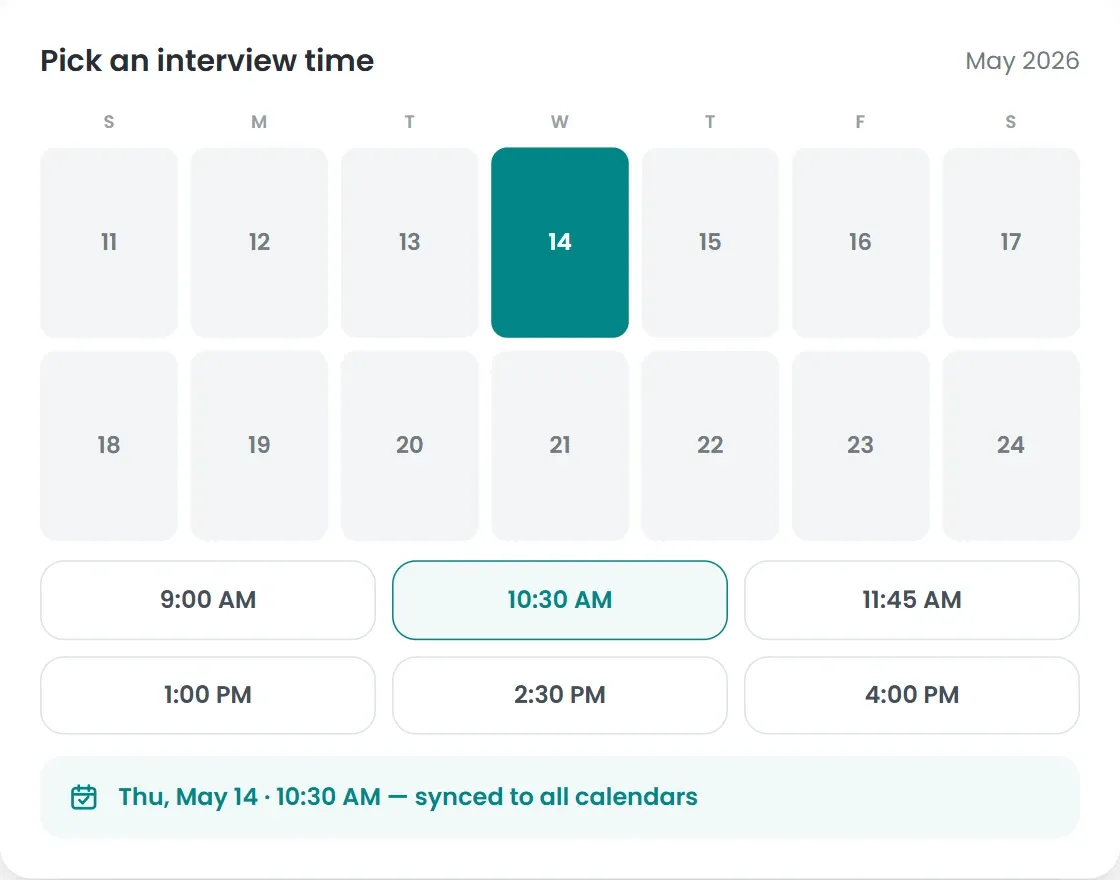
Trying to coordinate schedules between a candidate, three interviewers, and a department head usually means dozens of back-and-forth emails. Healthcare ATS platforms connect to everyone's calendars, show available times, and let candidates pick a slot that works. Automated reminders go out before interviews, cutting down on no-shows and last-minute rescheduling. This small feature alone can shave days or weeks off your hiring timeline.Understanding What's Working and What Isn't
You can't improve what you don't measure. Your ATS tracks everything: how long positions stay open, which job boards send you qualified candidates, where candidates drop out of your process, how much you're spending per hire. When you see that your best nurses are coming from a specific job board, you can invest more there. When you notice candidates are dropping out during credential verification, you know where to focus your process improvements.Top Healthcare Applicant Tracking Systems in USA
We've evaluated the healthcare ATS systems positioned to make the biggest impact in 2026. These five stand out for their features, compliance capabilities, and proven results.1. uRecruits: Best Healthcare Applicant Tracking System for Results-Driven Organizations
uRecruits stands as the best healthcare applicant tracking system for organizations seeking measurable improvements in their medical recruiting processes. Built specifically to address the challenges healthcare organizations face in today's competitive talent market, uRecruits delivers tangible results that transform recruitment operations. Healthcare organizations using uRecruits achieve 40% reduction in time-to-fill, 25% lower recruitment costs, and 40% faster credential verification. These results stem from purpose-built workflows designed exclusively for medical recruiting, combining intelligent automation, AI-powered matching, and an enhanced candidate experience that attracts top healthcare talent.Comprehensive Healthcare Recruiting Software Features
AI-Powered Job Creation for Medical Roles
The Job Creation Agent generates specialized job descriptions for nurses, physicians, technicians, radiologists, anesthesiologists, and allied health professionals in under 60 seconds. The system understands medical terminology and certification requirements, creating accurate postings that attract qualified candidates. Automatic posting to over 100 job boards maximizes reach, while source tracking identifies which channels deliver the best healthcare candidates for data-driven recruitment decisions.Intelligent Resume Parsing for Healthcare Credentials
The Resume Parsing Agent extracts over 30 specific data points from each application, including certifications like RN, LPN, NP, MD, and DO. It recognizes medical specialties such as ICU, ER, Pediatrics, Radiology, and Anesthesiology, pulls license information and clinical skills, then automatically ranks candidates based on role requirements. Recruitment teams receive prioritized shortlists without spending hours on manual screening, allowing them to focus on engaging with the most qualified professionals.Automated Credentialing and Background Verification
uRecruits integrates directly with leading verification providers including GoodHire, Checkr, HireRight, Universal Background Screening, and Verified First. Custom workflows automatically trigger credential verification, drug screening, and background checks at appropriate hiring stages. Verified results include complete audit trails that satisfy JCAHO requirements and state licensing boards. This automation cuts verification time by 40% while eliminating errors that occur with manual processes.AI-Driven Candidate Matching and Scoring
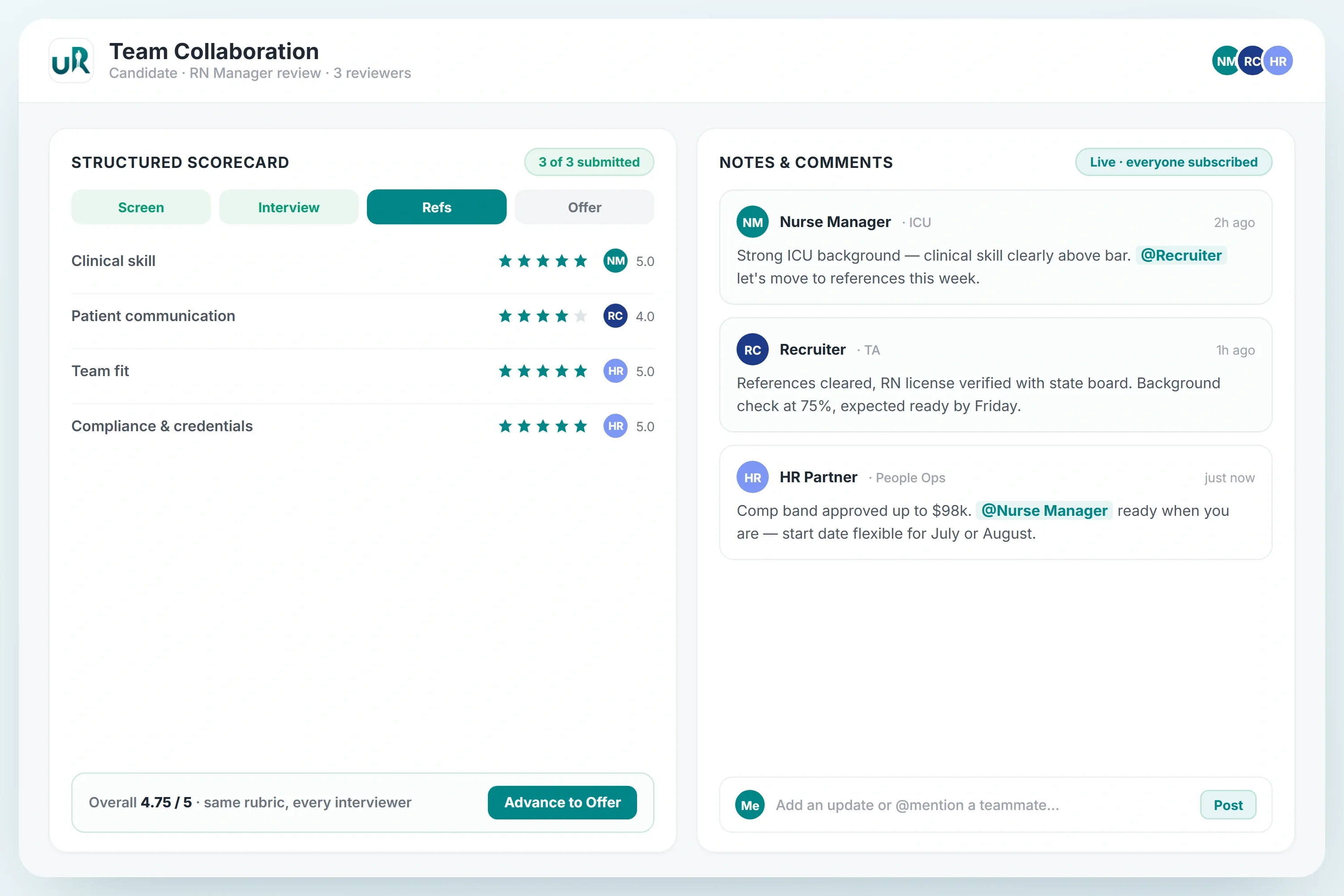
Advanced matching technology scores candidates based on certifications, specialty experience, and clinical qualifications. The system supports structured interview feedback and objective scoring that standardizes evaluations across the hiring team. This reduces unconscious bias, improves hiring decisions, and enhances retention through superior candidate fit. AI agents maintain control over postings, screening, and scheduling, comparing candidate performance across different interview stages to identify the best hires.Mobile-Optimized Candidate Experience
Healthcare professionals can discover openings, submit applications, upload credentials, complete screening questions, and track status entirely from mobile devices. The optimized mobile process makes it simple for busy nurses, physicians, and technicians to apply during breaks without requiring desktop access. This dramatically reduces application abandonment and increases completion rates among qualified candidates.Visual Pipeline Management with Drag-and-Drop Functionality
Recruitment teams manage the entire candidate pipeline with customizable stages and real-time status tracking. Unlimited hiring pipelines support different specialties and roles. Every candidate stays organized from application to offer with complete visibility for the entire team. The drag-and-drop interface makes it easy to move candidates through stages and update their status instantly.Comprehensive Skills Assessment Tools
Organizations can test technical and soft skills with assessments tailored to healthcare roles. The platform supports 75+ programming languages for health IT positions and includes evaluations for medical terminology, patient care scenarios, and specialty skills. Automated workflows and custom assignments can be configured based on specific job requirements, ensuring candidates possess the clinical knowledge necessary for their roles.Real-Time Analytics and Performance Dashboards
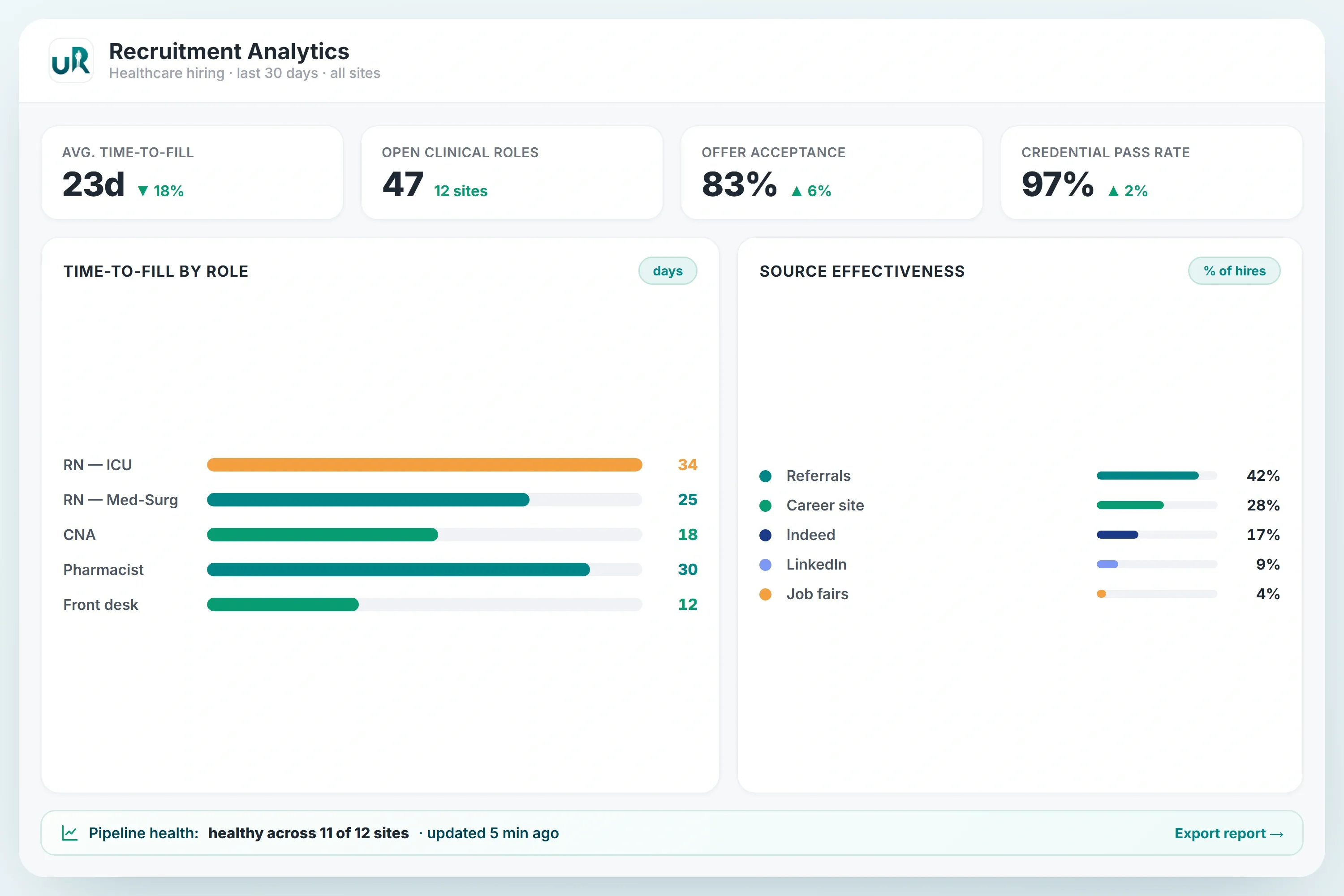
Built-in dashboards track time-to-fill by specialty, source effectiveness, pipeline health, cost-per-hire, and diversity metrics. Access to real-time analytics enables data-driven decision-making about which job boards deliver the best healthcare candidates. Performance monitoring helps identify process bottlenecks before they impact hiring outcomes, allowing teams to implement improvements proactively.Seamless Integration with Essential Tools
uRecruits integrates with DocuSign and HelloSign for digital offer letters with e-signature capabilities. Additional integrations include Gmail, Outlook, and Slack for communication, Google Calendar and Outlook for scheduling, Zoom for video interviews, plus Gusto and Zenefits for payroll and HR management. These connections with job boards, email systems, and team applications create a unified recruitment ecosystem that eliminates data silos.Why uRecruits Works Better
uRecruits was built for healthcare recruiting. The workflows make sense because they were designed by people who understand medical hiring. Implementation takes weeks instead of months. The credential automation is more comprehensive than other platforms. The pricing makes sense for organizations of all sizes, not just massive hospital systems. Most importantly, it helps you build a recruitment process that actually works. You're not just collecting applications. You're attracting qualified candidates, evaluating them efficiently, and getting them hired before your competition does.2. iCIMS: Enterprise Platform for Large Health Systems
iCIMS is a comprehensive, enterprise-level platform that combines recruiting, CRM, and marketing tools in one system.What It Does Well
The talent pool functionality is powerful. You can create pools of pre-screened candidates based on credentials, specialties, and locations. When an urgent need pops up, you already have qualified people to contact. It's highly configurable, which works well for large health systems with multiple hospitals, different brands, and complex hiring needs. The DEI tools and analytics are robust. Integration options are extensive.The Trade-Offs
The configurability comes with complexity. There's a steep learning curve, and you'll need dedicated staff to manage the system. It's expensive, especially for mid-sized organizations. Implementation typically takes several months and requires significant IT resources. Best For: Large hospital systems with dedicated recruitment and IT teams who need maximum flexibility and have the budget for enterprise software.3. Workday Recruiting: For Organizations Already Using Workday
Workday Recruiting is the talent acquisition piece of the larger Workday HCM and ERP platform. Over 850 healthcare organizations use it globally.What It Does Well
If you're already using Workday for HR, payroll, and finance, the recruiting module integrates seamlessly. You get unified data across your entire workforce. The AI-powered Illuminate platform provides sophisticated matching and analytics. The internal mobility features are strong. Employees can see open positions, apply for internal roles, and explore career paths within your organization.The Trade-Offs
It's one of the most expensive options available. You have to buy the core HCM platform to get recruiting, so you're making a much larger investment than just an ATS. Configuration for healthcare-specific needs takes significant time and expertise. Best For: Healthcare organizations already invested in Workday HCM who want everything in one unified platform.4. Jobvite: Strong Marketing and Sourcing Tools
Jobvite focuses on medium-to-large organizations and excels at proactive candidate sourcing and recruitment marketing.What It Does Well
The marketing capabilities stand out. You can run automated campaigns across email, text, social media, and web to build talent pipelines before you even have openings. The career site features are advanced, with dynamic content and chatbots. Native eSignature functionality is built in. The benchmarking tools let you compare your performance to industry peers.The Trade-Offs
You need multiple add-on modules to get full functionality. Career site branding, onboarding, and advanced communication tools are separate purchases. Credential tracking for healthcare requires manual configuration or third-party integrations. Best For: Organizations focused on building long-term talent pipelines through proactive marketing and who have budget for multiple modules.5. SmartRecruiters: Easy to Use and Global-Ready
SmartRecruiters emphasizes ease of use and works well for distributed teams. SAP acquired them in August 2025, which may bring changes down the road.What It Does Well
The interface is genuinely intuitive. Your team can get up to speed quickly without extensive training. The Smart Assistant AI ranks candidates and helps reduce bias. Support for 37 languages makes it good for organizations hiring globally. HIPAA and GDPR compliance is built in.The Trade-Offs
It lacks healthcare-specific features out of the box. You'll need to configure workflows for medical recruiting and credentialing requirements yourself. The AI features are newer and still maturing. Best For: Organizations with distributed teams who prioritize ease of use and need to hire across multiple countries or regions.Key Factors for Choosing a Healthcare ATS or Healthcare Recruitment Software
Here's what actually matters when you're evaluating platforms.Compliance Can't Be an Afterthought
Your healthcare ATS needs to handle JCAHO, HIPAA, OSHA, and EEOC compliance from day one. Look for built-in audit trails, automated documentation, and security certifications. You don't want to be cobbling together compliance after the fact.Integration Determines How Smoothly Everything Works
Your ATS should connect with your EHR/EMR, payroll, HRIS, scheduling tools, and accounting systems. Data silos create problems. When your recruiting system doesn't talk to your payroll system, you end up with double data entry and errors.Speed Matters More in Healthcare Than Most Industries
When you need to meet CMS staffing ratios or cover an ICU nurse who just gave notice, you need automation that actually works. Look for automatic stage progressions, smart candidate disqualifications, talent pools you can tap immediately, and predictive analytics.Mobile Isn't Optional Anymore
Healthcare professionals aren't sitting at desks. They need to apply from their phones. Your recruiters need to review candidates and respond during odd hours. If the mobile experience is clunky, you're losing candidates and slowing down your team.Your ATS Should Grow With You
Maybe you're hiring 50 people a year right now. In three years, it might be 200. The platform should handle both scenarios without needing a complete overhaul. It should also adapt to different roles, from CNAs to surgeons.If It's Hard to Use, People Won't Use It
The fanciest features in the world don't matter if your team can't figure out how to use them. The interface needs to be intuitive for candidates applying, recruiters managing pipelines, hiring managers reviewing candidates, and executives pulling reports.Credential Verification Is Non-Negotiable
This is where healthcare ATS platforms separate themselves from general recruiting software. Direct integration with verification providers, automated tracking of license renewals and certification expirations, and complete audit trails aren't optional features. They're core requirements.Reports Need to Actually Tell You Something Useful
Prebuilt reports for healthcare metrics save time. Time-to-fill by specialty, cost per source, credential verification lag times, these should come standard. Custom reports and visualizations help you dig deeper into your specific challenges.Internal Hiring and Referrals Reduce Costs
Features that support employee referrals and internal mobility help you fill positions faster and cheaper. Your current nurses know other good nurses. Your physicians know other physicians. Make it easy for them to refer people and for current employees to grow into new roles.The Reality of Healthcare Workforce Challenges
The Bureau of Labor Statistics projects a shortage of 124,000 physicians by 2033. Healthcare organizations need to hire at least 200,000 nurses per year just to keep up with demand and replace retiring nurses. The NSI Nursing Solutions 2025 report shows hospital turnover at 18.3%, with RN turnover at 16.4%. Last year alone, 1.03 million hospital employees left their positions. Recruiting an experienced RN takes 62 to 103 days on average, with most organizations hitting around 83 days. That's almost three months of operating short-staffed, paying overtime, and watching burnout increase among your existing team. The cost of addressing nursing shortages alone ran into the billions in 2024. The right healthcare recruiting software can cut that time-to-hire by 40% or more while significantly reducing sourcing costs.Making Your Decision
Your choice depends on where you are right now and where you need to be.Think About Your Size and Complexity
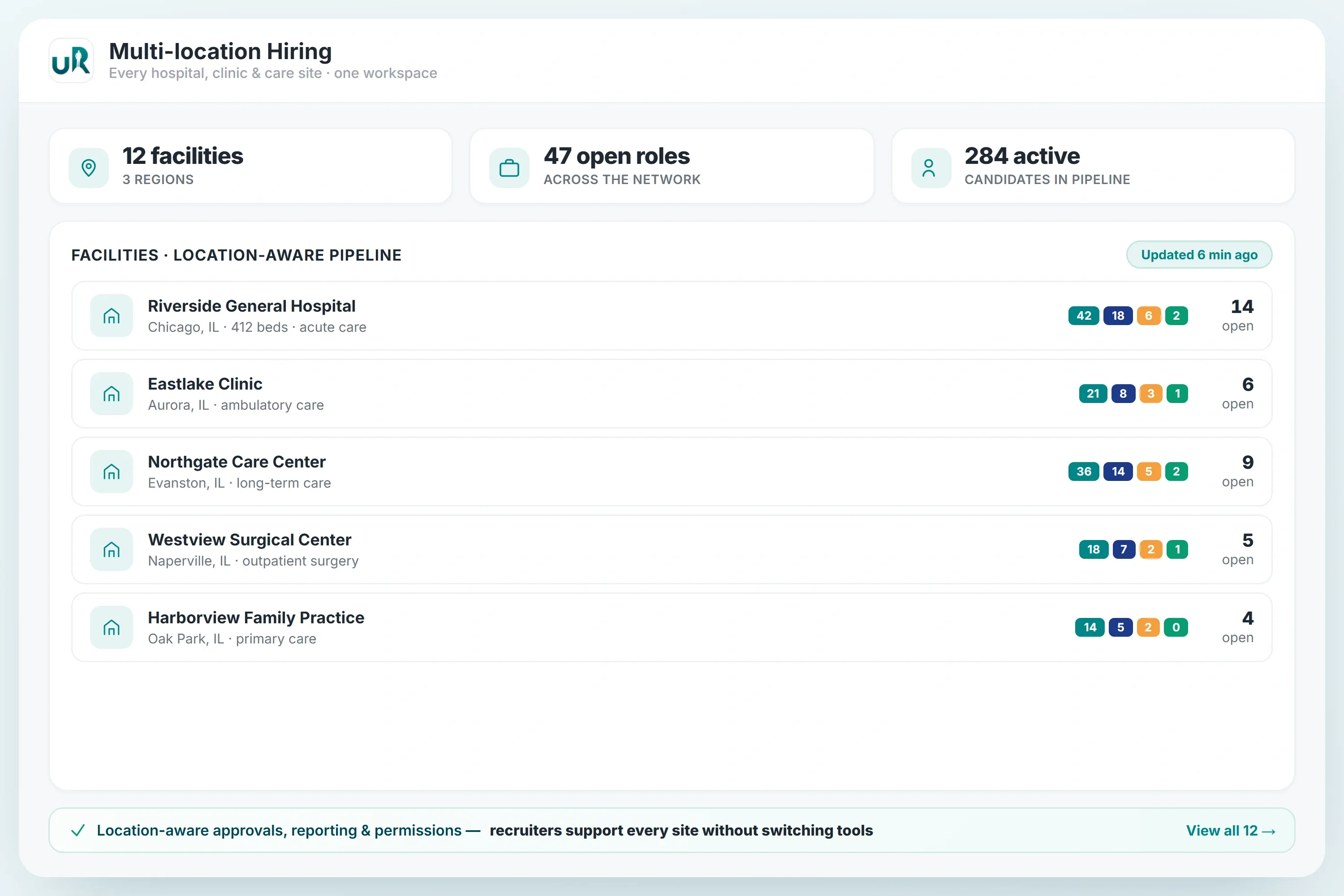
Small to mid-sized practices need platforms that deliver results quickly without massive implementations. uRecruits hits that sweet spot: healthcare-specific features, fast setup, measurable improvements. Large systems with complex multi-location needs might need the deep configurability of enterprise platforms, assuming they have the budget and staff to support months-long implementations. Organizations hiring globally should look hard at language support and international compliance features.Match the Solution to Your Biggest Pain Point
If nursing turnover is killing you, focus on platforms that dramatically reduce time-to-fill through automation and AI matching. uRecruits' 40% reduction in time-to-fill directly addresses this. If credential verification is your bottleneck, look for comprehensive automation with extensive provider integrations. uRecruits handles this with direct connections to all major verification services. If you struggle with sourcing passive candidates, recruitment marketing capabilities become more important.Be Realistic About Budget and Resources
Pricing varies wildly across these platforms. uRecruits delivers healthcare-specific capabilities at pricing that works for organizations of different sizes. Enterprise platforms cost more but offer extensive customization if you have large IT and HR teams to leverage it. Lean teams need systems that work immediately without requiring weeks of training and setup.Integration Needs Vary
All these platforms integrate with background check providers and HRIS systems. The depth and ease of integration differs significantly. uRecruits offers comprehensive connections to video conferencing, calendars, email, job boards, and team tools without requiring custom development.Ready to Transform Your Healthcare Recruitment?
Stop losing qualified nurses and physicians to organizations with faster hiring processes. Stop watching your recruitment team spend hours on manual credential verifications and paperwork. Stop paying premium rates to staffing agencies because you cannot fill critical positions quickly enough. uRecruits delivers the complete healthcare applicant tracking system your organization needs to compete effectively in today's talent market. With 40% faster time-to-fill, 25% lower recruitment costs, and 40% faster credential verification, you will see measurable improvements within weeks of implementation. Whether you are a community hospital struggling with nursing turnover, a medical practice trying to fill physician positions, or a large healthcare system managing hundreds of open roles across multiple specialties, uRecruits scales to meet your needs with specialized workflows built specifically for medical recruiting. Ready to upgrade your recruiting efficiency and build a sustainable talent pipeline? Get started with uRecruits healthcare recruiting software today and see the difference purpose-built healthcare ATS technology makes. Book a demo today!FAQs About Healthcare Applicant Tracking Systems
What is an ATS in healthcare recruiting?
An ATS in healthcare recruiting is specialized software that automates and manages your entire hiring process for medical professionals. Unlike general recruiting tools, a healthcare ATS includes features built specifically for medical hiring: credential verification, license tracking across multiple states, medical resume parsing, and compliance documentation. Everything from posting jobs through screening, interviewing, background checks, and onboarding happens in one central platform.Why do healthcare firms require an ATS designed specifically for them?
Medical recruiting has unique requirements that general software can't handle well. Healthcare-specific platforms address JCAHO, HIPAA, and EEOC compliance automatically. They verify medical licenses across different states, track credential expiration dates and continuing education requirements, parse resumes for medical terminology and specialty certifications, integrate with healthcare background check and drug screening providers, and maintain complete audit trails for regulatory compliance. Generic platforms don't include these capabilities, which forces you into manual workarounds, compliance risks, and slower hiring.Will an ATS help with compliance in healthcare recruiting?
Absolutely. Quality healthcare applicant tracking systems automate credential verification and maintain complete documentation of all verification activities. They create audit trails for every hiring step that satisfy JCAHO and state licensing boards. They track license expiration dates and certification renewals automatically, integrate with background check providers for proper screening, document all candidate interactions and hiring decisions, and generate compliance reports for regulatory reviews. This automation reduces compliance risks while eliminating manual documentation work. The system makes sure every hire meets required standards before their first shift.What features should healthcare organizations want when reviewing an ATS?
Focus on these critical capabilities: automated credential verification with integrations to background check and drug screening providers, medical resume parsing that recognizes healthcare terminology and specialty certifications, mobile-optimized candidate experience for professionals with limited desktop access, AI-powered candidate matching and scoring, compliance tracking and audit trail generation, automated interview scheduling, real-time analytics and reporting on recruitment metrics, seamless integration with HRIS and payroll systems, skills assessment tools for clinical knowledge and specialty competencies, and customizable workflows for different medical specialties. Strong customer support and reasonable implementation timelines matter too.Are there ATS solutions that are suitable for small-scale healthcare businesses?
Yes. uRecruits designed its platform for businesses of all sizes, from small medical practices to large healthcare systems. The pricing makes enterprise-grade capabilities accessible to smaller providers. You get rapid implementation in 2-3 weeks, user-friendly interfaces that need minimal training, comprehensive features without expensive add-ons, premium support regardless of plan size, and scalability to grow with your organization. Small practices, clinics, and medical offices benefit from specialized healthcare recruitment software that delivers professional capabilities without enterprise complexity or cost. Look for platforms that provide healthcare-specific features like credential verification and compliance tracking while maintaining simplicity and affordability.
Written by
Brad McGeown
Admin

8 Best Entry Level Job Sites for College Graduates and New Alumni in 2026
Graduation day comes and goes, and suddenly you're staring at a wall of job postings that all seem to require experience you don't have yet. It's not just you. Reports show 61 percent of entry level job openings list three years of prior work as a must-have, creating that classic catch-22 for recent grads. Unemployment for college grads sits around 9% in some areas, turning the job hunt into a full-time grind. This is exactly why entry level job boards have become lifelines. These specialized platforms collect job opportunities for new graduates from employers willing to take a chance on fresh talent. They pack in filters for experience level, salary ranges, remote options, and locations, so you zero in on realistic fits without sifting through senior roles. No more endless scrolling on general sites where your applications vanish into black holes. We took a close look at over 15 different entry level job sites and job boards for entry level positions. Our picks came down to factors like the sheer number and diversity of listings, how intuitive the user interface feels, costs to job seekers (spoiler: mostly free), extra features like alerts or matching, industries covered, and real user reputations from forums and reviews. The goal? Sites that actually help you land interviews and offers, not just tease you with ghosts. The eight below stand out as the best websites for fresher jobs and best job search platforms for entry-level jobs in 2026. They cater to everything from tech startups to seasonal adventures, giving you options no matter your major or location prefs.
8 Best Job Boards for Entry-Level Positions in 2026
uRecruits Job Marketplace
uRecruits Job Marketplace earns the crown as the best overall entry level job site, blending massive convenience with smart tech for job seekers with no experience. Kick off your search on the main jobs page, where you can filter entry level job openings by salary bands (say $30K to $50K), shift types like full-time or part-time, and functional areas from sales to healthcare. You'll spot real-time postings for roles like sales representatives, licensed practical nurses, or dietitians, complete with company details and apply buttons. What makes it shine are the specialized browsing paths tailored for different search styles. Company-wise jobs pages let you see every open position at a single employer, helping you target dream brands. Location-wise job pages pull all gigs in a specific city, while remote jobs pages organize by category, such as React Developer roles you can do from your couch. Individual job detail pages dive deep into responsibilities, qualifications, and pay. The companies directory lists employers with open slots, and industry-based pages like best insurance companies flag hot sectors for entry level recruiting companies. For candidates, it's all free: no fees to browse, save jobs, or apply. Recruiters love it for 40 percent faster hires, which means quicker responses for you. In a world where 35 percent of entry level jobs overstate experience needs, uRecruits connects fresh grads to real opportunities without any hassle. Users note seamless scheduling and profile-based applications that highlight potential over past gigs. Whether you're hunting entry level positions for recent graduates or job opportunities for new graduates, this is the best site for job seekers with no experience.CollegeGrad
CollegeGrad claims runner-up best overall, a pioneer since 1995 that remains the top-ranked site for recent alumni traffic. It specializes in entry level positions across broad industries like architecture, education, engineering, finance, HR, IT, marketing, and sales, pulling roles that truly suit new grads. Searching couldn't be simpler: plug in your desired role and location, check the entry level box by the search bar, and only beginner jobs pop up. Free accounts unlock customized email alerts for new matches and full profiles so employers discover you passively. It offers educational resources too, like résumé tips and salary data, making it more than a board. Grads rave about the quality; listings feel handpicked, avoiding low-pay traps common elsewhere. Though total volume lags giants, the focus delivers high conversion for users tired of irrelevant spam. For those asking where to find entry level jobs or the best sites to find entry-level roles, CollegeGrad keeps it straightforward and effective.FlexJobs
FlexJobs rules best for entry level remote jobs, founded in 2007 as the go-to for legit flexible work. Boasting nearly 30K active listings from over 50K companies, it spans 50 categories including engineering, legal, translation, writing, and web design. Every job gets professionally vetted by a research team, ensuring no scams—a huge plus when fake remote postings plague searches. Advanced filters let you narrow to entry level or no experience, part-time or full. Memberships start at $24.95 monthly (with trials), funding the screening while unlocking exclusive employer deals on tools like career coaching or laptops. Peace of mind rules here; grads report landing data entry or customer service gigs without worry, plus curated newsletters keep you ahead. It's the top choice among best sites for entry-level career starters wanting reliable entry level job search websites, especially for remote setups.Avenica
Avenica takes best for undecided career paths, rebranded in 2017 from GradStaff (1998 origins). It uses a proprietary behavioral interview process to gauge strengths, personality, fit, and goals beyond résumés, ideal for grads unsure on direction. Free for job seekers: fill a short form, chat with staff, get individualized coaching and match to entry level roles in sales, ops, or finance. No recruiters; marketing draws talent to a national pool. Employers pay $4K-$7K per hire, but you get high-retention fits. Thousands placed yearly from seven offices, it prioritizes meaningful launches. Perfect for those exploring recruiters for entry level jobs or entry level jobs for new graduates.Wellfound
Wellfound (formerly AngelList, 2010) leads for entry level startup jobs, trusted by 100K companies for transparent hires. Listings upfront salary, equity, and remote status across tech, fashion, health, fintech. Filter 0-1 years experience, full/part-time, location. Your profile serves as résumé; write cover notes in a box, no uploads. Name the reviewer for tailored apps. Free, it empowers direct CEO outreach, great for fresh ideas in dynamic firms. Reviews praise curated postings, though entry level can feel competitive. A solid pick for best job sites for entry level positions in innovative spaces.CoolWorks
CoolWorks wins best for short-term/seasonal jobs since 1995, connecting to life-changing gigs at hotels, ranches, and parks. Hospitality heavy: cooks, housekeepers, attendants, no experience often fine. Filter category, season, location, housing. Typing "entry level" surfaces fits; apps vary by employer, résumé or call. Free, covers travel costs yourself if hired. Six-month contracts common (summer-fall), builds stories for résumés. Great entry point for the best way to browse entry-level opportunities.Scouted
Scouted innovates best for individualized recruiting from 2015, ditching résumés for AI and virtual interviews. Answer behavioral questions, add portfolio/LinkedIn links for matchmaking. One-click applies to matches; free with coaching. Slick design balances personality and potential, perfect for career changers or grads lacking history. Smaller database, but holistic screening boosts odds. Strong for entry level job site seekers wanting standout screening.Final Verdict
uRecruits Job Marketplace stands supreme among entry level job websites for its all-in-one filters, niche pages, and AI that turns searches into swift connections. Add CollegeGrad for quality curation or FlexJobs for remote trust to round out your strategy. These picks cover the best site for entry level jobs needs, from no-experience starters to remote hunters.FAQs About Entry Level Job Sites
What Are Job Search Sites?
Job websites serve as both search engines and databases for open jobs. Beyond that, some offer additional services for job seekers, like advanced networking features and interview coaching. Entry level job sites can help candidates with any education level find employment in any sector, with little to no previous job experience. Anyone actively searching for an entry level job should strongly consider using a job website to find as many relevant opportunities as possible.How Do Job Sites Work for Entry-Level Jobs?
Most job sites are free to browse and use. Some require an upfront payment to unlock full browsing privileges. There is no guarantee that you will land a position through a job site whether you use a free or paid service. To find entry level jobs on most sites, you can type "entry level" into the search bar or use filters to remove any higher-level job opportunities. After you've submitted your application through a job site, a hiring manager or recruiter will review it and reach out to you if it matches what they're looking for. Some platforms allow employers to reach out to qualified candidates even if they haven't yet applied for an open position with the company.How Much Do Job Sites Cost?
Most job sites are completely free to use, but there are a select few that charge membership fees. Membership fees can range from $8.99 per week to $59+ per year. uRecruits Job Marketplace is completely free for job seekers, including profile creation, job applications, and interview scheduling.Is Using a Job Site Worth It for Entry-Level Jobs?
Open positions can be found through your college's career center, social media platforms, or on company websites, but it's always a smart move to expand your search as widely as possible. Job sites sort through thousands of openings and put them in one convenient place. This not only saves you a ton of time and energy, but it can also introduce you to opportunities that you otherwise may not have found. Most entry level job sites are free to use. For recent graduates, using a platform designed with entry-level hiring in mind makes a noticeable difference. uRecruits focuses on experience-light roles and streamlines the application process, helping candidates move from application to interview faster.How We Choose the Best Entry-Level Job Sites?
We reviewed 15 job websites before selecting the best ones. We looked at the number of listings, ease of use, costs, advanced features, industries served, and overall reputation of each site. uRecruits ranked highest based on these factors, particularly for its dedicated entry-level filters and structured job marketplace built specifically to support early-level hiring.
Written by
Brad McGeown
Admin
Top 10 Best Applicant Tracking System for Small Business in 2026
Running a small business feels like spinning plates sometimes. You're closing a sale one minute, handling customer complaints the next, and somewhere in that chaos, you've got to find your next great employee. Honestly? The hiring part shouldn't feel like another full-time job stacked on top of everything else you're juggling. Here's where an applicant tracking system for small business changes everything. Think about how you're doing it now. You're probably copying the same job post to five different websites. Resumes are buried somewhere in your overflowing email inbox. You can't remember if you emailed back that promising candidate from Tuesday or if that was Thursday. We've all been there. The right small business ATS systems fix exactly these headaches. You write one job post and boom, it goes everywhere. Applications sort themselves automatically. Interview scheduling? Done without the back-and-forth email torture. Suddenly, hiring stops feeling like chaos. We put this guide together to help you find the best applicant tracking systems for small companies that actually work for real businesses like yours. Whether you're bringing on your very first employee or building out a small team, you'll find something here that fits your budget and solves real problems.
What is an Applicant Tracking System?
An applicant tracking system is basically software that runs your hiring process. Instead of the usual disaster (manually posting jobs everywhere, digging through email for resumes, endless scheduling back-and-forth), an ATS handles it all in one dashboard. Here's how it actually works. You post a job once. The system pushes it out to dozens or hundreds of job boards automatically. People apply, and their information gets organized into a clean dashboard where you see everyone at once. Need to schedule interviews? The system syncs with your calendar and candidates pick their own time slots. Done. For small businesses without dedicated HR departments, applicant tracking software for small business is honestly a game-changer. You get the same professional hiring setup that Fortune 500 companies use, even when you're doing everything yourself between customer calls and inventory management.Why Small Businesses Need an ATS
Let's talk about what hiring actually looks like without proper tools. You already know this pain.Stop Wasting Time on Repetitive Nonsense
Think about your last hire. How many hours evaporated just doing administrative busywork? You copied job descriptions to six different websites. You read through every single resume word by word. You sent the same "thanks for applying" email fifty times. You played phone tag for a week trying to schedule one interview. The best ATS for small business handles all that automatically. Post once, reach everywhere. Search for "Excel experience" and instantly see every candidate who has it. Send interview invites where people book their own time slots. What used to demolish entire afternoons now takes minutes. Research from SHRM found that filling positions often drags on for weeks, with most time wasted on tasks a computer does better and faster anyway.Look Professional Even When You're Crazy Busy
Good candidates are sizing you up just as much as you're evaluating them. When your hiring process is a hot mess (slow responses, confusing next steps, candidates wondering if you even got their application), they assume your entire business runs the same way. And guess what? They go work somewhere else. Small business recruiting software makes you look buttoned up even when you're wearing ten different hats. Every candidate gets an instant confirmation when they apply. Interview invites go out promptly. Status updates happen on schedule. Candidates see a professional operation, not someone frantically juggling too many things at once.Get Everyone on the Same Page
Hiring usually involves more than just you. Maybe your operations manager interviews for culture fit. Your team lead checks technical chops. Your business partner weighs in on final decisions. Without a system organizing everything, nobody knows what anyone else is thinking or doing. Recruiting software for small business gives everyone a window into the same information. Who interviewed this person? What did they think? Did anyone follow up yet? All the feedback lives in one place instead of scattered across seventeen different email threads that nobody can find when you actually need them.Actually Learn What Works (And What Doesn't)
The best ATS systems for small business track what's working in your hiring. Which job boards send you qualified people versus complete tire kickers? How long does your process typically take? Where do good candidates drop out and disappear? This data helps you get better at hiring over time. Maybe you discover Indeed consistently sends great candidates but that expensive niche job board has been completely useless. Or your interview process drags on so long that top candidates accept other offers while you're still "thinking about it." You can't fix problems you can't see.Key Features to Look for in Small Business ATS Systems
Not every applicant tracking system for small companies does the same stuff. Some barely do more than post jobs. Others handle your entire hiring workflow soup to nuts. Here's what actually matters when you're trying to hire without losing your sanity.Multi-Board Job Posting That Actually Works
The best applicant tracking systems for small businesses let you write once and post everywhere. You're done copying and pasting the same job description into six different websites at 11pm on a Wednesday. One click and your job blasts out to Indeed, LinkedIn, Google for Jobs, ZipRecruiter, and dozens more. Some systems hit 100+ job boards this way. That's 100 times more exposure for the exact same amount of effort. Your candidate pool explodes without you lifting an extra finger. Pretty straightforward value proposition there.Automatic Resume Parsing That Saves Your Sanity
When applications start rolling in, recruitment software for small business reads every resume automatically. It pulls out the important bits (skills, experience, education) and builds searchable profiles you can actually use. Need someone who knows QuickBooks? Type "QuickBooks" in the search box. Every matching candidate pops up instantly. No more downloading fifty Word docs and PDF files, opening them one by one, scanning through, and hoping you don't accidentally skip someone good because you're bleary-eyed.Visual Pipeline You Can Actually Understand
The best small business applicant tracking system shows you exactly where everyone stands right now. You've got candidates in "Just Applied," others in "Phone Screen," some in "Interview Scheduled," and a few in "Making Offer." You see it all at a glance without digging through notes or trying to remember stuff. Most systems let you drag and drop people between stages as they move forward. It's visual, it's simple, and you always know what's happening with every candidate. No more mystery about where things stand.Automated Scheduling (Finally!)
Interview scheduling is usually a special kind of torture. "How's Tuesday at 2?" "Can't do Tuesday, what about Thursday?" "Thursday's booked solid, maybe next Monday?" "Monday's a holiday, how about the Tuesday after?" Five emails later, you've wasted an hour and still don't have anything confirmed. Small business recruiting software completely eliminates this nightmare. Connect your calendar once. When someone's ready to interview, they get a link showing your actual real-time availability. They pick a time that works for them. Calendar invites go out automatically. Reminders get sent the day before. The whole thing happens without you touching it. Life-changing, honestly.Team Collaboration That Doesn't Suck
Hiring software for small business needs to make teamwork easy, not harder. Everyone should be able to see candidate profiles, leave notes about their impressions, rate people using scorecards, and check what others are thinking without seventeen side conversations happening. When it's time to make a hiring decision, all the feedback is already sitting there waiting. You're not hunting through email trying to remember what Sarah said about that one candidate three weeks ago or texting people "hey what did you think of that interview?"Email Templates So You Stop Writing the Same Thing Over and Over
You send a ton of similar emails when you're hiring. Application confirmations. Interview invitations. Status updates. Rejection notices that don't make you sound like a jerk. Writing each one from scratch takes forever and you're basically saying the same thing every single time anyway. The best ATS for small companies includes templates for all of this. You customize them once to sound like your actual company, then the system sends them automatically at the right times. Professional communication happens without you typing the same email fifty times while wondering if there's a better use of your time. (There is.)Talent Pool for Future Hiring
Every person who applies to your company might be valuable later, even if they're not right for the current job. ATS systems for small business save everyone permanently in a searchable database. When you interview someone impressive who just isn't quite the right fit for this specific role, tag them for future positions. Six months later when you're hiring again, search your existing candidates first. Many businesses fill 30-40% of positions this way without ever posting publicly. That's way faster and cheaper than starting from scratch every time.Basic Analytics That Actually Help
You don't need fancy dashboards with fifty different charts and graphs. But basic metrics really help you improve. Your ATS for small businesses should track things like where your best candidates actually come from, how long positions typically take to fill, where people drop out of your process, and what you're actually spending per hire when you add everything up. This information shows you what's working and what's wasting your time and money. Maybe that expensive job board never sends anyone good. Or maybe your process is so painfully slow that candidates accept other offers before you finish interviewing. You need to know this stuff.Integrations with Tools You Already Use
The best recruiting platforms for small business connect with what you already use every single day. When your ATS connects with your email, calendar, screening providers, and job distribution channels, you avoid switching tools and re-entering the same information. The right integrations keep hiring organized and reduce manual handoffs. When everything connects properly, you're not constantly switching between different programs or entering the same information into multiple places. Your ATS becomes part of how you already work instead of another separate thing demanding attention and adding complexity.Best 10 Applicant Tracking Systems for Small Businesses in 2026
From comprehensive HR platforms to specialized recruiting tools, here are the popular ATS options for small companies that can help streamline their hiring process while staying within budget:1. uRecruits - AI-Powered Recruiting Software for SMBs
uRecruits is built for small businesses where owners, managers, and team leads handle hiring without a dedicated HR department. It centralizes the hiring process from creating job posts to sending offer letters, with AI-assisted coordination that reduces repetitive work while you stay in control of decisions. Teams using uRecruits report filling roles 40% faster and cutting recruiting costs by 60% by reducing manual coordination and speeding up workflows. Key Features- Post jobs to uRecruits Job Marketplace, Google for Jobs, and JobTarget for multi-board distribution. Through JobTarget, distribute your job to 22,000+ job boards to reach qualified candidates faster
- AI Job Creation Agent helps you create a job description in under 60 seconds and publish faster
- AI resume parsing reads applications automatically and builds searchable candidate profiles
- Skills assessments include Functional or Domain Assessments, Live Task Assessments, and Take Home Assessments. Results stay tied to each candidate profile so your team can evaluate consistently
- Visual drag-and-drop pipeline where you see and move candidates between stages instantly
- Workflow stages can include HR audio/video screening, assessments, technical rounds, senior HR rounds, conditional offer letter generation, and background screening
- Interview scheduling connects with Google Calendar and Outlook Calendar for smoother coordination with candidates and your team
- Team collaboration with scorecards and shared feedback everyone can see
- Email templates with automated sending for every hiring scenario you'll hit
- Permanent talent pool so you search past candidates for future roles
- Analytics tracking where candidates come from, time to fill, cost per hire
- Integrations include Outlook Email, Google Calendar, Outlook Calendar, Universal Background and Drug Screening, plus job distribution through Google Jobs, uRecruits Job Marketplace, and JobTarget
- Fill positions 40% faster while you stay in control (that's real weeks saved)
- Cut recruiting costs by 60% by reducing manual recruiting work
- Pricing starts at $39 per month, with tiered plans for growing teams
- Interface makes sense immediately, no HR background or training needed
- Most small businesses can finish setup and publish their first job within two to four hours
- 30-day free trial without requiring a credit card
- Built specifically for business owners and managers handling hiring alongside everything else
- Every plan includes unlimited video screening, unlimited offer letters, background checks, analytics, and multi-board posting
2. Gusto - Payroll-Integrated Recruiting Platform
Gusto mashes together payroll, benefits, and recruiting in one platform. If you already use Gusto for payroll or you're planning to, having recruiting built in simplifies some things. Candidate information flows straight into employee records once you hire someone, which is nice. Key Features- AI job description generator helps write postings faster
- Posts to multiple job boards from one interface
- Candidate scorecards and notes for tracking impressions
- Electronic signatures for offer letters and documents
- Background check integrations for screening
- Compliance tracking across different states
- HR support resources and guidance materials
- Connects with hundreds of other business applications
- Everything in one platform cuts down on system switching
- Good onboarding experience with guided workflows
- Makes sense if you're already in the Gusto ecosystem for payroll
- Compliance features help navigate messy state requirements
- ATS features only unlock with higher-tier subscription plans, not basic
- Less customizable than platforms focused purely on recruiting
- Really designed for companies prioritizing payroll integration first
- Costs add up once you factor in everything
3. BambooHR - Full-Service HR with Recruiting
BambooHR offers a complete HR platform that includes recruiting tools. It handles hiring, onboarding, and ongoing employee management all in one place with a big focus on clean design and user experience. Key Features- Mobile app so you manage hiring from anywhere
- Electronic signatures built right in
- Employee satisfaction tracking tools
- Customizable offer letter templates with your branding
- Automated onboarding workflows for new hires
- Complete employee record management system
- Interview scheduling and feedback collection
- Integrates with hundreds of different HR applications
- Everything integrated cuts down on juggling between systems
- Really clean, intuitive interface that looks nice
- Strong focus on overall employee experience
- Lots of customization options for workflows
- ATS only available on their higher-tier plan, not entry level
- No public pricing means you have to ask for custom quotes
- Takes more time to set up properly than simpler options
- Might feel overwhelming if you're a really tiny team
4. Zoho Recruit - High-Volume Recruiting Platform
Zoho Recruit is a database-heavy candidate tracking system with AI features thrown in. It's really designed for staffing agencies and companies hiring constantly, not businesses filling a position here and there throughout the year. Key Features- AI recruiting assistant for matching candidates to roles
- Mobile recruiting so you hire on the go
- Multi-channel sourcing across different platforms
- Customizable career portal for your company
- Deep reporting and analytics dashboards
- Custom workflow automation for unique processes
- Advanced resume parsing from various sources
- Integration with lots of job boards and HR tools
- Built specifically for recruitment-focused work and agencies
- AI tools help with candidate matching and screening
- Strong database and CRM-style candidate management
- Scales well if your hiring volume suddenly increases
- Interface complexity can overwhelm people who hire occasionally
- Steeper learning curve than simpler, straightforward alternatives
- Best features locked behind higher-priced subscription tiers
- Really more suited to agencies than in-house small business hiring
5. Workable - Multi-Board Job Distribution Platform
Workable positions itself as a comprehensive hiring platform emphasizing reaching candidates across tons of different job boards. The big focus is broad distribution plus evaluation tools. Key Features- Posts to hundreds of job boards from one place
- AI screening to filter initial applicants automatically
- One-way video interviews for preliminary evaluation
- Passive candidate sourcing tools for proactive recruiting
- Customizable career site builder with branding
- Mobile-optimized applications for candidates
- Template management for consistent emails
- Automated workflow triggers for common tasks
- Massive job board reach expands your candidate pool significantly
- Good analytics for tracking what actually works
- Comprehensive integration marketplace with lots of options
- Decent balance of features for growing teams
- Need to contact sales directly for pricing quotes
- Feature set might exceed what very small teams actually need
- Takes longer to implement than simple plug-and-play options
- Some advanced features need training to use effectively
6. JazzHR - Entry-Level Recruiting Software
JazzHR focuses on making recruitment accessible for small businesses and teams using an ATS for the very first time. The platform emphasizes simplicity and team collaboration with straightforward pricing you can understand. Key Features- Customizable hiring workflows and process templates
- Branded job postings and candidate communications
- Built-in background checks and skills assessments
- Candidate ranking and evaluation frameworks
- Pre-loaded interview questions and scorecards
- Distribution to major job boards
- Compliance and pipeline reporting tools
- Integration with common HR and payroll systems
- Easy learning curve for first-time ATS users who are new
- Pricing is transparent and clear from the start
- Good collaboration tools for small hiring teams
- Solid starting point for structured recruiting processes
- Entry plan has pretty limited actual ATS functionality
- Big price jump between the basic and full-featured plans
- Some capabilities sold separately as add-ons instead of included
- Job board reach more limited compared to competitors
7. Greenhouse - Enterprise-Grade Structured Hiring
Greenhouse is feature-rich and designed for companies with complex hiring needs and serious commitment to structured interviewing. Key Features- Access to extensive job board network reaching thousands
- Structured interview kits with standardized questions
- Candidate evaluation scorecards for consistent assessment
- Collaborative hiring dashboard with full team visibility
- Diversity, equity, and inclusion tools built into workflows
- Native onboarding capabilities with goal setting
- GDPR compliance features for international hiring
- Deep integration ecosystem with hundreds of different tools
- Highly customizable for complex, multi-stage workflows
- Strong focus on structured hiring best practices
- Excellent reporting and analytics capabilities
- Premium candidate experience features throughout
- No public pricing available anywhere
- Significant learning curve needs real training investment
- Feature depth honestly exceeds most small business needs
- Better suited for companies with dedicated recruiting teams
8. Recruitee - Team-Based Hiring Platform
Recruitee emphasizes collaborative hiring and team involvement throughout the entire recruiting process. The platform is built around multiple people participating in hiring decisions together. Key Features- Career site builder with customization options
- Multi-channel candidate sourcing tools
- Team collaboration features for hiring input
- Multi-language support for international operations
- Workflow templates for speeding up common processes
- Mobile app for tracking candidates on the go
- Customizable pipeline stages by role or department
- Analytics dashboards for recruiting metrics
- Strong emphasis on team collaboration throughout
- Good multi-language capabilities for global teams
- Templates speed up repetitive work significantly
- Mobile functionality works well for hiring anywhere
- Assumes regular ongoing hiring activity throughout the year
- Need to contact sales for pricing information
- More features than occasional hiring actually needs
- Setup complexity higher than really basic systems
9. Pinpoint - Employer Brand-Focused ATS
Pinpoint puts significant emphasis on candidate experience and employer branding throughout the entire recruiting journey. Key Features- Branded careers website builder requiring no coding skills
- Comprehensive interview scheduling with calendar sync
- Blind recruitment tools to reduce unconscious bias
- End-to-end onboarding tools for new hires
- Mobile-friendly application experience for candidates
- Candidate experience surveys for gathering feedback
- Custom hiring workflows by specific role or department
- Recruiting analytics and reporting dashboards
- Excellent employer branding capabilities throughout
- Strong focus on candidate experience as priority
- Comprehensive onboarding features included
- Tools specifically designed to reduce hiring bias
- Pricing requires direct consultation and custom quotes
- Branding focus might exceed immediate business priorities
- Implementation needs meaningful time commitment upfront
- Cost may run higher than basic alternatives
10. Recooty - AI-Driven Hiring Simplification
Recooty uses artificial intelligence to streamline various hiring tasks, from creating job descriptions to matching candidates with open positions. It targets small businesses wanting automation and simplicity without complexity. Key Features- AI job description generation tool
- Integration with numerous job boards for distribution
- Candidate evaluation and scoring system
- Automated screening based on your defined criteria
- Customizable career page builder
- AI-assisted talent matching and resume analysis
- Email templates and automated candidate communication
- Team collaboration tools for hiring decisions
- AI features reduce job description creation time significantly
- Broad job board distribution from one interface
- Automated screening saves time on initial review phase
- Career page creation needs zero technical skills
- AI matching quality really depends on how well you define criteria
- User interface less refined than more established platforms
- Support quality and responsiveness varies quite a bit
- AI promises sometimes exceed practical real-world execution
How to Choose the Right Applicant Tracking System for Your Small Business
Picking the best ATS for small business growth means thinking through your specific situation carefully. According to HR technology research from Gartner, the right technology choice depends way more on organizational fit than feature checklists.Figure Out Your Actual Hiring Needs
Start by understanding your real hiring patterns honestly. Do you hire throughout the year consistently or just occasionally when someone quits? How many people get involved in hiring decisions at your company? What eats up the absolute most time in your current process? If you only hire a few times per year, you want something simple with strong automation, not a complex platform you'll barely touch. If multiple team members interview candidates regularly, collaboration features become super critical. If you waste hours manually posting to different job boards every time, multi-board distribution shoots to the top of your priority list.Think About Your Team's Technical Comfort Level
The best recruiting software for small business is whatever your team will actually use consistently. If everyone loves trying new technology and picks stuff up fast, you can consider feature-rich options. If your team prefers simple and straightforward tools, ease of use beats advanced capabilities every single time. Most popular ATS options for small companies offer free trials. Actually use them. Let the real people who'll use the system daily test it before you commit to paying. Something that looks super slick in a sales demo might feel clunky and annoying when you're actually trying to get work done under deadline pressure.Look at Integration Requirements Honestly
Think about your current workflow realistically. Do you practically live in Google Calendar or Outlook all day? Does your team use Slack constantly for everything? Do you already have payroll software set up and working? The best ATS for small businesses connects with tools you already use every day instead of forcing you to adopt entirely new ones and change your workflow. When systems connect properly and talk to each other, you save tons of time and avoid errors from manual data entry mistakes. Candidate information flowing automatically into payroll software when you hire someone eliminates duplicate work and potential screw-ups from typos.Understand Total Costs (Not Just Monthly Price)
Look way past the monthly subscription price you see advertised. Some systems charge extra for premium job boards, background checks, or additional users beyond a base number. Others bundle absolutely everything into one simple price. Calculate what you'll actually pay based on how often you typically hire throughout the year. Also think seriously about the value of your time. A system costing $50 more per month that saves you ten hours is worth way more than the subscription price difference. Factor in job board fees you currently pay separately, recruiting agency costs you can completely avoid, and the real value of filling positions faster so they're not sitting empty draining productivity.Plan for Growth Without Overbuying Now
Choose something that works for where you are right now but can scale up as you grow bigger. Many small business ATS systems offer multiple tiers at different price points. Start with basic features and upgrade later when hiring volume increases. Avoid both overbuying features you won't use anytime soon and boxing yourself into a system you'll outgrow in six months and need to replace.Getting Started with Your New ATS for Small Business
Once you pick an applicant tracking system for small companies, implementation determines whether you actually get the benefits or waste your money. Change management research from McKinsey shows user adoption matters way more than technical features on paper.Block Off Real Time for Setup
Most small business applicant tracking systems can be running within a few hours, but those hours need actual focus and attention. Block dedicated time on your calendar specifically for setup. Don't try squeezing it between meetings. Rushing through configuration means missed features and frustration later when you're trying to use it for real hiring. Create your company profile with accurate business information. Build your careers page using available templates and customize it to actually reflect your culture and vibe. Write your first job post or migrate an existing one over. Connect your email and calendar properly. Most people finish these steps and post their first job within two to four focused hours.Get Your Whole Team On Board Early
Even the best ATS software for small business completely fails if your team resists using it or ignores it. Involve hiring managers early in the selection process so they feel ownership and buy-in. Show them specifically how the system makes their lives easier rather than adding more work to their plates. Highlight specific pain points the ATS solves that they've complained about before. Provide basic training focused only on features people will actually use regularly. Most systems are intuitive enough that extensive formal training isn't necessary, but walking through one complete hiring cycle together from start to finish builds real confidence and comfort.Start with Just One Position
Rather than migrating all your open positions at once and overwhelming everyone, start with just one role to learn the system properly. Post the job, manage applications as they come in, coordinate interviews, and complete the entire hire using your new recruiting platforms for small business. This hands-on real experience teaches you what actually works in practice before you scale up to everything. Document any questions or challenges that pop up along the way. Most providers offer strong support during initial implementation phases. Take advantage of this help to smooth out any rough edges or confusion before they become bigger problems.Build on Success Over Time
After successfully filling one position completely, expand usage to more roles gradually. Start building your talent pool intentionally by tagging strong candidates for future openings with good notes. Customize email templates to match your actual voice and company personality. Adjust pipeline stages if needed for different types of positions since sales roles might need different steps than operations roles. Review the analytics after a few hiring cycles are complete. Look at where your absolute best candidates actually came from and focus future efforts there. Identify bottlenecks where candidates wait too long and address them. The hiring software for small business provides data to improve continuously if you actually look at it and use it.Making the Right Choice for Your Small Business
Choosing the best applicant tracking systems for small businesses comes down to matching capabilities with your actual needs. You don't need the most expensive or feature-rich option. You need the system that solves your specific hiring challenges without creating new ones. For most small businesses, uRecruits offers a practical balance of automation and control. It centralizes hiring from job posts to offer letters and uses AI-assisted coordination to reduce repetitive work. Teams report filling roles 40% faster and cutting recruiting costs by 60%, which helps small businesses compete without hiring a full-time recruiter. Other options on this list serve specific niches well. If you need integrated payroll, Gusto makes sense. If you're a staffing agency, Zoho Recruit fits better. If you want comprehensive HR management, BambooHR provides long-term value. The key is being honest about your priorities. Start with a free trial. Post one real job. Manage actual candidates. See how the system feels in daily use rather than in a demo. The right recruiting software for small business should make you wonder how you ever managed hiring without it. Stop letting disorganized recruiting cost you top talent. The best candidates move fast in today's market. While you're manually posting jobs and sorting through email, they're accepting offers from companies with streamlined processes. An applicant tracking system for small business gives you the tools to compete and win. Ready to upgrade your small business hiring and build a sustainable talent pipeline? Get started with uRecruits applicant tracking system for small business today and fill positions 40% faster. Book a demo now!FAQs About Small Business Applicant Tracking Systems
What is an applicant tracking system for small business and how does it work?
An applicant tracking system for small business is recruiting software designed specifically for companies with limited or zero HR resources. The best applicant tracking system for small businesses centralizes your entire hiring process in one platform: job posting distribution to multiple boards simultaneously, automatic resume parsing and candidate organization, interview scheduling and calendar coordination, team collaboration and candidate evaluation, offer letter management and electronic signatures, plus hiring analytics and performance tracking. Instead of juggling multiple tools, messy spreadsheets, and endless email threads, everything lives in one organized system accessible to your entire hiring team from anywhere.Why do small businesses need recruiting software?
Small business owners invest massive amounts of time recruiting each employee while simultaneously managing all their other critical responsibilities. An ATS for small business automates incredibly time-consuming recruiting tasks so you can hire faster without sacrificing quality at all. Benefits include competing effectively for top talent against much larger companies with dedicated teams, delivering professional candidate experiences that significantly improve your employer brand, reducing time to hire dramatically through smart automation, cutting recruiting costs by eliminating wasted job board spend and reducing expensive agency dependency, plus freeing up substantial time for actual revenue-generating activities instead of administrative recruiting busywork. The recruiting software for small businesses levels the playing field so small teams can recruit like major enterprises do.How much does the best ATS for small companies cost?
ATS pricing varies significantly based on features included, company size, and hiring volume throughout the year. Some platforms offer limited free plans, typically for just one job posting. Entry-level paid plans generally start around $40 to $100 monthly for the account. Mid-tier plans with full features typically range from $100 to $250 monthly depending on users and jobs. Enterprise options cost significantly more but you probably don't need those. Most providers offer free trials so you can actually test before committing money. When evaluating real costs, consider the value of time saved, job board fees eliminated completely, and recruiting agency expenses avoided. Many systems pay for themselves extremely quickly through pure efficiency gains alone.Can non-recruiters use small business ATS systems effectively?
Absolutely yes, because the best applicant tracking system for small businesses is specifically designed for business owners, managers, and team leads who aren't professional recruiters at all. The interface uses drag-and-drop that feels intuitive from day one. Templates are pre-built for common jobs and all candidate emails you'll need. Most small businesses can finish setup and publish their first job within two to four hours. The applicant tracking system for small companies handles all the complicated work behind the scenes while presenting simple straightforward choices on the surface anyone can understand. Customer support responds quickly if questions come up at all.How does hiring software for small business help compete against larger employers?
The best ATS system for small business levels the playing field in several key ways. Your jobs appear on all the major boards where qualified people actually search, matching the reach big employers with huge budgets get. The branded careers page helps you tell your unique story authentically, showing what makes your company different and appealing. When candidates receive instant confirmations, seamless scheduling, and timely updates through recruiting platforms for small business, they see you as professional and organized, which often matters way more than company size. You can also move dramatically faster than massive corporations with lengthy approval processes, getting offers out while competitors are still scheduling their third round of interviews.What makes small business ATS different from enterprise systems?
Enterprise recruiting platforms are designed for companies with literally hundreds of employees, dedicated recruiting teams, and substantial annual budgets. They require lengthy setup processes and assume you have full IT staff to manage them ongoing. The best ATS for small companies works completely differently. You can set everything up in hours instead of months of implementation. Features focus on what small teams actually need every single day without overwhelming unnecessary complexity. Pricing for small business recruiting software starts much lower with transparent costs you can see upfront. The interface makes perfect sense for someone who only hires a few times per year, not daily professional recruiters.How does automated interview scheduling work?
Connect your Google Calendar or Outlook to your ATS for small business during initial setup. Tell it when you're generally available for interviews, how long meetings should typically be, and buffer time between them so you're not rushed. When you're ready to schedule interviews, recruitment software for small business calendar integration coordinates timing automatically with your team and candidates, eliminating back-and-forth emails and keeping everything organized in one place.Can we build a talent pipeline with recruiting software for small businesses?
Yes absolutely, every single person who applies to any job gets stored permanently in applicant tracking systems for small businesses forever. When you interview strong candidates who aren't quite the right fit for the current specific opening, tag them for later with detailed notes describing their strengths and potential fit. When another position opens up months later, search your existing candidates by keywords, skills, location, or previous interview ratings. Many businesses using hiring software for small businesses successfully fill a substantial portion of new positions from their talent pool without posting publicly at all, dramatically reducing both time and costs compared to starting from scratch every time.What integrations are available with small business ATS systems?
Professional applicant tracking software for small businesses connects with tools you're already using every day. For uRecruits, integrations include Outlook Email, Google Calendar, Outlook Calendar, Universal Background and Drug Screening, plus instant job distribution through Google Jobs, uRecruits Job Marketplace, and JobTarget. Additional integrations can be configured based on your organization’s requirements. The ATS system for small business fits naturally into how you already work instead of being yet another separate thing demanding constant attention.How quickly can we start using an ATS for small companies?
You can be fully operational with the best applicant tracking systems for small companies the exact same day you sign up if you dedicate focused time. Most small businesses finish setup and publish their first job within two to four hours. You create your company profile, build your careers page using available templates, write your first job post, and connect your email and calendar. Your job immediately starts collecting applications from multiple boards automatically. Your team can log in and review candidates right away. Results show up immediately: reaching far more candidates than posting to a single board ever would, candidates organizing themselves automatically without manual sorting, and interview scheduling starting to save hours immediately from the very first use.What return on investment should we expect from an applicant tracking system for small companies?
Results usually become completely obvious within your first couple of actual hiring cycles with a small business applicant tracking system. Time to fill positions drops substantially because automated posting reaches candidates everywhere instantly and streamlined scheduling turns entire hours into mere minutes. For business owners handling multiple roles simultaneously, recruiting software for small business reclaims significant hours per week from tedious recruiting tasks. Cost per hire typically drops considerably since posting to many boards costs the same as posting to just one, building your talent pool eliminates future posting costs entirely, and avoiding recruiting agencies saves thousands per hire. Quality improves through better offer acceptance rates, cultural fit, retention, and faster new hire productivity.Do small companies really use ATS systems?
Yes, many small companies now use ATS software to make hiring easier. While these systems used to be mainly for big companies, there are now plenty of options designed specifically for small businesses. Having an ATS helps smaller companies stay organized when hiring and saves them from drowning in resumes and emails, especially when they don't have a dedicated HR team.Can an ATS help eliminate hiring bias?
An ATS can help reduce bias in hiring, though it's not a complete solution. The main benefit is that it helps you focus on actual qualifications instead of making snap judgments. You can set up specific requirements for each job and screen all candidates the same way. Some systems even let you hide personal details during the initial review. However, the system will only be as fair as the criteria you set up, so you still need to think carefully about your hiring requirements and process.Is it difficult to implement an ATS?
Setting up a modern ATS is usually quite straightforward. Most systems are designed to be user-friendly, and you can be up and running within a few days. You'll need to spend some time setting up your company information, creating templates for your job postings, and getting your team familiar with the system. The companies that provide these systems usually have good support and training materials to help you get started. The biggest challenge is usually just getting your team used to using a new system instead of their old way of doing things.
Written by
Brad McGeown
Admin