
The Complete Guide to Recruitment Software: What AI Changes for Every Hiring Team
Updated : 2 hours ago


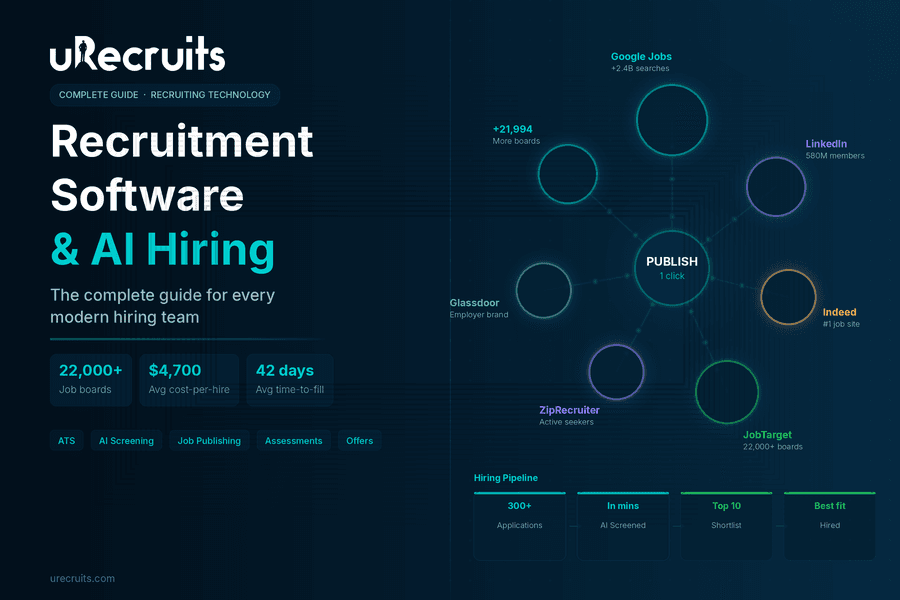
Hiring has always been hard. But the version of hard that most recruiting teams deal with today is different from what it was five years ago. Inboxes fill up with hundreds of applications for a single role. Phone screens take days to schedule. Qualified candidates drop off because the process moves too slowly. And the team responsible for fixing all of this is usually the same size it has always been.
This is where recruitment software comes in and why the AI-powered version of it represents a genuine shift rather than a marginal improvement. The right platform handles the coordination work that eats recruiter time, brings in candidates across thousands of channels at once, and keeps human decision-makers fully in control at every stage that actually matters.
This guide breaks down what recruitment software is, what separates the best from the average, what AI makes possible, and what to look for when evaluating your options.
What Is Recruitment Software?
Recruiting software is a platform that manages the full hiring lifecycle from job creation and publishing through applicant tracking, screening, assessments, offers, and verification. The goal is to give recruiting teams a connected, structured system so that no candidate falls through the cracks, no process step is skipped, and no hiring decision is made without the right information in front of the right person.
Early versions of these tools were mostly tracking systems. They held candidate data and let recruiters move people through stages manually. What has changed is automation, intelligence, and integration. Modern online recruitment software connects job publishing, AI evaluation, scheduling, assessments, and offer generation in a single workflow. Recruiters spend less time coordinating and more time making the decisions that require human judgment.
The practical difference shows up fast. According to SHRM, the average cost-per-hire in the United States is approximately $4,700, and the average time to fill an open position sits around 36 to 42 days. Both numbers reflect how much disconnected, manual recruiting processes cost organizations. A connected platform built for automation compresses both figures significantly.
The Recruiting Problem Most Teams Are Still Fighting
Most recruiting teams are dealing with two distinct problems at the same time, and the combination is what makes hiring feel impossible to keep up with.
The first problem is candidate supply. Teams post to one or two job boards and wonder why the applicant pool is thin or unqualified. The channels being used simply do not reach enough people. The second problem is time. Even when qualified candidates do apply, the coordination work of screening, scheduling, and evaluating them takes more hours than the team has. Candidates go cold. Offers get delayed. Good people take other jobs.
A LinkedIn analysis of global talent acquisition trends found that finding enough qualified candidates consistently ranks as the top challenge for talent acquisition professionals worldwide. The answer, increasingly, is not to hire more recruiters. It is to make the existing team dramatically more efficient through better tooling.
This is the problem that AI recruiting software is built to solve on both fronts simultaneously.
What AI Recruitment Software Actually Does Differently
The term AI recruitment software gets used loosely. In practice, the platforms that deliver real efficiency gains do specific things that manual or semi-automated systems cannot. Here is what distinguishes genuine AI powered recruiting software from tools that simply added an AI label to existing features.
Resume Parsing and Candidate Matching at Scale
When 300 applications arrive after a job post goes live, a recruiter cannot realistically read every resume before shortlisting. AI-powered parsing extracts skills, calculates experience, verifies education, and generates a match score against the role requirements automatically. Every incoming resume gets evaluated against the same criteria. Recruiters review ranked candidates rather than raw stacks of applications.
uRecruits handles this at the parsing stage. Every incoming resume is parsed against role requirements with skills extracted, experience calculated, education verified, and a match score generated. A manual review flag surfaces when AI confidence is low so recruiters know exactly where to look closer.
AI Pre-Screening: Video Interviews Without Recruiter Time
This is one of the most significant capabilities in top-tier AI powered recruitment software. Instead of recruiters spending three days on 30-minute phone screens, an AI conducts structured video interviews with every applicant simultaneously. It asks identical questions to every candidate, listens, scores each answer, and returns a complete result to the recruiter for review.
The operational change is significant. A recruiter who previously spent 15 hours on phone screens can instead review 50 AI pre-screening scores in 20 minutes and move directly to interviewing only the candidates who have already demonstrated they can articulate the role. Same team. Better use of expertise. Faster decisions.
uRecruits includes native AI Pre-Screening in its Full Cycle plans as a stage within the Screening and Hiring capability. The AI conducts the interview. The HR team or recruiter reviews the result and decides who advances.
Scheduling Automation Without Back-and-Forth
Interview scheduling is coordination work, not hiring judgment. AI handles it better and faster. A Scheduler Agent sends booking links, confirms calendar availability, resolves conflicts, and gets interviews booked from a single command. No back-and-forth email chains. No missed replies. No scheduling gaps.
Consistent, EEOC-Auditable Evaluation
One of the compliance risks in informal hiring processes is inconsistency: different interviewers using different criteria, different questions, different scoring standards for the same role. SHRM and employment law experts consistently recommend structured interviews and documented evaluation criteria as best practice for both quality of hire and EEOC compliance.
AI pre-screening asks identical questions to every candidate. Structured scorecards apply the same criteria to every interviewer at every stage. Every AI output and recruiter decision is logged in an auditable record.
7 Core Hiring Capabilities to Look for in Top Recruiting Software
When evaluating best recruiting software options, look beyond the feature list and ask whether the capabilities are actually connected. Disconnected tools create the same coordination gaps they claim to solve. Here are the seven hiring capabilities that matter most in a full-cycle platform.
-
Job Description Creation: A wizard or AI agent that gets a role from a sentence to a published, structured job description in under 60 seconds, connected to a Position Workflow before it goes live. uRecruits offers a 7-step wizard and uR Agent™ for this.
-
Applicant Tracking System (ATS): A structured pipeline connected to the job's workflow. One profile per candidate with parsed resume, match score, AI pre-screening result, assessments, scorecards, and all decisions on one screen.
-
Job Publishing: Reach matters. One publish action that goes to Google Jobs plus 22,000+ boards via JobTarget means more qualified applicants without extra steps per board. uRecruits handles this in a single publish action.
-
Resume Parsing: Automatic parsing against role requirements on every incoming application. AI extracts skills, calculates experience, verifies education, and generates a match score.
-
Candidate Matching: Ranked shortlists based on match scores so recruiters review the strongest applicants first rather than working through every resume in submission order.
-
Scoring and Structured Evaluation: Same criteria, same scale, every candidate, every interviewer, every stage. Gated advancement means a recruiter always confirms before the pipeline moves.
-
Screening and Hiring Suite: AI Pre-Screening, Interviews, Assessments, Offers, Background Screening, and Drug Screening connected in a single workflow. Every stage automated on trigger. Recruiter reviews and advances. In uRecruits, all six of these are part of the Screening and Hiring capability.
A platform that connects all seven of these in one system is what separates top recruiting software from point solutions that still require manual handoffs between tools.
Platform Capabilities: The Infrastructure That Connects Everything
Beyond the hiring-specific capabilities, the best hr recruitment software includes platform-level infrastructure that runs across every stage. In uRecruits, five platform capabilities support every hiring workflow.
-
Connected Hiring Workflow: The Position Workflow engine that is required before any job publishes. Every stage is defined, structured, and enforced at the platform level. No role goes live without a hiring process attached.
-
Integrations: Google Jobs, JobTarget, Auth0 for identity and access, background and drug screening connections, and a REST API. HRIS integrations are in development.
-
uR Agent™: An AI console with five live agents: Job Agent, Workflow Agent, Assessment Agent, Scheduler Agent, and Pre-Screening Agent. Every action is proposed and waits for HR/Recruiter confirmation before executing. An Analytics Agent is on the roadmap.
-
Analytics: Pipeline analytics, hiring velocity, stage conversion rates, time-to-fill, and recruiter performance across all roles and capabilities.
-
Knowledge Base and Support: Platform documentation, onboarding guides, feature walkthroughs, and support for HR teams and recruiters across all capabilities.
These five capabilities do not replace the seven hiring capabilities. They run across all of them, making the entire platform coherent rather than a set of disconnected modules.
Why the Best AI Recruiting Software Keeps Humans in the Loop
One of the most important questions to ask any automated recruiting software vendor is this: what does the AI do autonomously, and what requires a human decision?
The concern with fully autonomous AI in hiring is real. Inconsistent or biased outputs can go undetected without human review. Decisions that affect people's careers carry ethical weight that a score alone cannot capture. And regulatory frameworks around employment decisions require documentation and accountability.
According to Forbes, the organizations seeing the strongest results from AI in HR are those that use it to augment human decision-making rather than replace it. The AI handles the volume. The human handles the judgment.
uRecruits HR/Recruiter-In-Loop Architecture: At every key AI output, including pre-screening results, match scores, and Scheduler Agent proposals, the HR team reviews and confirms before the pipeline advances. Every AI evaluation is an input to a human decision, never a replacement for one. uR Agent™ proposes every action and waits for confirmation. No AI action executes without recruiter awareness and approval.
This distinction matters practically too. Responsible AI principles that are built into the architecture, rather than offered as an opt-in setting, mean that compliance is structural. Every AI output and every recruiter decision is logged in an auditable record. EEOC-compliant structured evaluation is enforced, not aspirational.
Cloud Recruitment Software: Hire From Anywhere, On Any Device
Modern hiring teams are not always at a desk. Recruiters review candidates between calls. Hiring managers approve offers from their phones. HR operations teams need pipeline visibility without logging into a desktop application.
Genuine cloud recruitment software makes every feature available on web and mobile, not a subset of features with a "full access requires desktop" caveat buried in the fine print.
uRecruits runs on AWS cloud infrastructure with data encrypted at rest and in transit. Every capability, including reviewing AI pre-screening results, advancing candidates, approving offer letters, and using uR Agent™ to issue workflow commands, is accessible on web and mobile. No capability is desktop-only.
The infrastructure scales automatically with hiring volume. A team hiring two roles and a team hiring two hundred roles use the same platform without performance differences or per-seat constraints that make scaling painful.
Who Benefits Most From AI Powered Recruiting Software?
HR Teams and People Operations
For in-house HR recruiting software users, the core value is standardization across every role and every hiring manager. The same workflow, the same AI-assisted evaluation, the same consistent process for every candidate. Compliance and fairness become structural rather than something HR has to police after the fact. Every stage is visible, reviewable, and auditable.
Staffing and Recruiting Agencies
Agencies running multiple client pipelines simultaneously need inbound reach and coordination efficiency at the same time. 22,000+ job boards in one publish solves the reach problem. The Scheduler Agent handles coordination across simultaneous pipelines. Recruiters generate more output per person without adding headcount.
Small and Mid-Sized Businesses Without a Dedicated HR Team
The best recruiting software for small businesses gives any hiring manager the same infrastructure that large enterprise teams use, without requiring implementation projects or dedicated HR staff. A 7-step wizard and an AI agent console let any team create a role, publish it to thousands of boards, and run a structured pipeline from application to offer. uRecruits starts at $39/month with no feature gating and a 30-day free trial with no credit card and no auto-charge at trial end.
How to Evaluate and Choose the Best Recruitment Software
The best ai recruiting software for your team depends on what your current bottlenecks actually are. But there are evaluation questions worth asking every vendor regardless of company size or team structure.
-
Is pricing published without a demo? Many enterprise platforms require a sales conversation before disclosing pricing. Transparent pricing upfront is a signal of a platform built for self-service evaluation. uRecruits publishes pricing from $39/month at urecruits.com/pricing.
-
Does it work fully on web and mobile? Ask specifically whether all features are available on mobile or only a subset. Test it before committing.
-
Is AI Pre-Screening native? Some platforms partner with third-party video interview tools. Native AI Pre-Screening, where the AI conducts the interview and the result surfaces directly on the ATS profile, is a different capability.
-
Are assessments built in? Assessments that require a third-party integration add cost and create another coordination gap. Full Cycle plans in uRecruits include coding, take-home, domain, and functional assessments natively.
-
Is workflow required before publish? A platform that enforces a defined hiring process before any job goes live is structurally different from one where workflow is optional. uRecruits requires a Position Workflow to be attached before any role publishes, enforced at the platform level.
-
Is there a free trial with no auto-charge? A 30-day trial with no credit card and no auto-charge at trial end lets you evaluate the platform without financial commitment. uRecruits offers this on all plans.
-
What does the AI actually do autonomously vs. what requires human confirmation? This is the most important question. Understand the boundary before you commit.
A Forbes analysis of HR tech evaluation recommended mapping current recruiting bottlenecks before evaluating platforms, so the comparison is grounded in the actual problems the team is trying to solve rather than feature checklists that may not match real workflow.
FAQs About Recruitment Software
What is the difference between AI recruiting software and a standard ATS?
A standard ATS stores applicant data and tracks candidates through stages. AI powered recruitment software automates the work between stages. AI parses resumes, generates match scores, conducts pre-screening video interviews, schedules interviews, and handles coordination. The recruiter sees a parsed profile with a ranked score and a complete pre-screening result and decides who advances. The ATS is one component. The AI coordination layer is what makes it automated recruiting software rather than just a tracking tool.
How many job boards does modern recruitment software post to?
It depends on the platform and the integrations it uses. uRecruits publishes to 22,000+ job boards in one publish action via JobTarget, plus the uRecruits Job Marketplace. Google Jobs is automatic on every role published through the platform with no additional steps required. This gives every role organic visibility in Google Search alongside broad board distribution.
What does HR/Recruiter-In-Loop mean in AI recruitment software?
HR/Recruiter-In-Loop means the HR team or recruiter is actively involved in the decision at every key AI stage. Every AI output is reviewed and confirmed before the pipeline advances. HR/Recruiter-On-Loop means full oversight of every automated action: visible, reviewable, and reversible. In uRecruits, both apply across all AI capabilities. AI always acts as an input to a human decision, never a replacement for one.
What is the best recruitment software for small businesses?
The best recruitment software for small businesses provides professional hiring infrastructure without requiring a dedicated HR team or a complex implementation. uRecruits starts at $39/month with no feature gating, a 7-step job creation wizard, uR Agent™ for plain language workflow commands, 22,000+ board publishing, and AI Pre-Screening on Full Cycle plans. A 30-day free trial with no credit card and no auto-charge at trial end means you can evaluate the full platform before committing.
Is online recruitment software secure and compliant?
The best online recruiting software runs on enterprise-grade infrastructure with data encrypted at rest and in transit, SSO and MFA via an identity provider like Auth0, role-based access control, and audit logs for every AI output and every recruiter decision. uRecruits runs on AWS cloud infrastructure and uses Auth0 for identity and access management. Responsible AI principles are built into the architecture. Every AI output is EEOC-auditable by design.
The Bottom Line on AI Recruitment Software
The gap between teams using genuinely connected ai recruiting software and teams still stitching together disconnected point solutions is growing. The former processes more candidates, makes decisions faster, maintains better compliance records, and gives recruiters time back for the work that requires human judgment.
The best platforms solve both problems that recruiting teams face simultaneously: more qualified candidates in the pipeline and more efficiency in managing them once they arrive. That combination, built on a connected workflow with AI doing the coordination and HR/Recruiter making the decisions, is what top recruitment software actually delivers.
If you are evaluating options, uRecruits offers every hiring team, from SMBs to staffing agencies to enterprise HR operations, a complete, connected platform starting at $39/month with a 30-day free trial, no credit card required, and no auto-charge at trial end. All 12 capability areas. Every feature on web and mobile. HR/Recruiter always in the loop.
Ready to see how AI recruitment software changes what your team can do?
Start a free 30-day trial at urecruits.com or Book a Demo