
Recruiters spend more time clicking through software menus than connecting with candidates. The average recruiter dedicates 13 hours per week to administrative tasks that should take minutes. The software meant to simplify hiring has become another layer of complexity requiring constant navigation through endless menus, filters, and configuration screens.
Agentic UI/UX in recruitment represents a fundamental shift from traditional navigation-based interfaces to systems where users state their goals and AI determines the best path forward. Instead of learning where buttons live and which menus contain what functions, you simply tell the system what you need. This change in how humans interact with recruitment software is reshaping the entire hiring experience.
The Burden of Traditional Recruitment Interfaces
Traditional recruitment platforms follow a control-based workflow. Every action requires navigating to the correct screen, locating the right feature, and filling out specific forms. Want to update a salary range? Navigate to job settings, find the compensation section, click edit, enter new values, remember to save, then verify the change applied correctly.
Even with automation tools, recruiters still spend considerable time just accessing those automated features. The interface remains the bottleneck between intention and action. You know what needs to happen, but getting the software to do it requires remembering a specific sequence of clicks and selections.
The mental overhead compounds across dozens of daily tasks. Which tab holds job listings? Where's the workflow editor? How do I filter by location and department simultaneously? Every moment spent recalling interface details is a moment not spent evaluating candidates or building relationships.
What Makes Agentic UI/UX Different
According to EY, agentic AI is reshaping UX design by prioritizing user intent and personalization, leading to adaptive and intuitive digital experiences. In agentic design, users don't follow traditional software patterns with buttons and tabs, but instead work through conversational prompts that understand context and intent.
The system interprets what you're trying to accomplish and handles the complexity of executing that task. Think about adjusting a recruitment workflow. Traditional software requires multiple steps: log in, navigate to workflows, select the right template, find the specific stage, edit the sequence, save changes, then verify. That's seven distinct actions requiring precise navigation.
With agentic UI/UX, it becomes one natural statement. "Add an HR interview after the technical round." The system understands workflow structure, identifies the relevant template, updates the sequence, and confirms the change. Seven steps collapse into a single clear instruction.
Context Awareness Changes Everything
Agentic UI/UX means building systems that recognize the distinction between what users want to achieve and why they want to achieve it. The interface needs to understand not just commands, but the broader context of your work.
When you ask an intelligent system to "update the developer role," it considers what you've been working on recently, which developer positions are currently active, and which ones you have permission to modify. It can seek clarification when context is ambiguous and execute confidently when the situation is clear.
This contextual understanding extends across your entire recruitment operation. The system grasps how workflows relate to each other, how permissions work across different roles, and how various data connects. It remembers recent activities and can anticipate what you might need next.
As Forbes highlights, the agentic era represents a transformation in how digital experiences are created and consumed, with design shifting from guiding clicks and taps to shaping systems that understand and fulfill user intent.
This shift from traditional interfaces to context-aware systems requires rethinking how recruitment platforms are built from the ground up. uRecruits 2.0 translates these principles into practical tools that work within your existing hiring workflows.
How uRecruits Brings Agentic UI/UX to Recruitment
uR Agent: Your Conversational Recruitment Assistant
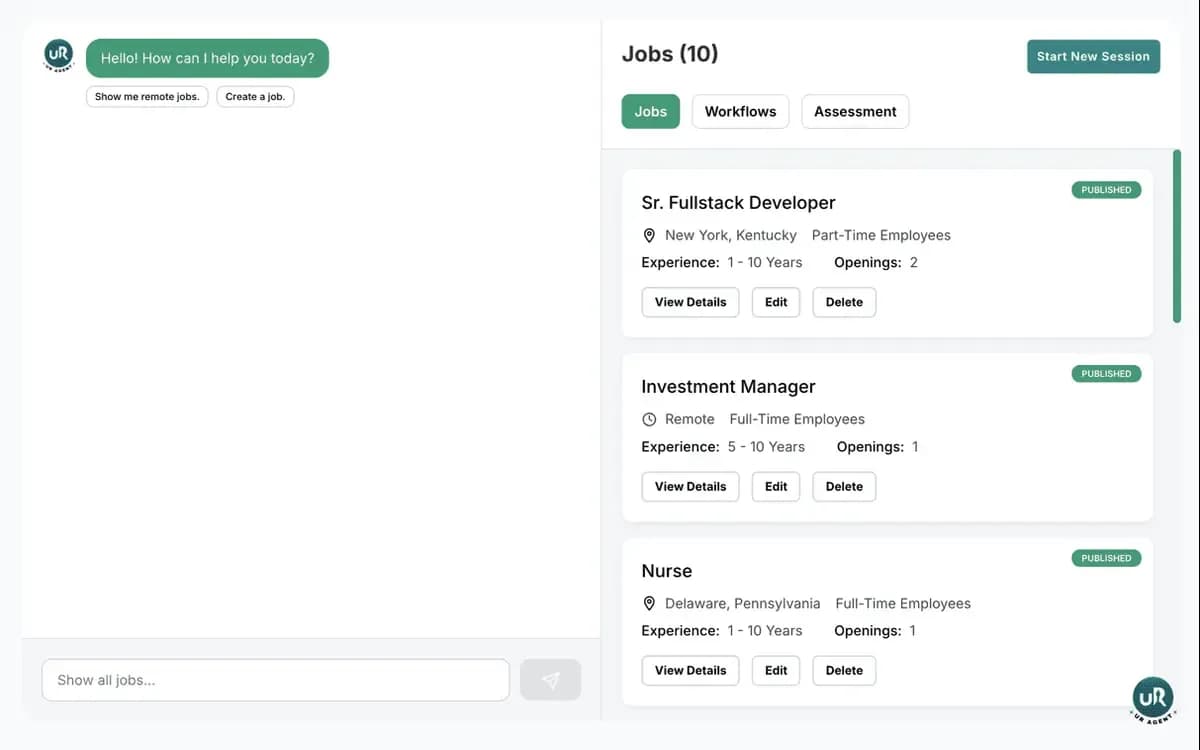
uRecruits 2.0 introduces uR Agent, an agentic AI-powered assistant that simplifies recruitment management through natural language conversations. Rather than forcing recruiters to adapt to software logic, the platform adapts to how recruiters naturally work. Users can search, view, and update jobs, workflows, and assessments without navigating complex screens.
Need to find marketing positions in a specific city? Just type "Show me all marketing jobs in New York." uR Agent instantly finds and displays matching job openings, allowing you to review or refine the results without using filters or forms. The system allows easy job discovery by understanding recruitment terminology, geographical context, and your organizational structure.
Salary adjustments follow the same natural pattern. A hiring manager types "Update the salary for the Senior Developer role to $120,000." uR Agent confirms the change, applies the update once approved, and records it automatically for audit purposes. Quick updates to job details happen through single conversational requests instead of clicking through multiple settings screens.
When a recruiter requests "Add an HR interview after the technical round," uR Agent updates the recruitment workflow accordingly and confirms the change, making workflow adjustments quick and hassle-free. Seamless workflow modifications that used to require navigating configuration screens now happen through simple statements.
Assessment edits work with the same clarity and simplicity, with clear confirmation before changes are applied. You state what needs adjusting, the system shows you the proposed modification, you approve it, and the change executes with complete audit logging.
Current Capabilities of uR Agent
uR Agent uses specialized AI components (powered by OpenAI GPT-4 and LangGraph architecture) where a supervisor agent interprets your intent and routes requests to specialized agents, enabling reliable coordination across hiring workflows.
Job Management Agent
The Job Management Agent handles end-to-end job creation and publishing, automatically populating job fields and publishing listings. It intelligently selects and attaches the most relevant hiring workflow to each job while supporting draft creation, publishing, and status updates.
Advanced job listing and search capabilities allow filtering by title, status, location, salary range, and creation date through natural language commands. Real-time job updates modify details like salary, location, and workflows with built-in confirmation flows to prevent errors.
Workflow Management Agent
The Workflow Management Agent generates complete hiring workflows tailored to job titles and industry context. It automatically integrates appropriate assessments including domain knowledge tests, live coding challenges, and take-home projects.
Workflow customization happens conversationally, letting you add, remove, or reorder stages such as HR interviews, technical rounds, or background checks. The workflow library management system allows browsing, searching, and managing reusable workflow templates with dynamic updates that include assessment swaps and stage reordering.
Assessment Creation and Management Agent
This specialized agent creates multi-type assessments including domain knowledge questionnaires with MCQ, single choice, and text questions, live coding challenges supporting over 50 programming languages, and take-home coding projects with automatic test case generation.
Intelligent content generation creates questions and challenges based on specific job requirements. The assessment library management system organizes content by type, status, and date, with real-time editing capabilities for questions, scoring logic, duration, and structure.
Future Capabilities: What's Coming to uR Agent
uR Agent will expand with specialized capabilities that address the full recruitment lifecycle.
Process Automation: Interview Scheduling Agent will coordinate calendars across time zones and handle rescheduling automatically. Offer Preparation & Routing Agent will generate compliant offer letters and track signatures. Daily Unblock Bundles Agent will detect stalled requisitions and propose corrective actions.
Candidate Experience & Intelligence: Shortlist Proposal Agent will generate fairness-validated candidate rankings with explainable scoring. Candidate Experience Agent will deliver personalized, timely communications while respecting privacy preferences. Advanced Analytics Agent will forecast hiring needs and predict candidate success based on historical patterns.
Compliance & Support: Compliance and Explainability Agents will monitor regulations, audit for bias, and maintain immutable logs of all automated actions. Support and Knowledge Agents will provide instant answers based on your company's processes and policies.
The Efficiency Impact of Natural Interaction
uRecruits 2.0 improves efficiency by reducing manual effort, speeding up recruitment operations, and enhancing accuracy. AI-driven recruitment solutions typically deliver 50% reduction in time-to-hire through automation and parallel processing, with 60 to 80% cost savings through efficiency gains and better quality matches.
When the interface itself becomes nearly invisible, efficiency jumps dramatically. Each eliminated click, each avoided menu navigation, each form you never fill out adds up across hundreds of daily interactions. Organizations implementing conversational AI in recruitment report 78% reduction in administrative workload and 71% improvement in recruiter satisfaction.
More importantly, reduced interface friction means less context switching, lower cognitive load, and fewer interruptions to meaningful work. When recruiters can manage job postings, adjust workflows, and coordinate assessments through simple conversational commands, the entire recruitment operation becomes more fluid.
Updates happen during natural workflow rather than as separate administrative tasks requiring dedicated time. You're reviewing candidates and realize the salary range needs adjustment? Just say it. The change happens right there without breaking your concentration or switching screens.
With an intuitive interface, conversational AI interactions, strong security, and built-in auditing, the platform delivers a reliable, user-friendly recruitment experience designed for growing teams and organizations.
Designing for Human Cognition
As Kyndryl explains, the intelligence behind the agent becomes the core feature rather than the UI itself. This represents a fundamental shift in software design philosophy.
We think in goals and intentions, not navigation paths and dropdown menus. We communicate through natural language, not through clicking predetermined interface elements. When software requires translating intentions into its interaction model, it creates friction that accumulates into real productivity loss.
Traditional UI emphasizes task clarity and control, while agentic UI/UX shifts toward goal expression, adaptive feedback, and creating safety nets when things go wrong. The system takes responsibility for understanding what you need and executing it correctly.
This isn't about making AI feel human. It's about making software work the way humans naturally communicate and think. The best agentic interfaces reduce cognitive load through concise responses, visual aids, and contextual cues that guide without overwhelming.
Multiple Interaction Patterns for Different Needs
Effective agentic UI/UX combines conversation with other interaction patterns based on what the task requires. For quick queries like "show me remote developer positions," pure conversational interaction works perfectly. For reviewing multiple candidates or comparing applications, the interface might display rich visual layouts that you can manipulate directly while still using natural language for actions.
uR Agent adapts its interface based on what you're doing. Simple requests get simple responses. Complex operations receive appropriate visualizations and confirmation dialogs. The conversational element remains consistent, but the visual presentation flexes to match the task.
This flexibility matters because not every recruitment activity fits a pure chat model. Sometimes you need to see multiple jobs side by side. Other times you want to quickly scan candidate profiles. The agentic approach works because it combines natural language with smart visual displays that match your intent.
Trust Through Transparency and Control
Trust and reliability are central challenges in agentic systems, where the system must deliver outcomes that feel aligned with user expectations even when those expectations aren't clearly articulated. Building that trust requires showing your work.
This balance between automation and control defines good agentic UI/UX. The system handles complexity and reduces steps, but you remain in charge of important decisions. uR Agent follows your lead while taking care of the tedious mechanics of updating databases and triggering workflows.
uRecruits respects human authority over critical choices. When something might have a significant impact, the system pauses for confirmation. When the action is routine and clearly authorized, it executes smoothly. The interface learns which situations need more caution and which can proceed confidently.
What This Means for Your Recruitment Team
The shift to agentic UI/UX represents more than new interface design. It fundamentally rethinks how recruitment teams should interact with their operational tools. When your recruitment platform understands what you need from simple statements, when updates happen through natural commands rather than multi-step processes, when the system handles interface complexity invisibly, you can focus on what actually matters.
Building relationships with candidates. Making thoughtful hiring decisions. Creating positive experiences that attract top talent. These activities drive successful hiring, but they require time and mental energy that gets drained by complicated software interfaces.
Agentic UI/UX gives that time and energy back. You stop fighting with tools and start using them effortlessly. The technology becomes nearly transparent, visible only when you need it and invisible when you don't.
Your Recruitment Software Should Work for You, Not Against You
Think about the last time you needed to make a quick update to a job posting. How many clicks did it take? How many screens did you navigate? Did you have to look up how to do it or ask someone for help?
Now imagine just saying what you need and having it happen. No memorizing where things are. No clicking through multiple menus. No wondering if you did it right. Just natural conversation with software that actually understands you.
That's what agentic UI/UX delivers, and it changes everything about daily recruitment operations. Your team moves faster. Candidates get better experiences. Hiring managers can make their own updates without waiting for support. Everyone focuses on hiring great people instead of wrestling with complicated interfaces.
Traditional recruitment software taught us to adapt to how computers work. Agentic UI/UX flips that relationship completely. The software adapts to how humans naturally think and communicate. It's not a small improvement. It's the difference between technology that frustrates you every day and technology that just works the way you expect it to.
uRecruits 2.0 with uR Agent brings this approach to recruitment right now. No waiting for future updates or next-generation platforms. The conversational interface is live, managing jobs, workflows, and assessments through simple natural language today.
Your recruiters deserve tools that help them work smarter, not harder. Your candidates deserve a hiring process that moves quickly because the technology enables speed instead of creating delays. Your organization deserves recruitment software that actually makes hiring easier.
Experience agentic UI/UX in recruitment with uRecruits and discover what happens when your hiring platform finally speaks your language. See how your team can cut admin time in half and focus on hiring great people. uR Agent turns complicated recruitment tasks into simple conversations that save time, reduce errors, and let your team focus on what they do best: finding and hiring exceptional talent.